
Achilles, the fastest man alive, gives a tortoise a 100-metre head start — and according to a 2,400-year-old argument, he can never overtake it. Every time he reaches where the tortoise was, the tortoise has crawled a little further. Repeat forever: Achilles is always behind. The argument comes from Zeno of Elea (c. 450 BC), preserved for us by Aristotle [1], and it stumped serious thinkers for two millennia. In this paper we run the race with actual numbers and watch the paradox dissolve into one beautiful fact: an infinite list of numbers can have a finite sum.
Zeno's dichotomy paradox says you cannot even cross a room. To reach the far wall you must first reach halfway. Then half of what remains. Then half of that. Since there are infinitely many stages, and each takes some time, crossing the room should take forever — so motion is impossible.
The Achilles paradox is the same trap with better characters. When Achilles reaches the tortoise's starting line, the tortoise has moved on. When he reaches that point, it has moved again. Infinitely many catch-up stages, therefore — Zeno claims — no overtaking, ever.
Both arguments smuggle in one assumption: infinitely many steps must take infinitely long. That assumption is simply false, and we can prove it.
Summing infinitely many shrinking steps
Consider the dichotomy distances, as fractions of the room:
Multiply both sides by 2: the right side becomes , which is just . So , which forces . Infinitely many pieces, total exactly one room.
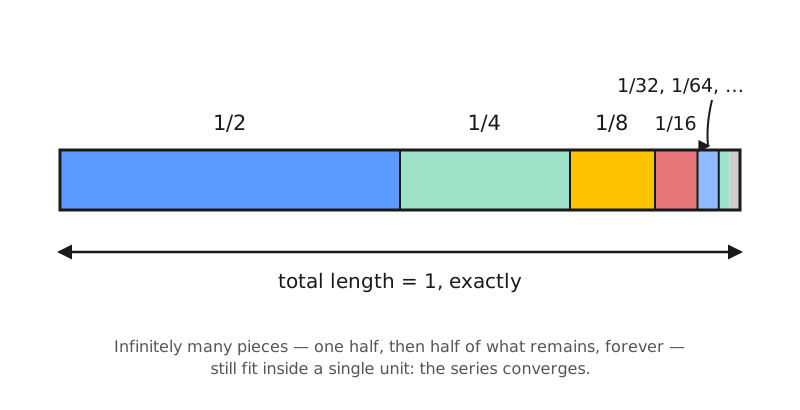
This works for any geometric series — one where each term is a fixed multiple of the last. Provided , the terms shrink fast enough that
You can watch the convergence happen: after just 10 terms of our halving series the running total is , and every extra term halves the remaining gap. It is exactly the same mechanism that makes equal 1 — a claim we prove in another paper.
Give Achilles a speed of m/s, the tortoise m/s, and a m head start. Now follow Zeno's own stages, but with a stopwatch:
- Achilles covers the 100 m gap in 10 s. The tortoise has crawled 10 m: it is at 110 m.
- Achilles covers those 10 m in 1 s. The tortoise is now at 111 m.
- Achilles covers 1 m in 0.1 s. The tortoise is at 111.1 m — and so on, forever.
Zeno is right that there are infinitely many stages. But look at the times: — a geometric series with and . The total time is
and Achilles' position at that moment is m. All of Zeno's infinitely many stages fit inside 11.1 finite seconds — after which Achilles simply strides past.
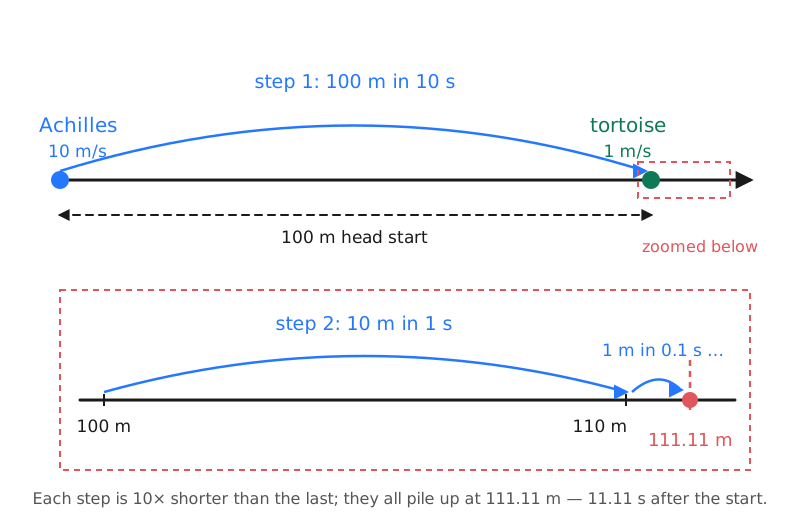
We can check this without any series at all. Achilles closes the gap at m/s, so a 100 m gap takes s to close. Same answer. Zeno did not discover a hole in motion; he discovered a genuinely surprising fact about infinite sums, a century before the mathematics existed to name it.
What the series doesn't settle
Honesty requires a caveat. The geometric series demolishes Zeno's stated inference — "infinitely many steps, therefore infinite time" — and that settles the mathematical puzzle completely. But philosophers still argue about a deeper question the series does not touch: can a physical process really consist of infinitely many completed acts (a "supertask")? Thought experiments like Thomson's lamp — switched on and off infinitely often in one second; is it on or off at the end? — show the metaphysics is genuinely subtle [2][3]. Mathematics answers the question it can formalise: the race ends, on schedule, at a computable time and place. What "completing infinitely many acts" means remains a live debate — and that is philosophy's problem, not Achilles'.
What Zeno actually discovered
Achilles overtakes the tortoise at 111.11 m, after 11.11 s — a finite answer assembled from infinitely many shrinking pieces, courtesy of . The paradox never showed motion was impossible; it showed that our intuition about infinity was uncalibrated. Two and a half millennia later, the same convergent series sits inside every calculus course — quietly resolving, on the first page, an argument that once seemed unanswerable.
References:
[1] Aristotle, Physics, Book VI, 239b (in The Complete Works of Aristotle, ed. Jonathan Barnes, Princeton University Press, 1984).
[2] James F. Thomson, "Tasks and Super-Tasks," Analysis 15, no. 1 (1954).
[3] Nick Huggett, "Zeno's Paradoxes," The Stanford Encyclopedia of Philosophy.
Note: We model Achilles and the tortoise as points moving at constant speed; real runners have width, which ends the argument even sooner.