
Next time a café table wobbles, do not fold a napkin — rotate the table. Mathematics guarantees that within a quarter-turn it will sit rock-solid on all four legs. This is the Wobbly Table Theorem: on any continuously uneven floor, a square table with four equal legs can always be stabilised by rotating it about its centre through at most 90°. Martin Gardner popularised the trick decades ago, and it has since been made fully rigorous. The proof needs just one beautiful idea from A-level calculus, worn as a disguise.
The gap that flips sign
A rigid four-legged table is over-determined: three feet can always find the floor (three points define a plane — why three-legged stools never wobble), but the fourth foot is stuck wherever geometry puts it. The wobble is that foot hovering above the ground.
So let us measure the failure. Rotate the table about its centre by an angle , always resting it on the floor, and define the gap function : the height of the hovering foot above the ground at angle . When the foot floats, ; if it would have to press below the ground for the other three to sit flat, we count the gap as negative. Stability — all four feet touching — is precisely
Our whole task is to show that some angle between 0° and 90° makes the gap vanish.
Here is the trick. The feet of a square table sit at the corners of a square, and a square looks identical after a 90° rotation: leg 1 moves exactly to where leg 2 stood, and so on around. After a quarter-turn the four feet occupy the very same four points of floor as before — but the roles have rotated by one position.
Consequence: the diagonal pair of legs pressing firmly into the floor at has swapped roles with the diagonal pair containing the hoverer, and the swap flips the sign of the gap:
If the gap started at mm, then after a quarter-turn it is, in this signed sense, mm.
Now the finale. As the table rotates from 0° to 90°, the gap changes continuously — a millimetre of turn changes the gap by a whisker, because the floor has no cliffs (this is where "continuous ground" earns its keep). So is a continuous function, positive at one end of the interval and negative at the other.
The intermediate value theorem — the same A-level fact that guarantees a continuous curve crossing from above an axis to below it must cut the axis — now forces the conclusion: somewhere strictly between 0° and 90° there is an angle with . At that angle, all four feet touch the floor. The table is stable, and we never turned it more than a quarter-turn.
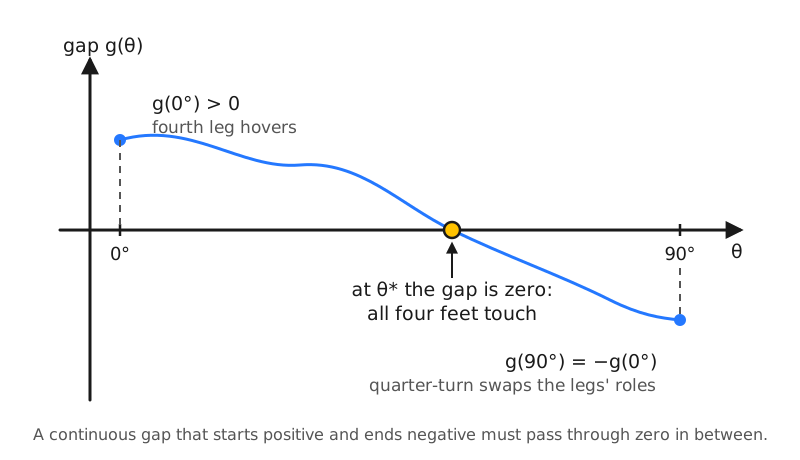
Notice the argument never finds the angle — it only proves one exists, so in the café you hunt for it by feel. We also checked numerically: simulating a bumpy floor and rotating a square table through it, the signed gap flipped sign across the quarter-turn exactly as predicted, with a zero in between.
The small print
This is a genuine theorem, so it comes with genuine hypotheses — and it is only honest to read them out. The ground must be continuous: a tile step or a stair edge breaks the argument (the gap can jump straight past zero). The table needs four equal legs at the corners of a square (the rigorous treatments extend this to rectangles), and the floor must not be absurdly steep — the careful versions allow local slopes up to about 35°. And one caveat that surprises people: the theorem promises a stable table, not a level one. All four feet on the ground may still mean your coffee sits on a tilt — level is a different, unguaranteed luxury. Hand-wavy versions of the argument circulated for years; Baritompa, Löwen, Polster and Ross, and independently André Martin, pinned down exactly when the folklore proof is valid.
Skip the napkin
The Wobbly Table Theorem is that rare thing: a piece of genuinely rigorous mathematics you can deploy in a café. A square table with equal legs on continuous ground always has a stable position within a 90° rotation — because rotating a quarter-turn flips the sign of the fourth leg's gap, and a continuous function cannot change sign without passing through zero. It is the intermediate value theorem moonlighting as a party trick, a cousin of the continuity arguments that tame Zeno's paradoxes. The practical takeaway is delightfully concrete: skip the folded napkin. Rotate.
References:
[1] B. Baritompa, R. Löwen, B. Polster and M. Ross, "Mathematical Table Turning Revisited," Mathematical Intelligencer 29, no. 2 (2007), 49–58.
[2] A. Martin, "On the Stability of Four-Legged Tables," arXiv:math-ph/0510065 (2005).
[3] Martin Gardner, "Mathematical Games," Scientific American (the table-turning trick appears among his collected columns).
Note: The theorem assumes continuous ground, a square (or rectangular) table with equal legs, and moderate slopes; it guarantees all four feet touch, not that the tabletop ends up level.