
In 1906, at a livestock fair in Plymouth, visitors paid sixpence to guess the weight of a fat ox. Nobody in the crowd — 787 valid entries, butchers and farmers alongside clerks and passers-by — knew the answer. Yet the middlemost guess, 1,207 lb, missed the true weight of 1,198 lb by less than 1%. The 84-year-old scientist Francis Galton collected the tickets, expecting to demonstrate how hopeless the average voter was. Instead he published the result in Nature under the title "Vox Populi" — the voice of the people — as a surprised tribute to collective judgement [1].
In this paper we recreate the mathematics behind the magic trick, and then — because the magic has fine print — work out exactly when a crowd is wise and when it is a mob with a spreadsheet.
Galton's setup was unusually clean. Each of the 787 entrants judged the dressed weight of the ox (its weight once slaughtered and prepared) independently, in writing, with a small prize for accuracy — no conferring, no shouting of estimates, real skin in the game. Galton, ever suspicious of the masses, took the median of all entries as the crowd's collective verdict: 1,207 lb against a true 1,198 lb, an error of just 0.8%, better than most individual experts in the crowd managed.
The story has an even sharper ending. Galton's original paper worked with the median; when a correspondent asked about the mean, Galton computed it in a follow-up note: 1,197 lb — one pound off the truth [1]. The crowd, averaged, essentially weighed the ox.
Why averaging works: errors cancel
Think of each person's guess as two ingredients:
Some guessers overshoot, some undershoot. When we average many guesses, the truth part survives untouched — it is the same in every ticket — while the personal errors, being a mix of positive and negative, start cancelling each other out.
How fast do they cancel? A standard result about averages (A-level statistics in one line: the standard deviation of a mean of independent guesses is the individual standard deviation divided by ) says the crowd's typical error shrinks like
Quadruple the crowd and you halve the error; a crowd of 787 should be roughly times more accurate than one person.
We ran the fair 10,000 times in a computer simulation: a 1,198 lb ox, and guessers whose individual errors average about 60 lb (a standard deviation of 75 lb, roughly consistent with the spread Galton reported). Averaging different crowd sizes:
- 1 guesser: typically off by 60 lb
- 10 guessers: mean off by 19 lb
- 100 guessers: mean off by 6 lb
- 787 guessers: mean off by 2 lb
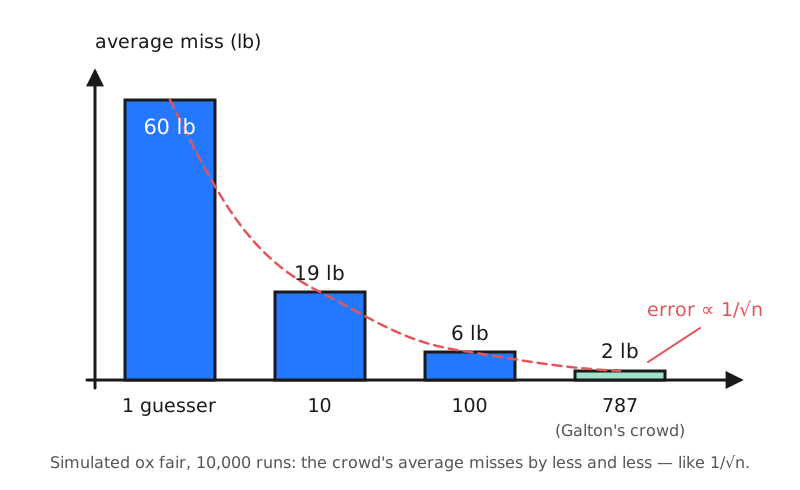
Each tenfold increase in crowd size cuts the error by about — precisely the law. And the simulated 787-person crowd lands about 2 lb from the truth, right where Galton's real crowd landed. His result was not a miracle; it was statistics doing exactly what statistics does.
When crowds stop being wise
Now the fine print. The cancellation argument leaned on two assumptions, and each one is load-bearing.
The errors must be independent. The Plymouth crowd guessed silently, in writing. If instead the first loud farmer announces "1,400 if it's an ounce!", later guesses drift toward his — errors become correlated, and correlated errors do not cancel; they pile up. Experiments have confirmed this directly: give people even mild information about others' estimates and the crowd's diversity collapses while its collective error stays put or worsens, with the group growing ever more confident in a wrong answer [3]. A crowd that talks to each other is not a wise crowd; it is one opinion wearing eight hundred hats.
The errors must have no shared bias. Averaging cancels personal noise, not collective blind spots. If everyone systematically underestimates — the ox is oddly proportioned, the question is misheard, the topic is one the whole culture gets wrong — then every guess is truth plus bias plus noise, and the average converges beautifully... to truth plus bias. The crowd at a fair full of livestock-savvy folk had expertise scattered through it; a crowd guessing something none of them has ever handled can be confidently, collectively wrong.
Markets, elections, forecasting panels and "ask the audience" all inherit these caveats: they work best with diverse, independent, motivated guessers, and they fail in bubbles, echo chambers and herds.
When to trust the crowd
Galton's ox stands as one of the cleanest experiments in statistics: 787 independent strangers, a median within 0.8% of the truth, a mean within one pound. The mathematics is honest about why — independent errors cancel at the rate — and equally honest about the price: break independence or share a bias, and the wisdom evaporates while the confidence remains. Crowd structure hides other surprises too — your friends really do have more friends than you, as we show in the friendship paradox. The voice of the people is worth listening to, but only when the people aren't listening to each other.
References:
[1] Francis Galton, "Vox Populi," Nature 75 (1907): 450–451; with the mean reported in Galton's follow-up letter, "The Ballot-Box," Nature 75 (1907): 509–510.
[2] James Surowiecki, The Wisdom of Crowds (Doubleday, New York, 2004).
[3] Jan Lorenz, Heiko Rauhut, Frank Schweitzer, and Dirk Helbing, "How social influence can undermine the wisdom of crowd effect," Proceedings of the National Academy of Sciences 108, no. 22 (2011): 9020–9025.
Note: The simulation assumes normally distributed, unbiased, independent errors; Galton's real entries were skewed, which is partly why he preferred the median. The conclusion is unchanged either way — both crowd statistics beat almost every individual ticket.