
99.6%. That is the probability that you go bust before you succeed, if you walk into a casino with £1,000, place £10 even-money bets on a European roulette wheel, and refuse to leave until you have either doubled your money or lost it all. In a perfectly fair game, the same mission would succeed exactly half the time. The casino's edge on each individual spin is a modest 2.7% — yet somehow that sliver compounds into near-certain ruin.
Every gambler who has noticed this gap has had the same thought: the game may be rigged, but surely a clever system of bets can un-rig it. Double after every loss. Grind small stakes. Quit while ahead. In this paper we put the most famous systems on trial using A-level probability — multiplying probabilities, one geometric series, and a single beautiful formula — and watch each one fail in its own instructive way. The failures turn out to be far more interesting than the systems.
I. Where the 37th pocket takes its cut
The European wheel has 37 pockets: numbers 1–36 (18 red, 18 black) plus a single green zero. Bet £1 on red and you win £1 with probability and lose £1 with probability — the zero is how the house wins. The expected value of the bet is:
We derived this — and why every bet on the layout carries the same — in our article on the house edge. The crucial consequence for tonight is that expectation is additive: whatever sequence of bets a system prescribes, its total expected result is just times the total amount staked. No arrangement of negative-edge bets can sum to a positive edge.
That settles the matter in principle. But it is worth seeing how each system loses, because each one promises to hide the edge somewhere clever — and it is illuminating to catch them smuggling it back in.
II. The staircase that outruns your wallet
The oldest system in the book: bet £10 on red. If you lose, bet £20. Lose again, £40 — doubling every time. Whenever red finally arrives, the win covers every loss so far and leaves you exactly £10 ahead, and you start again at £10. Since red must come up eventually, the system appears to manufacture £10 wins out of thin air.
The catch is the speed of the staircase. After straight losses your next stake is , and your accumulated losses form a geometric series, , that outruns any wallet:
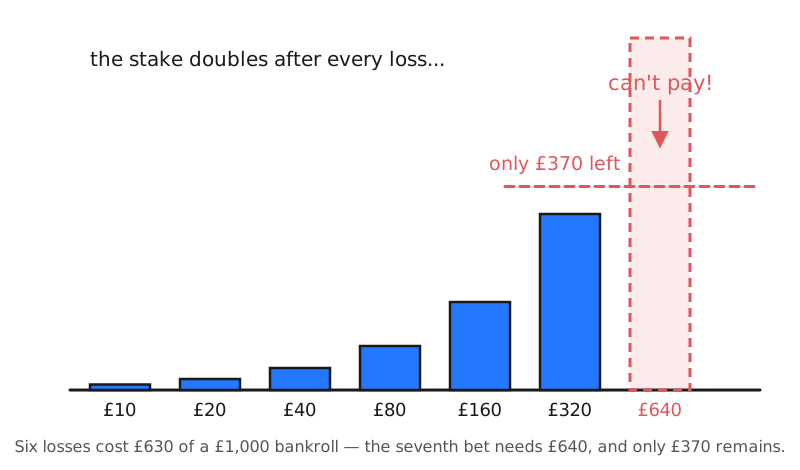
With £1,000, count the rungs. Stakes of £10, £20, £40, £80, £160 and £320 cost £630 in total when they all lose. The seventh bet must be £640 — but only £370 of your £1,000 remains. Six consecutive losses and the system is dead, sitting on a £630 hole that would take 63 flawless rounds to climb out of.
How likely is that? A fatal streak needs six straight non-reds, each with probability :
One round in 55 sounds comfortably rare — until you count rounds. A European wheel runs about 35 spins per hour, and a martingale round lasts on average spins, so a three-hour evening is roughly 50 rounds. The chance that at least one of them hits the wall:
A 60% chance that the "unbeatable" system detonates before closing time. And the accounting is cruelly asymmetric: every survived round wins exactly £10, so the best possible night is +£500, while a single wall costs £630 in one blow. We simulated 100,000 such evenings in Python, spin by spin (even allowing late-night winnings to occasionally fund a seventh bet): the disaster probability is still about 51%, and the average player finishes about £63 down — which is precisely the house's cut of the roughly £2,300 the doubling forces across the table. The martingale doesn't shrink the edge by a penny. It just rearranges it into many small wins and rare catastrophes — a distribution seemingly designed to maximise the surprise.
III. How 2.7% per spin becomes 99.6%
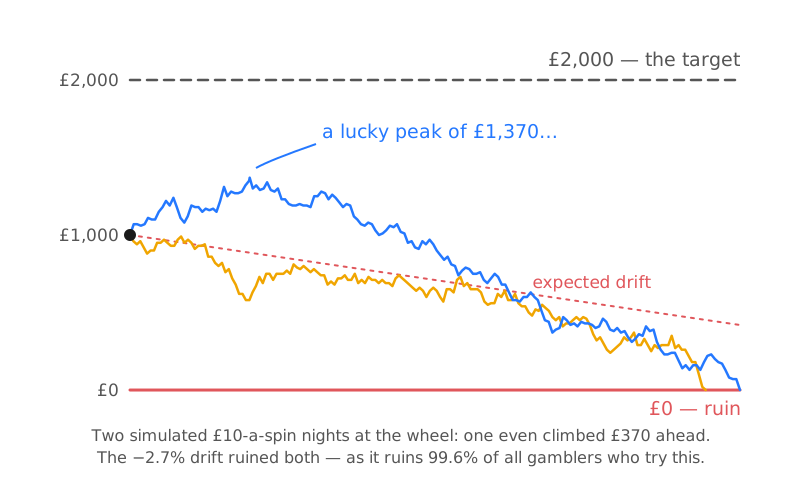
Fine — forget systems. Bet a flat £10 on red, over and over, until you either double your £1,000 or lose it. Your bankroll now performs a random walk: up one £10 step with probability , down one step with probability , trapped between an absorbing floor at £0 and a target ceiling at £2,000.
This is the classic gambler's ruin problem, solved in every probability textbook [1]. If your bankroll is betting units and you are trying to double it, the answer collapses to one clean formula built from the ratio :
Two sanity checks. With (one all-in bet) it gives — the plain single-bet probability, as it must. And in a fair game the ratio would be , giving for any bankroll.
Now the punchline. At £10 stakes, , and although is barely above 1, it gets raised to the hundredth power: . So:
A 99.6% probability of ruin — the number from our introduction. We verified it by simulating 100,000 such gamblers in Python: 0.45% of them doubled; the rest went bust. This is the real mechanism of the casino's invincibility: a 2.7% edge per spin looks harmless, but grinding small stakes pushes that edge through an exponent, and is not harmless at all.
IV. If you must gamble, gamble once
The formula above contains a genuinely useful lesson — just not the one gamblers hope for. The exponent is your choice: it is how many betting units you slice your bankroll into. Fewer, larger bets mean a smaller exponent and less compounding of the edge:
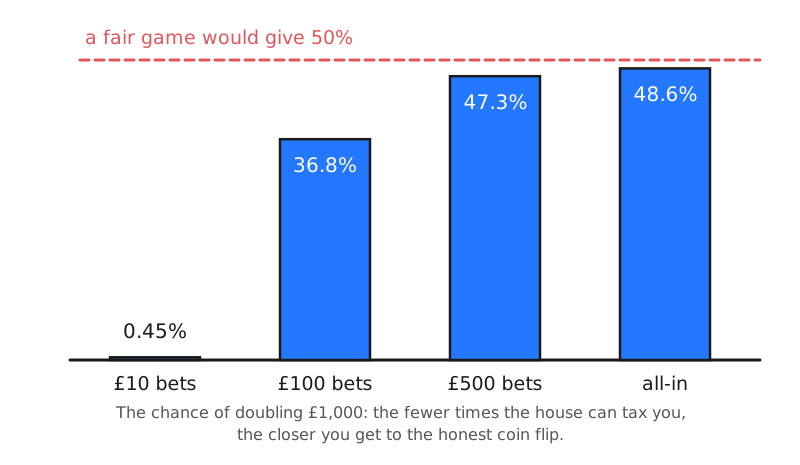
At £10 stakes you double with probability 0.45%; at £100 stakes, 36.8%; at £500, 47.3%; and putting the entire £1,000 on red in a single bet succeeds with probability — over a hundred times better than the grind.
The psychology, of course, screams the opposite. Small stakes feel safe because on any given spin you can barely lose anything — and that feeling is accurate about the spin while being silent about the night. What small stakes actually guarantee is more spins, and every extra spin pays the toll again. In a game where every wager is taxed, the optimal play is to be taxed as few times as possible. Probabilists call the extreme version bold play, and Dubins and Savage proved in their aptly titled 1965 classic How to Gamble If You Must that it is optimal for reaching a target in games like this one. Timid play — the strategy that feels safest — is the one that most reliably hands the house your entire bankroll, 2.7% at a time.
V. The one player the limits really stop
Walk up to any table and you'll see a placard: minimum £10, maximum £1,000. Folklore says the maximum exists to stop martingale players. It doesn't need to — as the doubling staircase showed, martingale players are profitable customers, paying the standard tax in an exotic instalment plan. The limits mainly cap the casino's exposure to variance from enormous single bets; that they also snap every doubling staircase after a few rungs is a tidy bonus.
But there is one player the limits genuinely guard against: the rare one whose edge is positive. In 1962 Edward Thorp showed that blackjack card-counters could tilt the odds roughly 1–2% in their favour [3] — possible in blackjack because cards dealt from a shoe are not independent events, unlike roulette spins. With a positive edge the right question flips from "how do I avoid ruin?" to "how fast can I grow?", and the answer is the Kelly criterion [2]: for an even-money bet won with probability , stake the fraction
of your bankroll. With a 51% edge, bet 2% of what you have, and your money compounds as fast as mathematically possible with no risk of ruin. Note what Kelly says about roulette, where : the optimal stake is . A negative Kelly stake means take the other side of the bet. The mathematics is not telling you how to beat the casino; it is telling you to become one.
VI. The only two winning moves
Every path through the casino leads to the same tollbooth. The house keeps of everything staked; the martingale converts that tax into a 60%-per-evening chance of a £630 catastrophe; flat betting compounds it into a 99.6% probability of ruin; and bold play — the best strategy on offer — merely gets you back to a single honest 48.6% coin flip, still 1.4 points short of fair. The only genuinely winning moves are not playing, or owning the wheel. If you do play, the maths offers two honest tips: treat your losses as the price of the entertainment (about 2.7p per £1 you cycle across the table), and never believe a streak is "due" — a mistake so expensive it has its own article.
References:
[1] William Feller, An Introduction to Probability Theory and Its Applications, Vol. 1, 3rd ed. (Wiley, New York, 1968), Ch. XIV: "Random Walk and Ruin Problems".
[2] J. L. Kelly, Jr., "A New Interpretation of Information Rate," Bell System Technical Journal 35 (1956), 917–926.
[3] Edward O. Thorp, Beat the Dealer: A Winning Strategy for the Game of Twenty-One (Random House, New York, 1962).
Note: All figures assume European single-zero roulette and even-money bets; American double-zero wheels are worse (a 5.3% edge). Ruin probabilities are for a player committed to a fixed stopping rule — real players improvise, but no improvisation changes the expected value.