
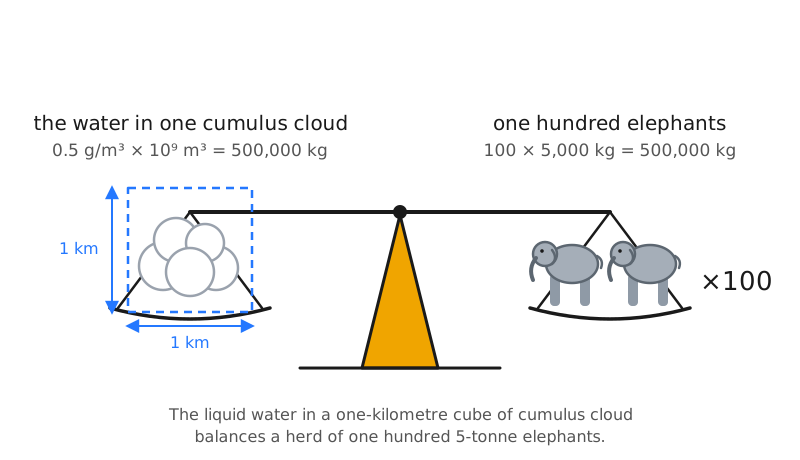
About 500,000 kilograms — the weight of a hundred elephants. That is the mass of the liquid water floating above you in one modest, fair-weather cumulus cloud, the fluffy cotton-wool kind you drew as a child.
This figure sounds like it cannot possibly be right. Clouds drift; elephants emphatically do not. In this paper we derive the number for ourselves with one measurement and one multiplication, and then use a little mechanics to resolve the paradox of how a hundred elephants' worth of water stays up.
How much water is in a cloud?
A cloud is not a solid lump of water — it is ordinary air containing a fine mist of liquid droplets. Meteorologists measure this as liquid water content, and for a typical cumulus cloud it is about grams of water per cubic metre of cloud [1]. That is remarkably little: a whole cubic metre of cloud — a box you could stand inside — contains about a tenth of a teaspoon of water.
The trick is that clouds contain a lot of cubic metres. A typical cumulus is about km across, km deep, and km tall [1], and its volume is where the calculation comes alive:
One innocent-looking cloud is a billion cubic metres of damp air.
Now the whole calculation is a single multiplication:
Half a million kilograms, or tonnes, of liquid water. An adult African elephant has a mass of around kg, so our cloud carries the water-weight of
Curiously, all that water gathered into one place would be underwhelming: tonnes is , a cube less than m across — one back-garden swimming pool, stretched into a cloud a kilometre wide. (For a comparison in the other direction, we once poured all of humanity into a Scottish lake in another article.)
Why doesn't it fall?
Here is the resolution of the paradox: the cloud's water is not one -tonne mass but around separate droplets, each with a radius of about micrometres ( m) and a mass of about four billionths of a gram. For objects this small, air resistance dominates completely.
A falling droplet stops accelerating when drag balances its weight — its terminal velocity. For tiny spheres this is given by Stokes' law:
where m is the droplet radius, , and are the densities of water and air, and is the viscosity of air. Substituting:
The droplets are falling — at about centimetres per second. At that rate a droplet takes roughly hours to descend one kilometre, while the gentle updraughts inside a cumulus cloud (often around m/s, nearly a hundred times faster) carry it back up long before it gets anywhere. A cloud is less a floating object than a very slow fountain.
What the number leaves out
A typical cumulus cloud holds about 500,000 kg of liquid water — one hundred elephants — kept aloft because that mass is shattered into droplets so small that air resistance almost cancels their weight. We should be honest about what "the weight of a cloud" means, though. The air inside our cubic kilometre of cloud has a mass of about kg — over a million tonnes, dwarfing the water by a factor of more than . The water is barely of the cloud by mass. And the truce with gravity is temporary: when droplets merge and grow, terminal velocity grows with , drag loses the argument, and the elephants arrive after all — as rain.
References:
[1] U.S. Geological Survey, Water Science School, "How Much Does a Cloud Weigh?": usgs.gov/special-topics/water-science-school
[2] Rogers, R. R. and Yau, M. K. A Short Course in Cloud Physics, 3rd ed. (Pergamon Press, 1989).
Note: Liquid water content varies widely — from around 0.05 g/m³ in wispy stratus to several g/m³ in storm clouds — so "the" weight of a cloud spans a few orders of magnitude. A large cumulonimbus can carry millions of tonnes of water.