
5,970,000,000,000,000,000,000,000 kg. That is the mass of the Earth — nearly six septillion kilograms, or kg in standard form. It is a number you will find printed in every physics textbook, and it invites an obvious question: who weighed it, and how? There is no set of scales large enough to put a planet on, and even if there were, what would the scales themselves stand on?
In this paper we will derive the mass of the Earth for ourselves. The remarkable thing is how little we need: one law of physics, one rearrangement, and three numbers — each of which can be measured from the Earth's surface. The hardest of the three was pinned down in 1798 by a man working alone in a shed.
Newton's law of universal gravitation says that two masses and , a distance apart, attract each other with a force
where is the gravitational constant — a universal number measuring how strong gravity is.
Now consider an apple of mass sitting on the Earth's surface, a distance (one Earth radius) from the Earth's centre. The gravitational force on it is its weight, . Setting the two expressions equal:
The apple's mass cancels from both sides, leaving . Rearranging for the mass of the Earth:
That is the whole trick. To weigh the planet we need three ingredients: , which we can measure with a pendulum; , which the ancient Greeks already estimated with shadows (we retrace that measurement in another article); and — which is where the story gets good.
Weighing the Earth in a shed
is extraordinarily hard to measure, because gravity is extraordinarily weak: the pull between two everyday objects is a tiny fraction of a newton. In 1798 Henry Cavendish — using an apparatus designed by his late friend John Michell — managed it anyway [1].
The instrument was a torsion balance: two small lead balls on the ends of a wooden rod, hung from a thin wire. Two large lead spheres, each weighing about 160 kg, were brought close to the small balls. Their gravitational pull — of order a ten-millionth of a newton — twisted the wire through a tiny angle. Since Cavendish knew how much force the wire needed to twist by a given angle, measuring the angle gave him the force, and therefore .
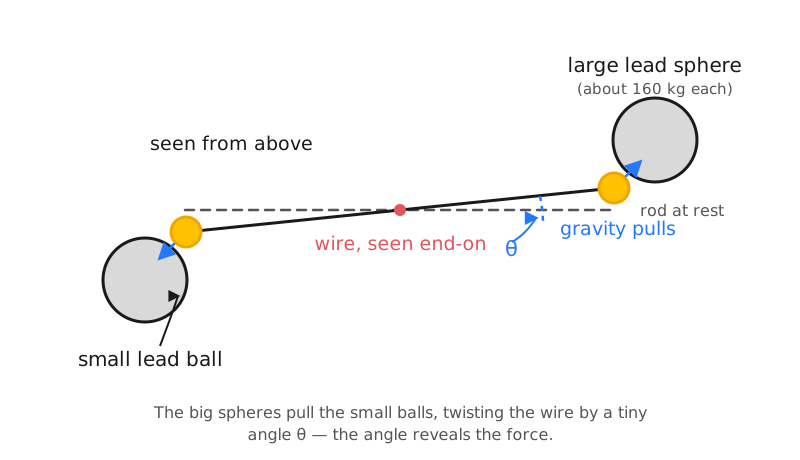
The forces were so small that a person standing in the room would ruin the experiment — even air currents from body heat were enough. So Cavendish sealed the apparatus in a shed on his estate and read the angle from outside, through a telescope. Strictly speaking he never wrote down at all: he reported the Earth's density, about 5.45 times that of water, which is why the experiment is still called "weighing the Earth". His answer was within about 1% of the modern value.
Plugging in the numbers
We can now plug in modern values: , , and [2].
- Square the radius:
- Multiply by :
- Divide by :
As a sanity check, let's compute the density this implies. The Earth's volume is , giving a density of about — roughly twice that of ordinary surface rock. Cavendish's contemporaries drew the correct conclusion: the Earth's interior must contain something far denser than rock, and we now know that it is mostly iron.
The corners our model cuts
Our one-line rearrangement gives kg, within about 0.1% of the modern accepted value of kg [3]. The model does cut corners — actually varies between about 9.78 and 9.83 m/s² across the globe, and the Earth is a slightly squashed sphere rather than a perfect one — but using mean values washes most of that out. Once you have , other famous numbers fall like dominoes: it is exactly the ingredient we need to compute the escape velocity of the Earth.
References:
[1] Henry Cavendish, "Experiments to Determine the Density of the Earth," Philosophical Transactions of the Royal Society of London 88 (1798).
[2] CODATA internationally recommended values of the fundamental physical constants, NIST: physics.nist.gov/constants
[3] NASA Earth Fact Sheet: nssdc.gsfc.nasa.gov/planetary/factsheet/earthfact.html
Note: This paper treats the Earth as a uniform sphere and uses globally averaged values of and .