
Earth hosts about 3.04 trillion trees; the Milky Way contains somewhere between 100 and 400 billion stars. The trees win — by roughly a factor of ten.
This feels backwards. A galaxy is unimaginably vast; a forest is just... a forest. Yet the claim is genuine, and both numbers come from real, checkable estimation methods. Nobody has counted every tree, and nobody has counted every star — in both cases scientists counted a sample and scaled up. In this paper we look at where each number comes from, and do the scaling-up ourselves.
Counting the stars
We cannot count the Milky Way's stars one by one: we sit inside the disc, and dust hides most of it from view. Instead, astronomers weigh the galaxy — the orbital speeds of stars reveal the mass holding them in orbit — and then divide the mass in stars by the mass of an average star:
Both quantities are uncertain. The dividing step is especially slippery because most stars are not like the Sun: the galaxy is dominated by dim red dwarfs with perhaps a quarter of the Sun's mass, too faint to see individually across the disc. Depending on the assumptions, the answer lands between and — which is why NASA quotes the famously wide range of 100 to 400 billion stars [2].
Counting the trees
The tree count is more recent, and the method is beautifully down-to-earth. In 2015, Thomas Crowther and colleagues published the first rigorous global tree census in Nature [1], built from 429,775 ground-truthed measurements: real plots of land, all over the world, where someone counted actual trees (defined as woody stems at least 10 cm across at chest height).
Each plot gives a density. Suppose a surveyed plot measures and contains trees. Since , that plot's density is:
Averaging thousands of such plots within each biome — rainforest, taiga, savanna — and using satellite maps for each biome's area, the count becomes a sum of multiplications:
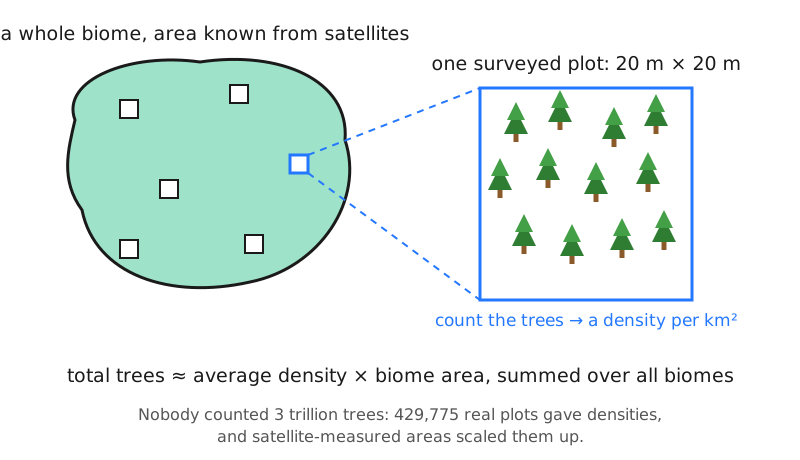
As a toy example, a biome with our density above and an area of million km² would contribute trees on its own. Do this properly across every biome and the total comes to — about 422 trees per person at the paper's 2015 population figure, or about each for today's 8.1 billion people.
Trees by a factor of ten
Putting the two counts on the same scale makes the result vivid — on an order-of-magnitude ladder, where each step is a factor of ten, the trees stand a full rung above the stars:
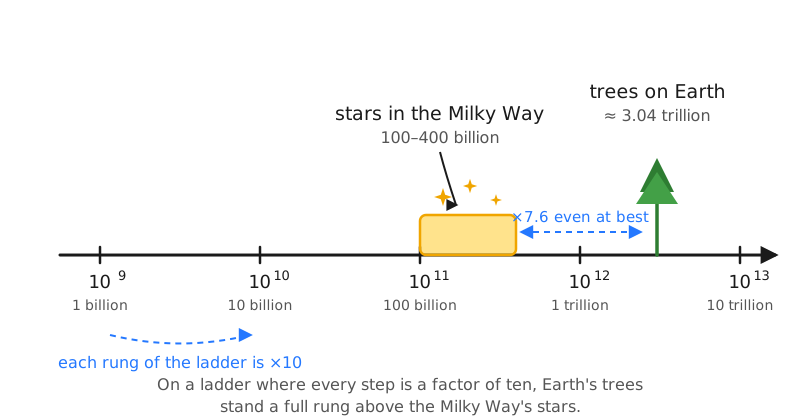
Even in the least favourable matchup — the top-end galaxy of stars —
the trees win nearly eight-fold, and against the low-end estimate they win thirty-fold. Against a middling stars the ratio is almost exactly ten. To feel the size of the winning number: counting one tree per second, day and night, would take about years. (If trillions and billions blur together, we untangle them in another article.)
Yes — there really are more trees on Earth than stars in the Milky Way, by around a factor of ten, and the comparison survives even the most generous star count. What we should hold loosely is not the verdict but the precision: the star count spans a factor of four, and the tree count depends on where you draw the line for "a tree". The deeper lesson is the method — you do not need to count three trillion of anything; you need a good sample, a density, and an honest multiplication. The same paper carries a sting in its tail: it estimates we remove about billion trees per year, and that the global tree count has fallen by roughly since the dawn of human civilisation. The trees are winning the race against the stars, but not against us.
References:
[1] Crowther, T. W. et al. "Mapping tree density at a global scale." Nature 525, 201–205 (2015).
[2] NASA Goddard Space Flight Center, Imagine the Universe! — "The Milky Way Galaxy": imagine.gsfc.nasa.gov
Note: Both figures are estimates with substantial uncertainty; the Crowther count itself carries a confidence interval of roughly ±0.1 trillion, and star-count estimates depend heavily on the assumed abundance of faint red dwarfs.