
The sun, an abundant natural energy source, continually showers the Earth with enormous quantities of energy. Some assert that the energy it delivers to Earth in just one hour could satiate the planet's annual energy needs. This claim's validity is often taken for granted, yet it is rarely scrutinized with mathematical rigor. This paper builds a simple model to check the claim for ourselves — and everything we need is GCSE maths: the area of a circle, unit conversion, and standard form.
Which area actually catches the sunlight
We model the Earth as a sphere with a radius of approximately 6,371 kilometers (km), and the sun's energy is assumed to be uniformly distributed over the Earth's surface exposed to the sun. Solar radiation at the top of Earth's atmosphere, also known as solar constant, is approximately 1,361 Watts per square meter (W/m²) [2].
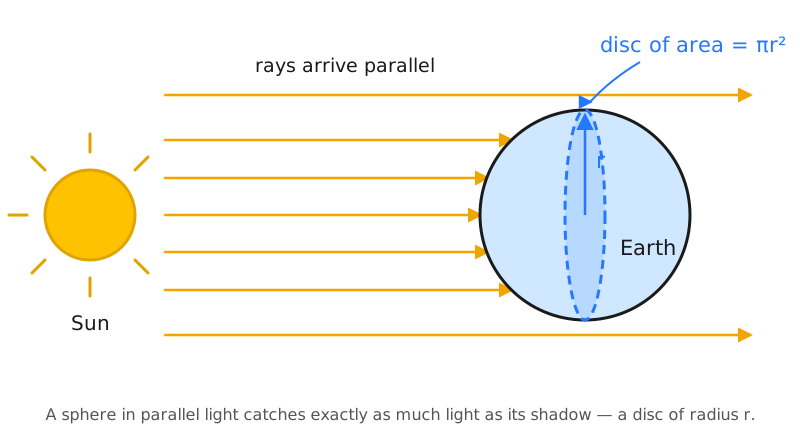
One question worth pausing on: what area of the Earth actually catches this sunlight? Your first instinct might be the surface area of the sphere, — but that would be wrong. The sun is so far away that its rays arrive essentially parallel, and only the half of the Earth facing the sun is lit at any moment. A sphere sitting in a beam of parallel light intercepts exactly as much light as its shadow — a flat disc of radius , with area :
From disc area to terawatt-hours
- First, we calculate the area that intercepts sunlight at any given moment — as we saw above, a disc with the same radius as the Earth.
- Convert this to square meters:
- Calculate the total power the Earth receives from the sun per second:
- To find the energy the Earth receives from the sun in one hour, we multiply the power by the number of seconds in an hour:
- Convert this energy to TeraWatt-hours :
What our model ignores
Our simple model suggests that the sun indeed delivers about to the Earth in just one hour, exceeding the global annual energy needs of . However, this does not consider factors like the earth's tilt, atmospheric absorption, seasonal variations, or the technology required to harness this energy, meaning that the actual obtainable amount of energy that could be harnessed in one hour is likely to be a fraction of the figure we've obtained.
References:
[1] Our World in Data: Energy Production & Consumption
[2] Kopp, Greg, and Judith L. Lean. "A new, lower value of total solar irradiance: Evidence and climate significance." Geophysical Research Letters 38.1 (2011).
Note: The calculations in this paper are based on a simplified model and should be treated as rough estimates.