
In 1967, Stanley Milgram asked strangers in Nebraska to get a letter to a stockbroker near Boston, passing it only between people who knew each other on a first-name basis. The chains that arrived took a median of just five to six intermediaries. Six handshakes, it seems, connect you to anyone on Earth. Half a century later, Facebook ran the measurement on 1.59 billion users and got an average of just 3.57 degrees of separation [3].
The claim sounds like magic. In this paper we check whether the maths actually supports it — and it turns out the obvious calculation in its favour is wrong, and the truth is saved by something subtler: the mathematics of weak ties.
Milgram's "small-world" experiment gave folders to volunteers in Omaha, Nebraska (and a pilot group in Wichita), naming a target: a stockbroker in Sharon, Massachusetts. Each holder had to post the folder to a personal acquaintance who seemed closer to the target. In the main study, analysed with Jeffrey Travers, 217 chains actually started and 64 arrived — a 29% completion rate — with completed chains averaging about 5.2 intermediaries, and a median between five and six [1].
Honesty requires both halves of that sentence. The famous "six degrees" comes only from the chains that finished; 71% of letters were simply dropped somewhere along the way. Critics have argued ever since that this attrition weakens the claim — though note the direction of the bias: every extra link is another chance for a chain to die, so long chains were more likely to vanish, meaning the true average is, if anything, understated. And one more wrinkle Milgram himself reported: the chains funnelled — a quarter of all completed letters reached the stockbroker through the same final person, a local clothing merchant.
Where the seductive arithmetic breaks down
Why should short chains exist at all? Here is the back-of-envelope argument. Suppose everyone maintains about 150 acquaintances — Dunbar's estimate of a stable human social circle. Then your friends-of-friends number , and six steps out:
That is about 1,400 times the world's population of 8.2 billion. Even five steps gives , nine planets' worth of people. Solving gives . Case closed?
No — because it silently assumes each handshake reaches 150 new people. Real friendship circles overlap massively: your friends mostly know each other, so most of those paths lead straight back into your own social village. Sociologists measure this as clustering, and it is huge in real networks. (It is exactly the double-counting that wrecks the naive claim that you have ancestors — see how many ancestors do you have?) In the extreme, a world made of tightly-knit villages of 150 would have enormous chain lengths: to cross the planet you would have to trudge village by village.
So the exponential argument overshoots by design. If clustering ate all the growth, six degrees would be false. Something else must be doing the work.
Weak ties: what actually saves it
The rescue comes from the handful of acquaintances who don't live in your village — the old flatmate in Singapore, the cousin's colleague from a conference. Mark Granovetter called these "weak ties" and showed they carry a network's long-range traffic. In 1998, Watts and Strogatz made it precise with their small-world model [2]: start with a ring of nodes each linked only to near neighbours (high clustering, horribly long paths), then randomly rewire just a small fraction of edges into long-range shortcuts. The clustering barely changes — but the average path length collapses towards the behaviour of a random network. A few shortcuts do almost all the shrinking.
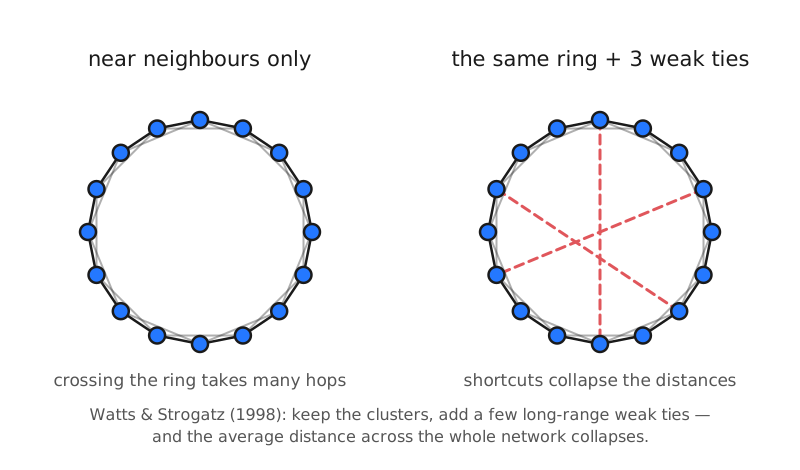
That is the real structure of "six degrees": most of your 150 ties are redundant, but you only need a few per person, worldwide, to make the exponential intuition roughly right again. It also explains Milgram's funnelling — chains race through the rare well-connected shortcut-holders, the same hubs that make your friends have more friends than you do in the friendship paradox.
What survives the caveats
The famous number survives, with caveats. Milgram's completed chains really did average five to six intermediaries, though only 29% of chains completed; and in 2016 Facebook computed the average distance between all pairs of its 1.59 billion users as 4.57 hops — 3.57 intermediaries [3], with the usual caveat that a Facebook friendship is cheaper than a handshake. The naive argument is wrong on its own, defeated by clustering; the honest version is that a sprinkling of long-range weak ties restores short paths, which both simulation and planetary-scale data confirm. Six handshakes was never magic — it is what feels like from the inside.
References:
[1] Jeffrey Travers and Stanley Milgram, "An Experimental Study of the Small World Problem," Sociometry 32 (1969), 425–443; Stanley Milgram, "The Small World Problem," Psychology Today 1 (1967).
[2] Duncan J. Watts and Steven H. Strogatz, "Collective dynamics of 'small-world' networks," Nature 393 (1998), 440–442.
[3] Sergey Edunov, Carlos Diuk, Ismail Onur Filiz, Smriti Bhagat and Moira Burke, "Three and a half degrees of separation," Facebook Research (2016).
Note: Dunbar's 150 is an order-of-magnitude estimate of stable acquaintanceship, and "degrees" here counts intermediaries; counting hops instead adds one to every figure.