
Reject the first 37% of everything you look at — candidates, flats, dates — then commit to the first one better than all of them. Mathematically, this is the best you can do, and it finds you the single best option about 37% of the time. The same strange number answers both questions, and it is no coincidence: both are the constant , where is the number at the heart of compound interest.
This is the secretary problem, the most famous result in optimal stopping — the mathematics of deciding when to stop deciding. In this paper we derive the rule, verify it with 200,000 simulated hiring seasons, and then honestly poke at the assumptions.
Look, then leap
Suppose candidates (we will use ) can be ranked from best to worst with no ties. They arrive for interview one at a time, in completely random order. After each interview you must decide immediately: hire, or reject forever. You cannot recall a rejected candidate, you can only compare candidates you have already seen, and you win only if you hire the single best of all 100 — second best counts as failure.
Some strategy is clearly needed. Hire the first candidate and you win with probability . Hold out for the last and it is the same. Choose early and you have no idea what "good" looks like; wait too long and the best has probably already walked out the door.
The optimal strategy has a beautifully simple shape. Pick a cut-off . Look at the first candidates and reject them all, remembering the best — this phase is pure calibration. Then leap: hire the first candidate who beats everyone from the look phase.
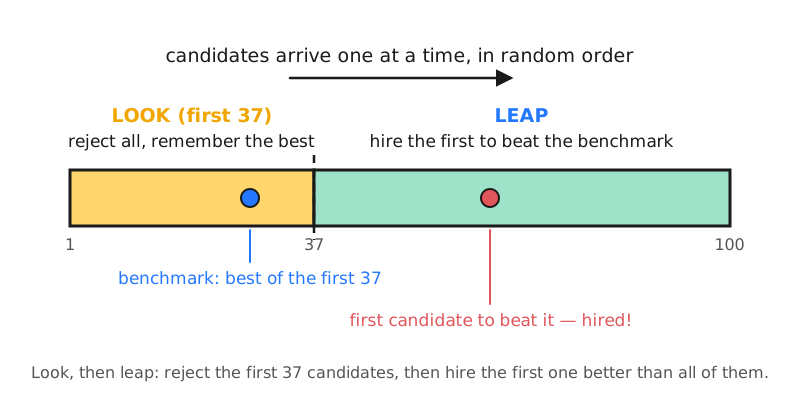
What is the best ? The strategy wins exactly when the best candidate sits at some position (probability for each position), and the best of the first candidates falls inside the look phase — otherwise someone would have triggered the leap too early. That second event has probability . Adding up over all positions:
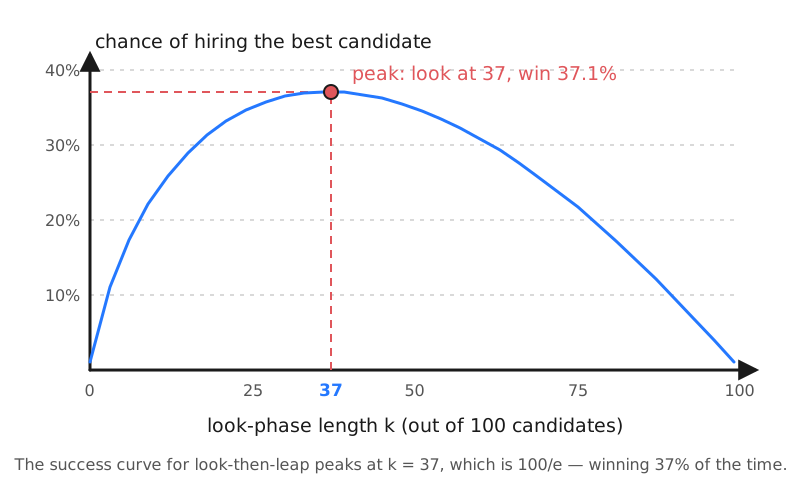
using the standard approximation of the sum by a logarithm. Writing for the fraction we look at, we want to maximise . A-level differentiation gives , so . And substituting back in, the winning probability is also . Look at 37%, win 37% of the time. For the exact sum is maximised at , with .
A 37% hit rate at picking the single best of 100, sight unseen, sounds too good — random guessing manages 1%. So we simulated it: 200,000 independent trials with 100 candidates in random order, rejecting the first 37 and hiring the first to beat them. The strategy found the outright best candidate in 37.03% of 200,000 trials, matching the theoretical 37.1%.
Sweeping the cut-off confirms 37 is the sweet spot: stopping the look phase at 20 wins about 33% of trials, at 50 about 35%, at 60 only 31%. The curve peaks exactly where says it should — and it is pleasingly flat near the top, so being roughly right costs little.
But should you dump the first 37%?
Before reorganising your love life around this, look at what we assumed — because dating fails every assumption at once. You win only with the absolute best: in reality the second-best partner out of 100 is not a failure. Relax that, and the optimal look phase shrinks dramatically. No recall: rejected candidates are gone forever, yet people do agree to second chances. Strict ranking, no ties: you can always tell who was better, with no outside scale — though one glance at the wider world tells you plenty about the market. Known : nobody knows how many candidates their search holds. And even played perfectly, the strategy fails 63% of the time — optimal is not the same as good.
What survives the assumptions
The 37% rule is a genuine theorem, and our 200,000-trial simulation shows it delivering exactly what it promises: look at of the field, then leap, and the best option is yours with probability . What survives the unrealistic assumptions is the qualitative lesson, the same one the Monty Hall problem teaches from another angle: in decisions under uncertainty, a pre-committed strategy beats instinct — and instinct's usual failure is committing too early, before we know what good looks like.
References:
[1] Thomas S. Ferguson, "Who Solved the Secretary Problem?" Statistical Science 4, no. 3 (1989).
[2] Martin Gardner, "Mathematical Games," Scientific American 202, no. 2 (February 1960) — the "game of googol", the problem's first popular appearance.
[3] Brian Christian and Tom Griffiths, Algorithms to Live By: The Computer Science of Human Decisions (Henry Holt, New York, 2016), ch. 1.
Note: Simulation: 200,000 trials at the cut-off of 37 with a fixed random seed; re-running shifts the result by about a tenth of a percentage point. The classical scoring counts only the single best candidate as a win; gentler goals give better odds and shorter look phases.