
43,252,003,274,489,856,000. That is how many arrangements a standard Rubik's Cube can reach — about 43 quintillion. If you tried a new arrangement every single second, you would need over a trillion years to see them all: roughly a hundred times the age of the universe (a number we derive in another article).
The Rubik's Cube, invented by Ernő Rubik in 1974, is one of the world's best-selling toys. In this paper, we will use combinatorics — the mathematics of counting — to see exactly where that enormous number comes from.
Counting the corners and edges
The classic Rubik's Cube is a cube, with each face divided into smaller squares. Each face is a distinct color, with six colors in total. The cube can rotate along any axis, which allows the small pieces, or 'cubies,' to permute.
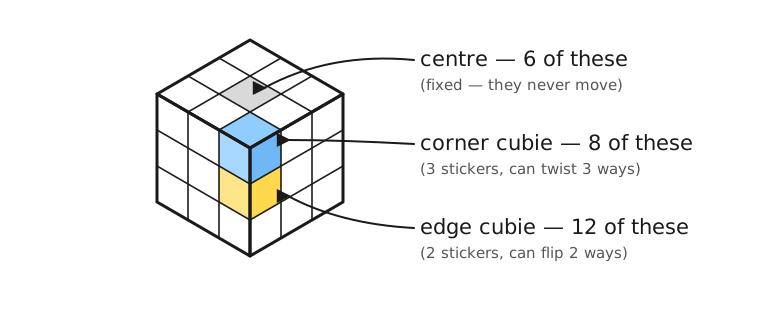
Before we count anything, it helps to see that the cube is made of three different kinds of piece: 8 corner cubies (each showing 3 stickers), 12 edge cubies (each showing 2 stickers), and 6 centre pieces which never move relative to one another — they form the fixed skeleton the other pieces move around.
A 3×3 cube has 8 corners (3 stickers each), 12 edges (2 stickers each) and 6 centres (1 sticker each). One face turn moves four corners and four edges together. Try following those pieces on a physical cube.
-
Corner Cubies: There are corner cubies, and they can be arranged in (factorial) ways. Each corner cubie can be in one of orientations, but the orientation of the last corner cubie is determined by the preceding seven. Therefore, the total combinations from corner cubies are
-
Edge Cubies: There are edge cubies, which can be arranged in ways. Each edge can be in one of 2 orientations, but similar to the corner cubies, the last edge cubie's orientation is determined by the preceding eleven. Hence, the total edge cubie combinations are
Combining corner and edge cubie possibilities gives us the total possible arrangements:
Why half the arrangements are impossible
Notice that we have already dealt with the orientation constraints — that is exactly why we used rather than for the corners, and rather than for the edges: the last cubie's twist or flip is forced by all the others.
One physical constraint remains: the parity of permutations. Every turn of a face cycles four corners and four edges at the same time. A 4-cycle is an odd permutation, so each move flips the parity of the corner arrangement and the edge arrangement together — they can never disagree. The consequence is that you can never swap just two pieces of a solved cube and leave everything else untouched. Exactly half of the arrangements we counted are therefore physically unreachable, so we divide by :
What 43 quintillion really means
In conclusion, the classic Rubik's Cube, an iconic symbol of human curiosity and problem-solving, possesses a staggering 43 quintillion possible combinations. This underlines the rich complexity and intricacy inherent in this ubiquitous puzzle and illustrates the fascinating mathematical principles embodied within a Rubik's Cube.
References:
[1] David Joyner, Adventures in Group Theory: Rubik's Cube, Merlin's Machine, and Other Mathematical Toys (Johns Hopkins University Press, Baltimore, 2002).
[2] Alexander Frey and David Singmaster, Handbook of Cubik Math (Enslow Publishers, 1982).
Note: This paper assumes a standard Rubik's Cube and does not account for modified or larger versions of the puzzle.