
−2.7%. Every pound bet on a European roulette wheel returns, on average, about 97.3p. The casino does not win by luck, by cheating, or by reading your face — it wins because of a single green pocket and one idea from GCSE probability: expected value. In this paper we derive the famous house edge for ourselves and then see why, over thousands of spins, a tiny average edge becomes an essentially guaranteed income.
Where the 37th pocket comes in
A European roulette wheel has 37 pockets: the numbers 1 to 36, coloured red and black, plus a single green 0. The simplest bet is a straight-up bet on one number: if the ball lands there, you are paid at 35 : 1 — you keep your stake and win 35 more.
Here is the whole trick in one sentence: a 35 : 1 payout would be perfectly fair if the wheel had 36 pockets — but it has 37.
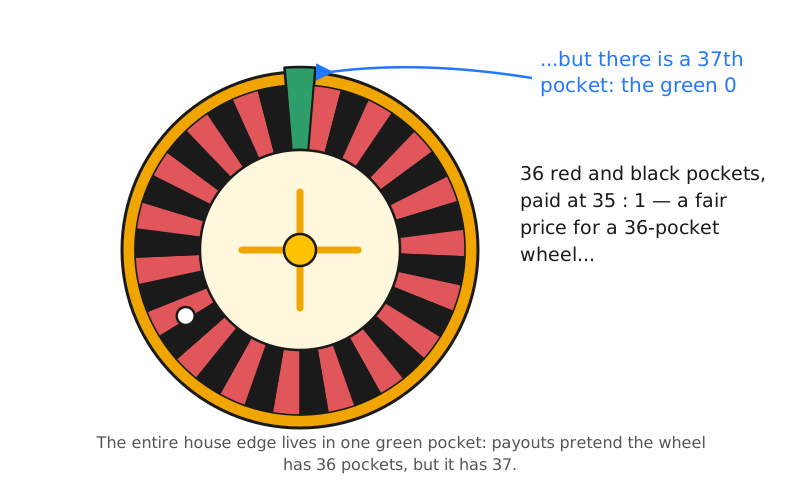
Expected value is the long-run average result of a bet: multiply each outcome by its probability, then add. Bet £1 on the number 17.
-
With probability the ball lands on 17 and your profit is .
-
With probability it lands anywhere else and your profit is .
On average you lose of your stake — about 2.7p per £1 — on every spin. Not because 17 is unlucky, but because the payout is priced for a 36-pocket wheel while the probability comes from a 37-pocket one.
Red, black, and the long game
Perhaps the "safe" even-money bets escape? Bet £1 on red. There are 18 red pockets, but 19 ways to lose: the 18 black pockets and the green zero.
Exactly the same edge. This is no coincidence: every standard roulette payout is calculated as if the zero did not exist, so every bet on the table quietly donates the same to the house. (American wheels add a second green pocket, 00, doubling the edge to — avoid them.)
A 2.7% edge sounds beatable — and on any single spin, it is: you win a straight-up bet 1 time in 37. The casino's real weapon is the law of large numbers: as the number of trials grows, the average outcome gets closer and closer to the expected value. One spin is a coin toss; a million spins are accountancy. For every £1,000,000 wagered across its tables, a casino expects to keep
and the relative fluctuations shrink as volume grows. A player betting £10 a spin at 30 spins per hour expects to lose about £8.11 per hour — slowly, politely, and with free drinks.
Why no betting system escapes it
The house edge of European roulette is exactly on essentially every bet, and no clever combination of bets can fix that: the expected value of a sum of bets is the sum of their expected values, and adding negative numbers never yields a positive one. Betting systems like the Martingale merely rearrange when you lose. To be honest about our model: it says nothing about any single night — variance means plenty of players go home winners, which is precisely what keeps the tables full. The casino simply plays the long game, where the law of large numbers collects. The same expected-value lens explains why 1, 2, 3, 4, 5, 6 is a bad lottery ticket — there, at least, the odds are honest about being terrible.
References:
[1] Richard A. Epstein, The Theory of Gambling and Statistical Logic, 2nd edition (Academic Press, 2009).
[2] John Haigh, Taking Chances: Winning with Probability (Oxford University Press, 2003).
Note: We assume an unbiased wheel; the handful of historical players who beat roulette did so by finding physically biased wheels, not by beating the maths.