
18,446,744,073,709,551,615 grains of rice. That is what a king owes if he agrees to place one grain on the first square of a chessboard, two on the second, four on the third, and keeps doubling to square 64. It is about 18.4 quintillion grains — roughly 461 billion tonnes of rice, nearly nine centuries of today's entire world harvest, or enough to bury the United Kingdom three metres deep. In this paper we derive the total ourselves with one elegant trick, weigh it, and meet the idea that makes the story famous: the second half of the chessboard.
The story, recorded by the 13th-century scholar Ibn Khallikan, goes like this. The inventor of chess presents the game to his king, who is so delighted that he offers any reward. The inventor asks for something that sounds absurdly modest: one grain of rice (wheat, in older tellings) on the first square of the board, two on the second, four on the third — each square holding double the one before, for all 64 squares.
The king laughs at such a humble request and agrees at once. His treasurers start counting. They do not stop laughing so much as stop being able to count.
Adding 64 numbers without adding them
The total owed is a sum of doublings:
That is 64 terms, and adding them one by one would be miserable. Here is the classic trick: double the whole sum, then subtract the original. Doubling every term shifts each power of 2 up by one:
Now subtract. Almost everything cancels — every term from 2 up to appears in both lines:
So , with no long addition required. This is the geometric series formula in its friendliest form: the sum of all the doublings up to is one less than the next doubling. Punching it out in full:
About 18.4 quintillion — and as a bonus fact, it means every square holds one grain more than all previous squares combined.
A grain of rice has a mass of roughly 25 milligrams. Multiplying:
How big is that? The world currently produces around 520 million tonnes of milled rice per year, so the debt is
of the entire planet's rice harvest — almost nine centuries. (The claim is sometimes rounded up to "a thousand years"; the honest figure at today's record output is closer to 900.) And the burial claim from our title: at a bulk density of about 600 kg/m³, the pile occupies roughly 770 km³. Spread evenly over the United Kingdom's 244,000 km², that is a layer about 3.2 metres deep — enough to bury every house up to the first floor.
The second half of the chessboard
Here is the strangest part. Halfway through the board — 32 squares in — the king owes billion grains. That is only about 107 tonnes of rice: a few lorry loads, a large field's harvest. Annoying, but payable. A doubling story that ends at square 32 is a story about a mildly embarrassed king.
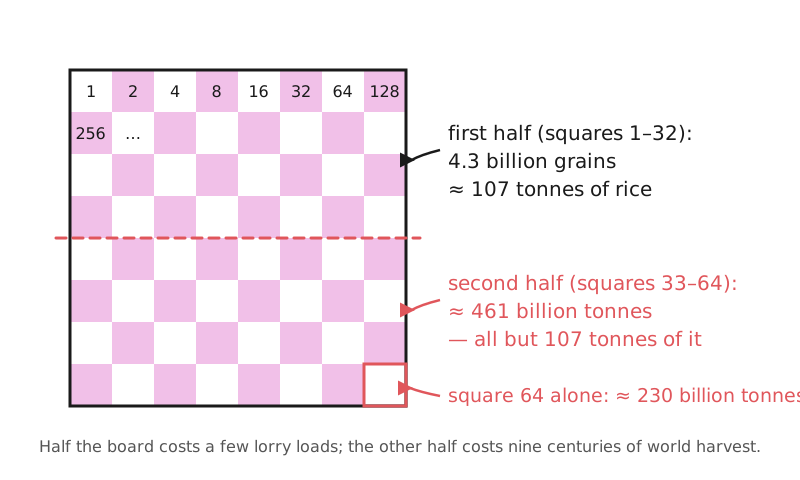
Then square 33 alone demands grains — one more than everything paid so far. From there the numbers leave human scale: square 64 alone carries quintillion grains, about 230 billion tonnes, more than all 63 previous squares put together. Of the full 461 billion tonnes, all but 107 tonnes — 99.99999998% — sits on the second half of the board. The entire first half is a rounding error.
Futurist Ray Kurzweil turned this into a general principle he called the second half of the chessboard: exponential growth spends its early doublings looking harmless, because doubling a small number gives another small number. The catastrophe is back-loaded. It is the same reason a sheet of paper folded 42 times reaches the Moon, and why compound interest does almost all of its work in the final years.
They creep, then they pounce
The legend checks out, and then some: the reward really is grains, about 461 billion tonnes — nearly nine hundred years of world rice production, a country buried in rice. The deeper lesson is where the debt hides: half the board costs 107 tonnes, and the other half costs 461 billion. Exponentials do not creep up on you gradually. They creep, and then they pounce.
References:
[1] Ray Kurzweil, The Age of Spiritual Machines (Viking, New York, 1999).
[2] Our World in Data: Rice production (FAO data).
[3] Clifford A. Pickover, The Math Book (Sterling, New York, 2009).
Note: Grain mass (25 mg) and bulk density (600 kg/m³) are typical values; real rice varies by variety and moisture, which shifts the tonnage but not the moral.