
0.999… equals 1. Not approximately, not "in the limit", not after rounding — exactly. Few statements in mathematics generate as much argument, and the argument almost always turns on the same misreading. The trailing dots mean the 9s never stop: not a billion 9s, not a googol of them, but infinitely many. Most objections, we will see, secretly imagine the 9s stopping somewhere. In this paper we give three proofs, in increasing order of rigour, and then face the strongest objection directly.
Two quick arguments, then an honest one
From fractions. Most people happily accept that
Multiply both sides by 3. The left side is exactly ; the right side, digit by digit, is So if you accept the first equation, you have already accepted that — you just hadn't noticed.
From algebra. Let Multiplying by 10 shifts the decimal point, so Now subtract the first equation from the second:
so , giving . Notice why the subtraction is so clean: both tails of 9s are infinite, so they cancel perfectly — there is no "last 9" left dangling at the end, because there is no end.
The two arguments above are convincing, but they quietly assume you can do arithmetic with infinite decimals. The honest route is to ask what actually means:
This is a geometric series — each term is the previous one multiplied by a fixed ratio. Here the first term is and the ratio is . A-level maths gives the sum of such a series when as , so:
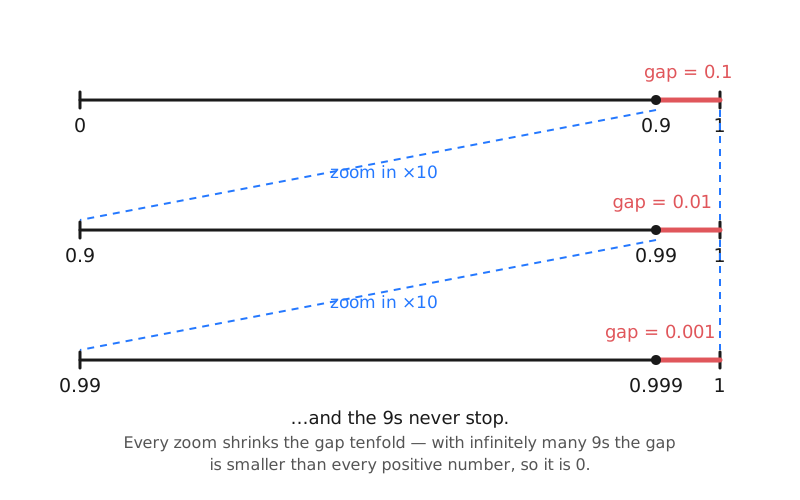
You can watch the sum close in. After nines, the distance left to 1 is exactly : after one digit the gap is , after two it is , after three . Each new digit shrinks the gap tenfold — powers of ten shrink as violently as they grow (the growing direction is what lets folded paper reach the Moon).
But surely there's always a tiny gap
This is the objection everyone reaches for, so let's meet it head-on. A basic fact about numbers: if two numbers are different, other numbers lie strictly between them — their average, for a start. So if and were different, we could name a number in between. Try. It would have to be bigger than , so somewhere its decimal expansion would need a digit that beats a 9. There is no digit bigger than 9. Nothing fits between — so the two are not different.
Alternatively, chase the gap itself. Any gap would have to be smaller than , smaller than , smaller than for every — smaller than every positive number. The only non-negative number smaller than every positive number is . The gap is zero, and a gap of zero is no gap at all.
What trips people up is the assumption that every number has exactly one decimal name. Not so: and are two different names for the same point on the number line, just as and are.
Why the discomfort is about notation
The equation is exact, and we reached it three independent ways: through fractions, through algebra, and through the geometric series that defines what an infinite decimal means [1]. The discomfort it causes is real, but it is discomfort about notation, not about numbers — decimals are names, and some numbers simply have two. One honest caveat: all of this takes place in the real numbers, the number system of school and science [2]. There are exotic number systems (the hyperreals) that do contain infinitely small quantities, but decimal notation does not describe those — and within the reals, the verdict is unanimous.
References:
[1] Richard Courant and Herbert Robbins, What Is Mathematics? (Oxford University Press, 1941).
[2] Walter Rudin, Principles of Mathematical Analysis, 3rd ed. (McGraw-Hill, 1976).
Note: Every terminating decimal has this double identity: and It is a feature of decimal notation, not a bug in the numbers.