
Somewhere in London, at least 60 people have exactly the same number of hairs on their head. Not probably — certainly. We can prove it without counting a single hair, without a survey, without leaving the room. The tool is one of the oldest and simplest ideas in mathematics, the pigeonhole principle, and this paper is a tour of how far one obvious-sounding sentence can reach.
More pigeons than holes
Put 10 pigeons into 9 pigeonholes, and some hole must contain at least 2 pigeons. Why? If every hole held at most one pigeon, the holes could hold at most 9 pigeons between them — but we have 10. That is the entire proof.
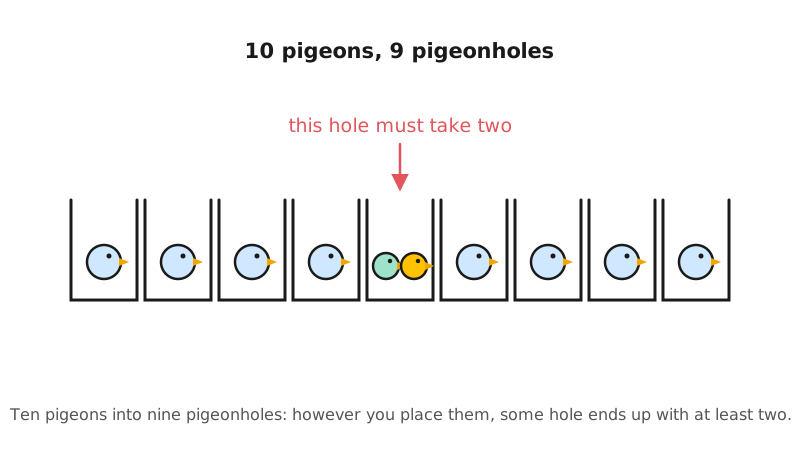
The general version is just as easy: put objects into boxes, and some box must contain at least objects, where means "round up". If every box held fewer, the total would fall short of .
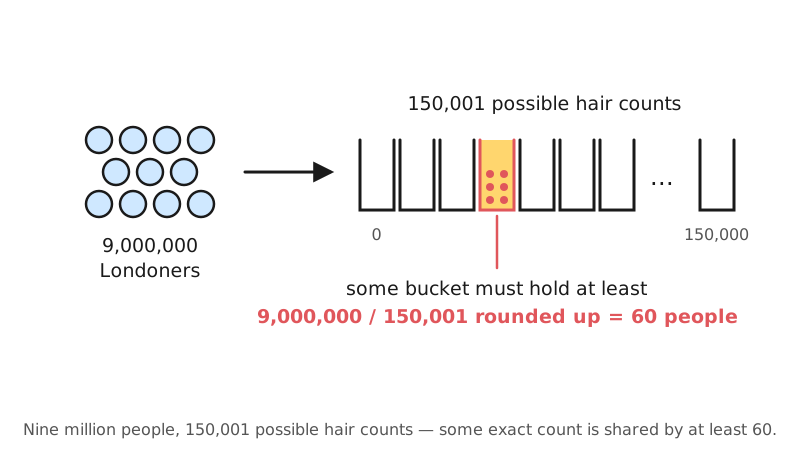
Now for the hair. Dermatology gives us the first number: a human scalp carries roughly 100,000 hairs [1], and even the most generous estimates put the ceiling around 150,000. So every Londoner's exact hair count is one of at most possible values: . Those are our pigeonholes.
The pigeons are the Londoners. The 2021 census counted about 8.8 million of them [2], and the population has since edged towards 9 million. Dividing:
So some specific number of hairs — we have no idea which — is shared by at least 60 Londoners. The classic two-person version of the claim is almost embarrassingly cheap by comparison: any 150,002 people already guarantee a matching pair, and London clears that bar sixty times over.
The same one-line argument keeps paying out across mathematics.
Birth months. Any 13 people include two who share a birth month: 13 pigeons, 12 holes.
Birthdays and initials, together. Combine categories and the boxes multiply: 366 possible birthdays times 26 first initials gives boxes. Nine million Londoners into 9,516 boxes forces at least people who share both a birthday and a first initial.
The party theorem. In any group of 6 people, there are either 3 mutual acquaintances or 3 mutual strangers. This is the first result of Ramsey theory, written [3], and we will only state it here — but the proof opens with a pigeonhole move: each guest has 5 relationships of 2 possible kinds, so at least of them are of the same kind. With 5 people the guarantee fails, so 6 is exact.
Existence without exhibits
Here is the strange beauty of what we proved. We know 60 hair-matched Londoners exist, yet we cannot name a single one, and no realistic effort could find them — nobody is counting nine million heads hair by hair. The pigeonhole principle is non-constructive: it proves the treasure is buried in the field without ever digging.
It also makes a nice contrast with its probabilistic cousin. The birthday paradox shows that coincidences become likely shockingly early — 23 people make a shared birthday better than a coin flip. The pigeonhole principle finishes the job: at 367 people, a shared birthday stops being likely and becomes logically unavoidable. Probability gets you to "almost surely"; pigeonhole gets you to "no possible universe says otherwise".
What one sentence bought us
From one sentence — more pigeons than holes means sharing — we squeezed out a guaranteed 60-way hair-count tie among 9 million Londoners, a birth-month match in any group of 13, a 946-way birthday-and-initial coincidence, and the doorstep of Ramsey theory. Our numbers were deliberately generous: if the true hair ceiling is nearer 100,000, the guarantee rises from 60 towards 90. That is the pigeonhole principle's signature move — the weaker you make its assumptions, the more comfortably its conclusion survives.
References:
[1] Ralf Paus and George Cotsarelis, "The Biology of Hair Follicles," The New England Journal of Medicine 341, no. 7 (1999).
[2] Office for National Statistics, Census 2021 first results, England and Wales.
[3] Ronald L. Graham, Bruce L. Rothschild, and Joel H. Spencer, Ramsey Theory, 2nd ed. (Wiley, New York, 1990).
Note: Hair counts vary with hair colour and age, and 150,000 is a deliberately generous ceiling — any smaller ceiling only strengthens the conclusion. The 9 million figure rounds the ONS estimate up; using the 2021 census figure of 8.8 million still guarantees a 59-way tie.