
Here are four dice with a very strange property: A beats B, B beats C, C beats D — and D beats A. Every arrow in that circle holds with probability exactly . There is no best die. Whichever one you choose, another die in the set beats yours two rolls out of three — which is why Warren Buffett, a fan of these dice, once proposed a game to Bill Gates and generously offered him first pick. Gates inspected the faces and insisted Buffett choose first instead [2].
These are nontransitive dice, and the set below was designed by the statistician Bradley Efron [1]. In this paper we check every duel for ourselves — each one is just 36 equally likely outcomes — and then ask why the word "beats" refuses to behave like the symbol "".
Meet the dice
Efron's four dice carry these faces:
- A: 4, 4, 4, 4, 0, 0
- B: 3, 3, 3, 3, 3, 3
- C: 6, 6, 2, 2, 2, 2
- D: 5, 5, 5, 1, 1, 1
Two players each pick a die, both roll, and the higher number wins. No number appears on two different dice, so a duel can never tie.
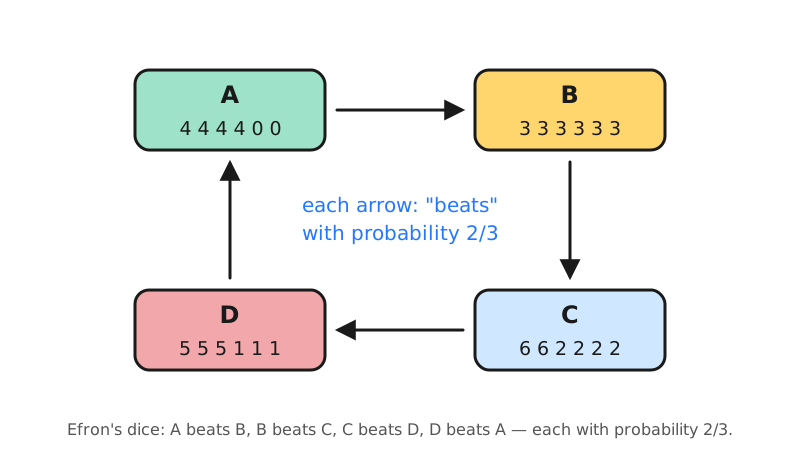
When two dice roll against each other there are equally likely outcomes, so every claim can be settled by counting.
A vs B. B always shows 3, so A wins exactly when it shows a 4 — four faces out of six:
B vs C. B always shows 3, so B wins exactly when C shows a 2 — again four faces out of six, so .
C vs D. C's 6 (two faces) beats anything on D; C's 2 (four faces) beats only D's 1 (three faces):
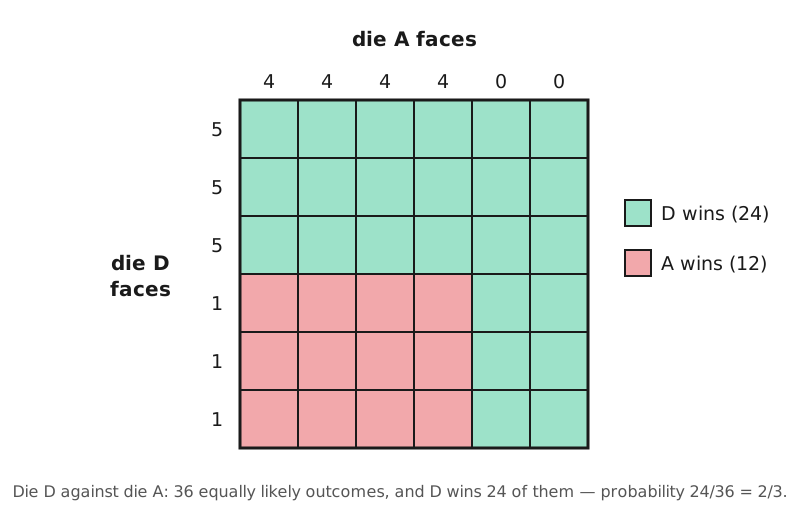
D vs A. D's 5 (three faces) beats both of A's numbers; D's 1 (three faces) beats only A's 0 (two faces):
The circle closes. We also verified all four duels exhaustively by computer: 24 winning outcomes out of 36, every single time.
Why "beats" is not like ">"
For numbers, the relation "" is transitive: if and , then , no exceptions. Our instinct quietly assumes every "better than" works the same way. But "die X beats die Y" compresses a whole 36-outcome contest into one word. It is a majority vote: it asks only who wins more often, and throws away by how much and against which faces. Majority votes are famously nontransitive — the same effect (the Condorcet paradox) lets three perfectly rational voters produce a circular group preference between three candidates.
Each of Efron's dice is simply tuned to exploit the next one: A's frequent 4s trump B's constant 3; B's constant 3 trumps C's frequent 2s; C survives on its occasional 6s plus D's frequent 1s; and D's 5s tower over everything A has. Four local ambushes, no global ranking.
Nor is the circle hiding a secret ordering across the diagonals: our exhaustive count gives C beating A with probability , while B against D is a dead-even 18 outcomes each.
The practical upshot: never pick first. Whatever your opponent chooses, take the die one step behind it in the circle — they take A, you take D; they take B, you take A; and so on — and you hold a edge. The game feels symmetric and fair, which is exactly what makes it a hustle.
And the edge compounds. Playing best-of-three, your chance of taking the match is
The longer the series, the more certainly the second picker wins. Gates was right to be suspicious.
Transitivity has to be proved
Efron's dice pass every check we threw at them: all four duels really do fall –, a clean cycle with no best die. The lesson is that transitivity is a property to be proved, not assumed — "beats" between random quantities, like preferences between candidates or results between sports teams, can happily run in circles. As with the Monty Hall problem, the mathematics is elementary; it is our intuition about what "better" must mean that gets quietly ambushed.
References:
[1] Martin Gardner, "The Paradox of the Nontransitive Dice and the Elusive Principle of Indifference," Scientific American 223, no. 6 (December 1970).
[2] James Grime, "The Bizarre World of Nontransitive Dice: Games for Two or More Players," The College Mathematics Journal 48, no. 1 (2017).
[3] Richard P. Savage Jr., "The Paradox of Nontransitive Dice," The American Mathematical Monthly 101, no. 5 (1994).
Note: All pairwise probabilities were verified by exhaustively enumerating the 36 outcomes of each duel. Efron's is one of many nontransitive sets; three-die sets with the same circular property also exist.