
Switching doors doubles your chance of winning the car — from 1/3 to 2/3. The setup: a game show has three closed doors. Behind one is a car; behind the other two, goats. You pick a door. The host — who knows where the car is — opens one of the other doors, always revealing a goat, and offers you the chance to switch to the remaining closed door. Should you?
Almost everyone's instinct says it doesn't matter: two doors left, so 50:50. That instinct is wrong, and in this paper we will see exactly why, using nothing more than careful case-counting.
The problem was first posed by the statistician Steve Selvin in a 1975 letter to The American Statistician [1], but it exploded in September 1990, when a reader put it to Marilyn vos Savant's "Ask Marilyn" column in Parade magazine. She gave the correct answer — switch, it wins 2/3 of the time — and the backlash was extraordinary. She received roughly 10,000 letters, around a thousand of them from readers with PhDs, many writing on university letterhead to inform her, in bruising terms, that she was wrong and that the answer was obviously 1/2 [2][3]. She wasn't wrong. Let's check for ourselves.
Enumerating the three cases
The car is equally likely to be behind any door, so each position has probability . Since the doors are symmetric, we can fix your initial pick as door 1 and simply walk through where the car might be:
- Car behind door 1 (probability ): the host opens door 2 or door 3 — both hide goats. Switching moves you off the car. Switch loses.
- Car behind door 2 (probability ): the host cannot open your door and cannot reveal the car, so he is forced to open door 3. Switching takes you to door 2. Switch wins.
- Car behind door 3 (probability ): the host is forced to open door 2. Switching takes you to door 3. Switch wins.
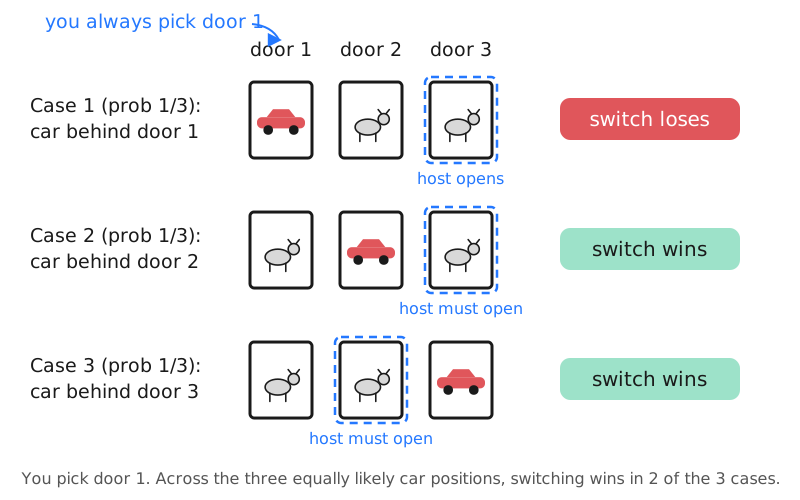
Switching wins in exactly 2 of the 3 equally likely cases:
Not convinced by counting alone? Neither were the letter-writers, so we simulated one million games in Python: staying won 33.4% of them, switching won 66.6%. The enumeration and the experiment agree.
Now play it yourself. Pick a door and decide whether to stay or switch before revealing the car. Then compare 1,000 games: the two bars count what each strategy would have done on the same games, so this is a fair comparison.
Under the standard rules, the host knows where the car is, always opens an unchosen goat door, and always offers a switch. Your first choice is correct in 1 of 3 equally likely cases. Switching wins in the other 2 cases, so its winning probability is 2/3, compared with 1/3 for staying. A small sample need not match these proportions.
After each game, ask: was my first choice right or wrong? Switching wins exactly when the first choice was wrong. The experiment illustrates the result; the three-case argument above explains why it holds.
Why isn't it 50:50?
The "two doors, so 50:50" instinct treats the host's reveal as new random information. It isn't random. Your initial pick is right of the time, and nothing the host does can change that — he can always find a goat to show you, whether your pick was right or wrong. So the probability that the car is "somewhere else" doesn't evaporate; it collapses entirely onto the one other door he carefully avoided opening. The host's knowledge is the whole trick: 2 times out of 3 his hand is forced, and the door he leaves shut is the car.
If the fog persists, exaggerate the game. Imagine 100 doors: you pick one, and the host — knowing where the car is — opens 98 others, all goats, leaving your door and one other. Would you stay with your 1-in-100 guess, or take the door that survived his purge? Switching there wins of the time; the three-door game is the same logic in miniature.
When switching stops working
Always switch: it wins with probability , double the of staying. One honest caveat: this answer depends on the rules we assumed — the host always opens a goat door and always offers the switch. If instead the host opened a random unpicked door and merely happened to reveal a goat, the two remaining doors really would be 50:50. The paradox is a lesson in how much hidden information a deliberate action can carry — and, like the birthday paradox, a reminder that our probability instincts deserve regular auditing.
References:
[1] Steve Selvin, "A problem in probability (letter to the editor)," The American Statistician 29 (1975).
[2] Marilyn vos Savant, "Ask Marilyn," Parade magazine, 9 September 1990.
[3] John Tierney, "Behind Monty Hall's Doors: Puzzle, Debate and Answer?" The New York Times, 21 July 1991.
Note: The 2/3 result assumes the standard rules: the host knows where the car is, always opens a goat door you didn't pick, and always offers the switch.