
11.6 days versus 31.7 years. That is the gap between a million seconds and a billion seconds. Most of us file "million" and "billion" in the same mental drawer — both simply mean a lot — yet one is a fortnight and the other is half a lifetime. In this paper we compute the comparison for ourselves and then push it further, into towers of banknotes and multi-millennium spending sprees, to see just how badly our intuition handles a factor of 1,000.
Eleven days versus thirty-one years
All we need is unit conversion. A day contains seconds, so a million seconds is
Not even twelve days: count one number per second, day and night without sleeping, and you finish counting to a million in under a fortnight. Now a billion — one thousand times more:
Start counting on your 18th birthday and you finish just before you turn 50. And for completeness, a trillion seconds — the next factor of 1,000 — is about 31,700 years, comfortably back into the last Ice Age.
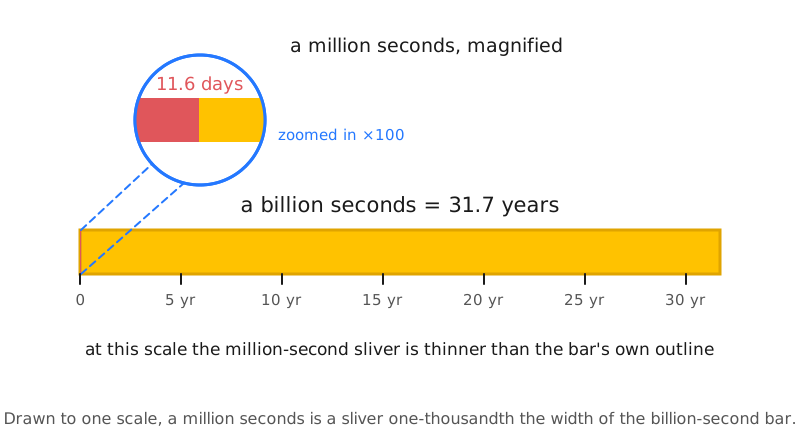
The diagram above is the honest picture: drawn to the same scale, the million is a sliver one-thousandth the width of the billion bar — thinner than the line used to draw it.
Stacks, strolls and spending sprees
Money makes the same point physically. A US banknote is 0.0043 inches thick [1], which is
A million dollars in 100-dollar bills is notes, so the stack stands
about waist height — you could hide it under a desk. A billion dollars is 10 million notes:
That single stack of banknotes towers over the Burj Khalifa, the tallest building on Earth at 828 m [2], by more than 250 metres. The same ratio works for distance: a million millimetres is a 1 km stroll; a billion millimetres is 1,000 km, roughly London to Monaco.
Here is the framing that surprises people most. The gap between a millionaire and a billionaire is 999 million dollars; the gap between a millionaire and someone with nothing is just 1 million. So on the money number line,
a millionaire is 999 times closer to being broke than to being a billionaire. Or put it in spending terms: at 1,000 dollars a day, a million lasts about 2.7 years — while a billion lasts about 2,740 years. Had a Roman started spending 1,000 dollars a day two thousand years ago, the fortune would still have more than seven centuries left in it today.
Why our intuition fails
Every number in this paper came from one division sum, yet the results feel absurd: 11.6 days against 31.7 years, a waist-high stack against one dwarfing the Burj Khalifa. The lesson is that human intuition is linear while the numbers that describe wealth, populations and computation are not — we hear "million" and "billion" as neighbours when they are separated by a factor of 1,000. It is the same blind spot that makes 42 paper folds reaching the Moon sound impossible and 43 quintillion Rubik's Cube arrangements sound meaningless. The cure, as ever, is to stop filing big numbers in one drawer and actually do the division.
References:
[1] U.S. Currency Education Program, Federal Reserve note specifications: https://www.uscurrency.gov
[2] Council on Tall Buildings and Urban Habitat, Burj Khalifa: https://www.skyscrapercenter.com/building/burj-khalifa/3
Note: All figures use the short-scale billion (), standard in modern English; the older long-scale billion () would make the contrast a thousand times starker still.