
1 in 45,057,474. That is the chance that a single UK Lotto ticket wins the jackpot — and it is exactly the same for 1, 2, 3, 4, 5, 6 as it is for any random-looking pick. Most people feel in their bones that 1 to 6 "could never come up". That feeling is wrong. And yet, in this paper we will argue that 1, 2, 3, 4, 5, 6 really is one of the worst tickets you can buy. Resolving this apparent contradiction takes nothing more than GCSE-level counting, plus one genuinely powerful idea: expected value.
Counting the tickets
In Lotto you pick 6 numbers from 59, and the order you pick them in does not matter. The tool for counting selections like this is combinations — the number of ways of choosing objects from when order is irrelevant. Let's build the answer step by step.
- Imagine the balls being drawn one at a time. The first can be any of 59 numbers, the second any of the remaining 58, and so on down to 54. Multiplying:
-
But this counts every set of six numbers many times over — once for each order it could have been drawn in. Six objects can be ordered in ways (factorials — the number of ways to arrange objects).
-
Dividing out the repeats:
Just over 45 million possible tickets. To put that in perspective: playing one line in both weekly draws, you would expect to wait roughly 433,000 years for a jackpot.
The draw machine has no memory and no taste. Each of the 45,057,474 combinations comes out with probability exactly — the tidy-looking 1, 2, 3, 4, 5, 6 included. When someone says "1 to 6 will never come up", they are almost right, but only in the sense that any particular ticket will almost certainly never come up. Our brains flag 1–6 as special because it makes a pattern; the machine cannot see patterns at all.
Expected value: where 1 to 6 falls apart
So why is it a bad ticket? Because "how likely am I to win?" and "how much is my ticket worth?" are different questions. The second is measured by expected value: multiply each possible payout by its probability, then add everything up. Consider just the jackpot, and take a healthy £10,000,000 rollover. A ticket with unpopular numbers wins the whole thing:
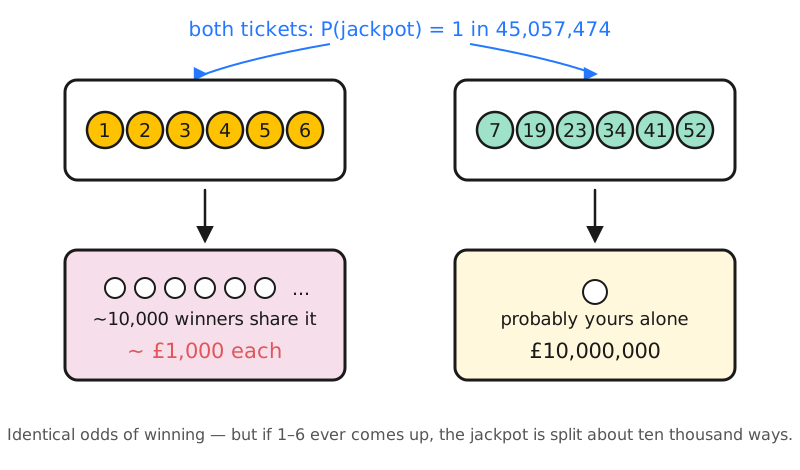
But lottery jackpots are shared between all winning tickets, and an estimated 10,000 people play 1, 2, 3, 4, 5, 6 every single draw [1]. If it ever came up, your share would be about , so:
Same probability of winning, yet the expected jackpot payout is about 10,001 times smaller — roughly 22p versus 0.002p.
Cheap, not unlikely
1, 2, 3, 4, 5, 6 is not an unlikely ticket — it is a cheap one, in the sense that whatever it wins, it shares. The same logic penalises any popular choice: birthdays force numbers to 31 or below, so low-number tickets are systematically overpicked and their prizes over-shared. If you must play, the expected-value-maximising move is to pick combinations other people avoid. And we should be honest: the whole game has negative expected value — only a fraction of ticket sales is returned as prizes, so on average every ticket is worth well under its £2 price. That is no accident; it is the same mathematics that guarantees the house always wins at roulette.
References:
[1] John Haigh, Taking Chances: Winning with Probability (Oxford University Press, 2003).
[2] The National Lottery, Lotto: national-lottery.co.uk/games/lotto
Note: The 59-ball Lotto format dates from 2015; the "around 10,000 people play 1–6" estimate comes from the earlier 49-ball era, so treat it as an order of magnitude rather than a precise count.