
The year 1900 was divisible by 4 — and it was not a leap year. There was no 29 February 1900, yet 2000, exactly a century later, had one. Stranger still: in October 1582, ten dates simply never happened. In Rome, Thursday 4 October was followed directly by Friday 15 October, by papal decree. Nobody aged ten days — the dates were deleted on purpose.
Both oddities trace back to one inconvenient number, and everything in this paper follows from it with nothing more than division and careful bookkeeping of small errors.
The year is not a whole number of days
A calendar year should track the tropical year — the time from one spring equinox to the next, which is what keeps the seasons pinned to the same dates. Its length is about
Not 365. And — this is the whole story — not 365.25 either. Since a calendar must use whole days, every calendar design is a scheme for smuggling in that awkward 0.2422 of a day using occasional extra days.
Julius Caesar's calendar (45 BC) used the obvious patch: one extra day every 4 years. The average Julian year is then
which overshoots the true year by days — about 11 minutes per year. Invisible in a lifetime. But the error compounds in one direction only, and one full day of drift takes just
Left to run from the Council of Nicaea (AD 325, whose equinox date anchored the calculation of Easter) to 1582, the drift reached days. The spring equinox, nominally 21 March, was arriving around 11 March, and Easter was sliding out of season.
1582: the ten days that never happened
Pope Gregory XIII's reform did two things [1]. First, it cancelled the accumulated error in the bluntest way imaginable: ten dates were struck from the calendar, and 4 October 1582 was followed by 15 October 1582. Second — the mathematically interesting part — it fixed the leak so the drift would not return.
The fix is a lovely piece of fraction-tuning. We need an average year of 365.2422 days built from whole days. The Julian rule adds 100 leap days per 400 years; that is slightly too many. So the Gregorian rule removes exactly three:
A year divisible by 4 is a leap year — unless it is divisible by 100 — unless it is also divisible by 400.
Century years are demoted (1700, 1800, 1900, 2100 — and this is why 1900 missed out), but every fourth century is spared, which is exactly how 2000 kept its leap day: it is divisible by 400. Per 400-year cycle that leaves leap days:
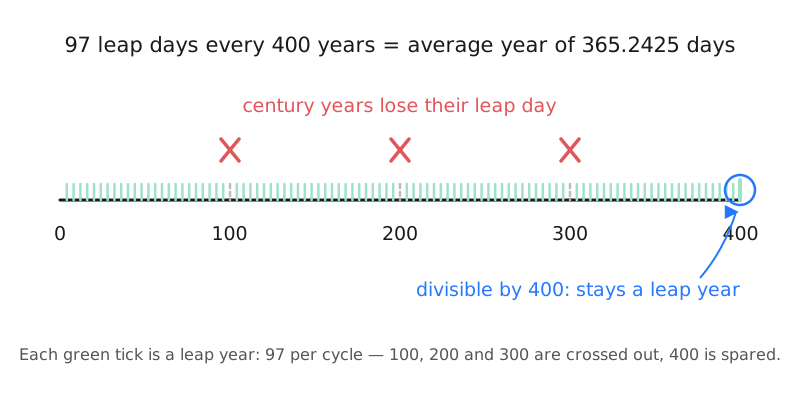
The Gregorian average year is
leaving a residual error of days per year — about 26 seconds. One full day of drift now takes
From 11 minutes a year to 26 seconds a year, achieved entirely with divisibility tests: the calendar won't need another Gregory until around the year 5000.
Britain, incidentally, rejected the "popish" reform for 170 years, by which point the drift had grown to eleven days: in 1752 Wednesday 2 September was followed by Thursday 14 September [2] — the calendar change that folklore says raised cries of "give us our eleven days".
Why no rule can be exact
1900 wasn't a leap year because "every 4 years" is not a fact about the world but a first approximation to 365.2422, and it leaks 11 minutes a year — a day every 128 years, ten days by 1582. The century-skipping rule is the patch: 97 leap days per 400 years gives a mean year of 365.2425 days, wrong by only about a day in 3,300 years. That is why 1900 lost its 29 February and 2000, divisible by 400, kept it. Honesty compels two footnotes: the tropical year itself drifts slowly over millennia, and the Earth's rotation is gradually changing too (that one is patched with occasional leap seconds — a different fix for a different wobble). Measuring time is much like measuring the age of the universe: the arithmetic is straightforward, but everything depends on pinning down the right constant to feed it — and no whole-number rule will ever match our orbit exactly. 97/400 just misses more slowly than anything simpler.
References:
[1] Pope Gregory XIII, Inter gravissimas (papal bull, 24 February 1582).
[2] David Ewing Duncan, The Calendar: The 5000-Year Struggle to Align the Clock and the Heavens (Fourth Estate, London, 1998).
[3] P. Kenneth Seidelmann (ed.), Explanatory Supplement to the Astronomical Almanac (University Science Books, Mill Valley, 1992).
Note: The tropical year of 365.2422 days is itself a rounded, slowly changing value; all drift figures are approximate but correct to the precision shown.