
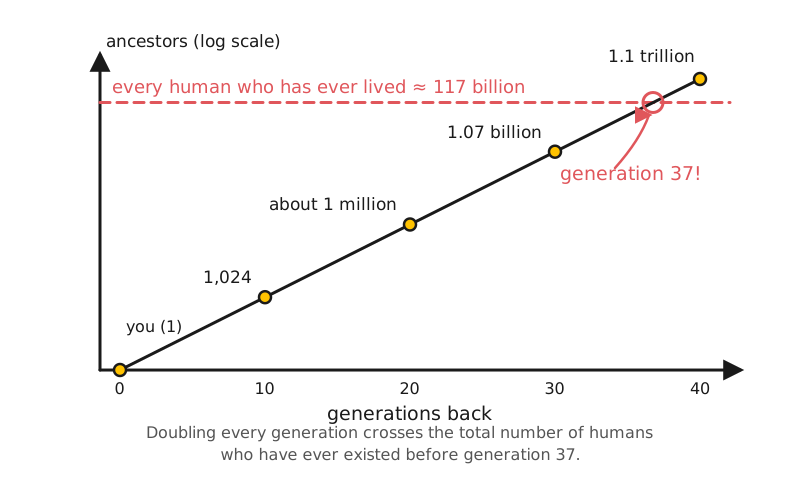
1,099,511,627,776. That is how many ancestors you appear to have just 40 generations back — over a trillion great-great-...-grandparents. You have 2 parents, 4 grandparents, 8 great-grandparents; the count doubles every generation, and doubling is merciless. The trouble is that demographers estimate only about 117 billion humans have ever lived [1]. Your family tree demands roughly ten times more people than have ever existed. In this paper we run the doubling for ourselves, find the exact generation where the maths collides with reality, and then resolve the paradox — because you do, after all, exist.
Doubling until the world runs out
Everyone has exactly two biological parents, so a naive family tree assigns you ancestors at generation :
The powers of 2 climb quietly at first — ancestors ten generations back — and then not quietly at all: and . If we add up every slot in the tree over 40 generations, we get a geometric series:
About 2.2 trillion positions to fill. How far back is that in time? Historically a generation is around 25–30 years, so 30 generations is roughly 900 years — the era of castles and crusades — and 40 generations lands a bit over a millennium ago.
Now the collision. Thirty generations back, around the year 1100, the model demands billion living ancestors for you alone — yet the entire world population at the time was only around 350 million [2]. Your tree needs three Earths' worth of medieval people, all of them your direct ancestors.
It gets worse. Even if we could recruit from all of human history, the ceiling is about 117 billion people [1], and the doubling smashes through it before generation 37:
Thirty-seven generations — roughly a thousand years — is all it takes for your personal family tree to demand more people than have ever drawn breath.
Where the branches start to merge
The escape from the paradox is a single realisation: your family tree is not a tree. The formula counts slots, not people, and nothing forces every slot to be filled by a different person. Whenever two of your ancestors were related to each other — say, third cousins who married, which was utterly routine in villages of a few hundred people — their shared ancestor occupies multiple slots at once. Genealogists call this pedigree collapse: trace the branches back and they begin to merge, folding the tidy binary tree into a tangled web.
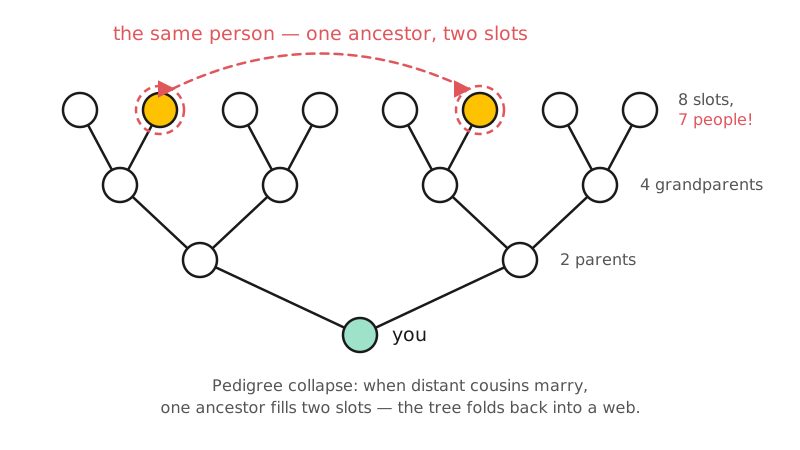
Far from being a rare quirk, collapse is a mathematical necessity — it is the only way a finite population can supply an exponentially growing demand for ancestors. And it runs deep: mathematical models of human ancestry suggest that a few thousand years ago there lived individuals who are common ancestors of every person alive today [3]. Go back far enough and the question is not whether some medieval farmer is your ancestor, but how many thousands of separate routes through the web lead from them to you.
Slots are not people
The naive count was never wrong as arithmetic — 40 generations of doubling really does give 1.1 trillion slots, and the geometric series really does total 2.2 trillion. What is wrong is the hidden assumption that the slots hold distinct people. Pedigree collapse quietly recycles ancestors into multiple slots, and the exponential demand is exactly why the recycling is unavoidable. It is the same lesson exponentials always teach — whether stacking ancestors or folding paper to the Moon, doubling outgrows any finite supply almost immediately.
References:
[1] Toshiko Kaneda and Carl Haub, "How Many People Have Ever Lived on Earth?", Population Reference Bureau: https://www.prb.org/articles/how-many-people-have-ever-lived-on-earth/
[2] Our World in Data, Population Growth: https://ourworldindata.org/population-growth
[3] Douglas L. T. Rohde, Steve Olson and Joseph T. Chang, "Modelling the recent common ancestry of all living humans", Nature 431, 562–566 (2004).
Note: Generation lengths vary between 20 and 35 years across cultures and eras; shifting the average moves the dates in this paper by a century or two but leaves the doubling argument untouched.