
828,000 kilometres per hour. That is roughly how fast you — yes, you, sitting perfectly still in a chair — are travelling around the centre of the Milky Way right now [1]. And that is only the outermost layer of your motion: underneath it, the Earth is carrying you around the Sun, and the Earth's spin is carrying you around its own axis, all at the same time.
In this paper we peel back these three nested layers of movement and put a number on each one. The only tools we need are GCSE staples: the circumference of a circle, , and the formula speed = distance ÷ time.
Three circles you ride at once
The Earth's radius is about km [2], so a full trip around the equator measures:
(A distance first measured over two thousand years ago with a stick — we retrace that feat in another article.) Someone standing on the equator covers that full circle once every 24 hours:
But most of us don't live on the equator. At latitude , you travel around a smaller circle of radius , so your speed shrinks by the same factor. London sits at N, and :
Sitting in a London café, you are moving eastward faster than a cruising airliner. Stand exactly at a pole and this layer vanishes: you would simply turn on the spot, once per day.
One layer out, the Earth's orbit is very nearly a circle of radius one astronomical unit, about million km [2]. One lap takes one year, which is hours:
That is about km per second, roughly 64 times faster than the equatorial spin. While you read this sentence, the Earth carried you about 150 kilometres along its orbit. In a single day, you cover about 2.6 million km without leaving your bed.
The Sun itself is not still. It orbits the centre of the Milky Way, about 26,000 light-years away, at roughly km/s according to NASA [1]. Converting:
That is nearly 8 times our orbital speed around the Sun, and about 500 times the equatorial spin. Even at this extraordinary pace, one full lap of the galaxy takes the Sun around 230 million years — the last time we were on this side of the Milky Way, dinosaurs were only just appearing.
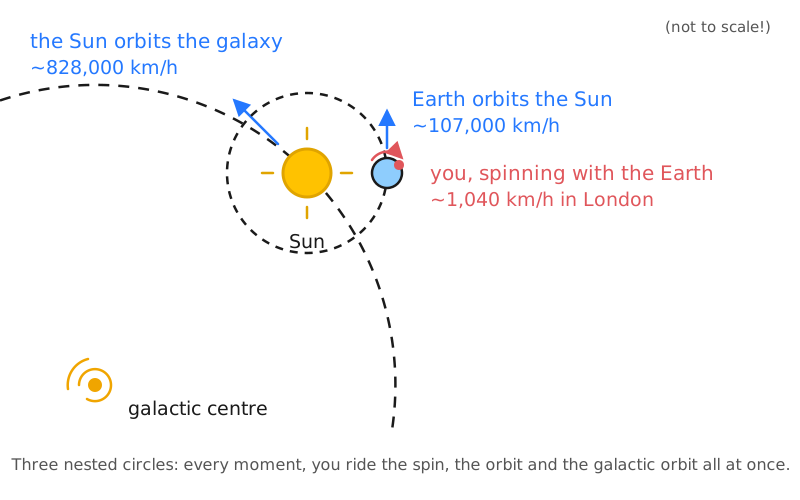
Why you can't add these up
Layer by layer, "sitting still" turns out to mean spinning at about km/h (in London), orbiting the Sun at about km/h, and circling the galaxy at about km/h. A few honest caveats. First, these speeds point in different directions and change constantly, so they cannot simply be added up — they are three separate answers to three separate questions. Second, we used the familiar 24-hour day; the Earth's true rotation period relative to the stars is 23 h 56 min, which would nudge Layer 1 up by about 0.3%. Third, and most importantly, physics tells us there is no absolute standard of rest: every speed here is relative to something — the Earth's axis, the Sun, the galactic centre. Relative to your chair, you really are sitting still. Both statements are true at once, and that is perhaps the best punchline of all.
References:
[1] NASA Science: The Milky Way Galaxy
[2] NASA Goddard Space Flight Center: Earth Fact Sheet
Note: All speeds are rounded and treat the relevant orbits as perfect circles; real orbits are slightly elliptical, so the true values wobble a little around these figures.