
For the same storage area, a hexagonal cell needs about 7% less wall than a square cell and about 18% less than a triangular one. For a honeybee this is not a curiosity — it is the wax bill. Wax is metabolically expensive: bees secrete it from glands on their abdomen and must eat a great deal of honey to produce it, so every millimetre of unnecessary wall is wasted food. Darwin called the honeycomb "absolutely perfect in economising labour and wax" [3], and as far back as the 4th century AD, Pappus of Alexandria claimed the bees chose hexagons through "a certain geometrical forethought". Bold claims — so let's check the geometry ourselves. Everything we need is GCSE maths: interior angles and area formulas.
Three shapes, one wax bill
If identical regular polygons are to tile a flat plane with no gaps, the angles meeting at each corner must add up to exactly . That is a brutal filter:
- Equilateral triangle: interior angle , and . Works.
- Square: interior angle , and . Works.
- Regular hexagon: interior angle , and . Works.
A regular pentagon's angle is , which does not divide . Any regular polygon with seven or more sides has an interior angle bigger than but smaller than , so you can fit neither three of them nor two around a corner. The triangle, the square and the hexagon are the only regular shapes that tile the plane — so the contest has exactly three entrants.
Fix each cell's area at (the units don't matter) and compute the perimeter each shape needs.
Square: area gives side , so
Equilateral triangle: area gives , so
Regular hexagon: area gives , so
The hexagon needs about less wall than the square and about less than the triangle. (In a real comb every wall is shared between two neighbouring cells, which halves the wax per cell — but it halves it for all three shapes, so the ranking is untouched.)
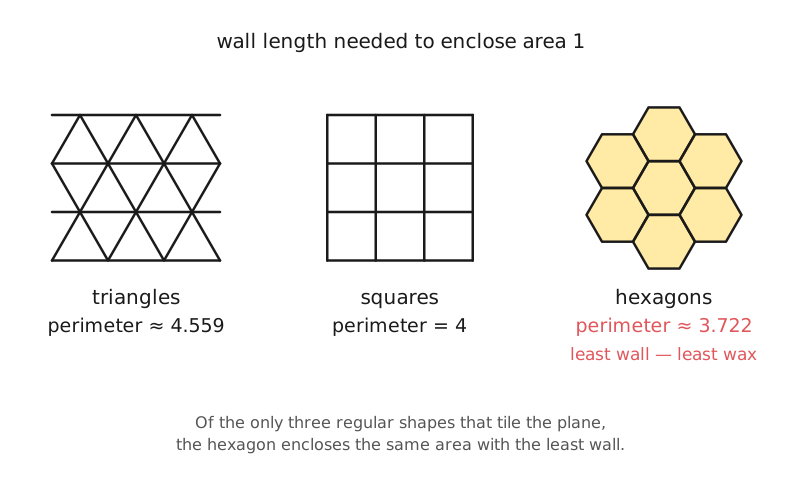
Could anything beat the hexagon?
Among single shapes, the circle is unbeatable: enclosing area needs perimeter — π being the same constant we estimate by dropping needles on the floor. That is why lone soap bubbles are round. But circles refuse to tile: pack them together and wasteful gaps appear between them.
What about irregular shapes, curved walls, or clever mixtures? This is where the problem gets serious. The claim that the regular hexagonal grid is the most economical way to divide the entire plane into equal-area cells — allowing any shapes whatsoever — is called the Honeycomb Conjecture. It was assumed true since Pappus, yet a full proof only arrived in 1999, when the American mathematician Thomas Hales settled it (published in 2001) [1] — shortly after he proved Kepler's sphere-packing conjecture. Two millennia between claim and proof: the bees were right, but the paperwork took a while.
Do the bees actually know?
The maths is unambiguous: of every conceivable way to partition a plane into equal cells, the hexagonal grid spends the least on walls, and the bees build it. But do bees know this? Honest answer: probably not in the way Pappus imagined. Research by Karihaloo, Zhang and Wang (2013) found that bees actually build roughly circular cells, and the warm, soft wax then flows into flat-walled hexagons where three cells meet — much as bubbles do in a raft of foam [2]. Physics may be doing part of the optimisation for free. Either way, the conclusion stands: the hexagon is the least-wax tiling, and between the bees' instincts and the wax's surface tension, nature found the optimum long before we could prove it was one.
References:
[1] Thomas C. Hales, "The Honeycomb Conjecture", Discrete & Computational Geometry, 25 (2001), 1–22.
[2] B. L. Karihaloo, K. Zhang and J. Wang, "Honeybee combs: how the circular cells transform into rounded hexagons", Journal of the Royal Society Interface, 10 (2013).
[3] Charles Darwin, On the Origin of Species (John Murray, London, 1859), chapter VII.
Note: Real honeycomb is three-dimensional — cells have depth and angled bases — and the 3D problem is subtler: László Fejes Tóth showed in 1964 that the bees' cell base is not quite optimal. Our result concerns the flat cross-section, where the hexagon genuinely is unbeatable.