
The golden ratio, φ ≈ 1.618, is a genuine mathematical celebrity — and most of what you have heard about it is false. The Parthenon was not designed around it, the Mona Lisa does not secretly encode it, and the nautilus shell does not grow by it. Yet φ is no fraud either: it falls out of a two-line equation, Fibonacci ratios genuinely converge to it, and sunflowers genuinely use it. In this paper we put the golden ratio on trial: the defence presents its real evidence first, then the prosecution brings out a ruler. Everything we need is one quadratic equation.
The case for the defence
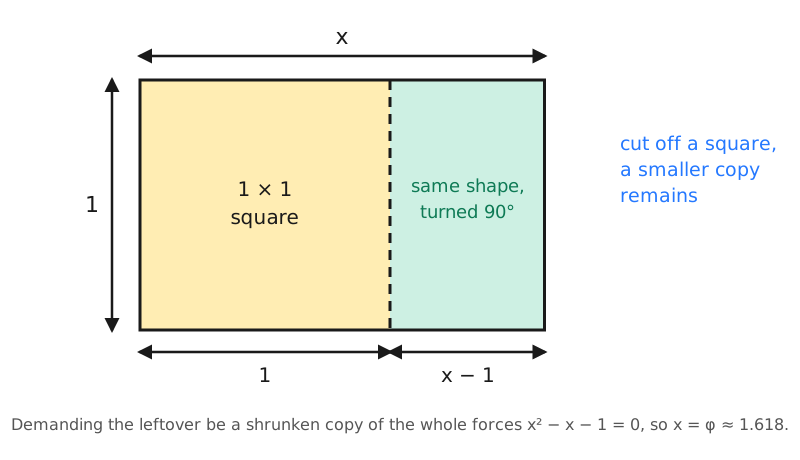
The golden ratio has a precise definition. Take a rectangle with short side and long side , and slice off a square. What remains is a smaller rectangle with sides and . Now make one demand: the leftover must be a shrunken copy of the original — the same proportions, just rotated. Setting the two ratios of long side to short side equal:
Cross-multiplying gives , and the quadratic formula (taking the positive root) delivers:
The number inherits strange talents directly from that quadratic: (squaring it just adds one) and (its reciprocal just subtracts one). No other positive number does either.
Take the Fibonacci sequence — , each term the sum of the previous two — and divide neighbours: , , , , . The ratios bounce alternately above and below, and by they have locked on to φ to five decimal places.
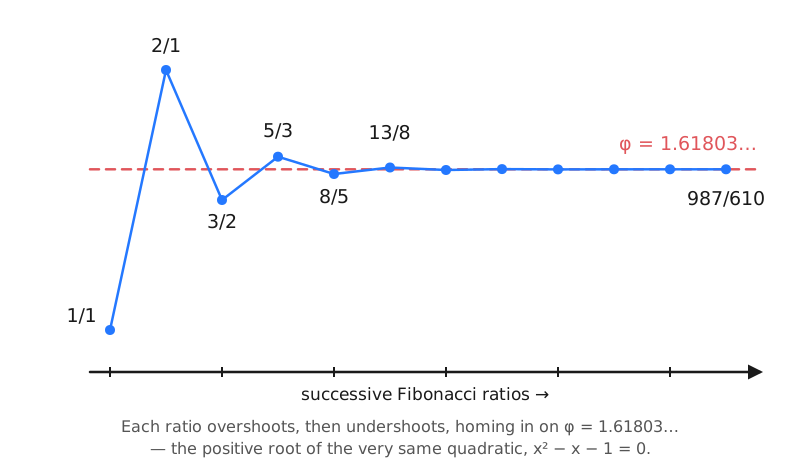
This is no coincidence. If the ratio of consecutive terms settles down to some limit , then dividing the rule through by gives — which rearranges to . The same quadratic as the rectangle. Verdict: genuine.
The most honest natural appearance of φ is phyllotaxis — how plants place seeds and leaves. A sunflower adds each new seed at a fixed angle around the centre, and the angle that packs seeds most evenly is the golden angle, . The reason is that φ is, in a precise sense, the hardest number to approximate by fractions — so seeds placed at the golden angle never line up into wasteful spokes. A visible consequence: the spirals you can count on a sunflower head come in consecutive Fibonacci pairs, typically 34 and 55, or 55 and 89. Honesty demands a caveat: when a 2016 citizen-science project measured 657 real sunflowers, roughly one in five deviated from perfect Fibonacci structure [3]. Nature uses φ as engineering, not mysticism — just as bees use hexagons, a claim we put on trial too.
The prosecution calls its witnesses
Now for the famous claims, against the evidence — most of it assembled in Markowsky's classic takedown [1].
The Parthenon. There is no documentary evidence that its architects used φ; a "golden rectangle" appears only if you cherry-pick what to include (steps? pediment? just the columns?), and measured width-to-height ratios come out nearer 1.7. Nobody even called the ratio "golden" until 1835.
The Mona Lisa. Nothing in Leonardo's notebooks connects φ to the painting; the rectangles you see online are drawn on afterwards, wherever they fit. Leonardo did illustrate Pacioli's 1509 De divina proportione — with drawings of polyhedra, not paintings.
The nautilus shell. It really is a logarithmic spiral — but not the golden one. A golden spiral widens by a factor of every quarter turn; measured nautilus shells widen by about per quarter turn [2]. Per full turn that is a factor of about 3.1 versus φ's 6.85 — not even close.
Credit cards. The standard card is mm, a ratio of — about 2% short of φ. Close-ish, but the dimensions come from a practical ISO standard, and "roughly 1.6" is precisely what φ is not about: its defining property is exact self-similarity.
Verdict: guilty of being beautiful
φ is guilty of being beautiful mathematics and innocent of most charges filed on its behalf. The quadratic, the Fibonacci convergence and the sunflower packing are real and provable. The Parthenon, the Mona Lisa, the nautilus and your debit card are retrofitted folklore: measure them and you get 1.7, or 1.33, or 1.586 — anything but exactly . A claim repeated everywhere is still not evidence. Bring a ruler.
References:
[1] George Markowsky, "Misconceptions about the Golden Ratio," The College Mathematics Journal 23, no. 1 (1992).
[2] Clement Falbo, "The Golden Ratio — A Contrary Viewpoint," The College Mathematics Journal 36, no. 2 (2005).
[3] Jonathan Swinton and Erinma Ochu, "Novel Fibonacci and non-Fibonacci structure in the sunflower: results of a citizen science experiment," Royal Society Open Science 3 (2016).
Note: "Deviates from φ" here means deviates beyond measurement error; a logarithmic spiral can resemble a golden spiral to the eye while growing at a very different rate, which is exactly how the nautilus myth survives.