
On the evening of 18 August 1913, the roulette ball at the Casino de Monte-Carlo landed on black 26 times in a row — and the casino made a fortune. Not from the streak itself, but from what the crowd believed about it. From around the fifteenth black, gamblers piled ever-larger bets on red, certain that the wheel owed them: after so much black, red was surely "due". It wasn't. Millions of francs crossed the table into the casino's vault [1], and the episode gave its name to one of the most expensive mistakes in probability: the gambler's fallacy. In this paper we compute just how freakish that streak was — and then show why, remarkably, that has no bearing at all on the next spin.
One in 137 million
How rare is a run of 26 blacks? A European wheel has 37 pockets — 18 black, 18 red, 1 green zero — so each spin lands black with probability . Spins are independent, so we multiply:
About 1 in 137 million — rarer even than the same streak from a fair coin (, about 1 in 67 million), because the green zero makes each black slightly less likely than an even chance. The gamblers were right that they were witnessing something extraordinary. Their mistake was what they concluded from it.
Nobody at the table had bet on a 26-black streak in advance. By the time the crowd gathered, 25 blacks had already happened — and the only live question was the next spin. That is a conditional probability, and independence answers it instantly:
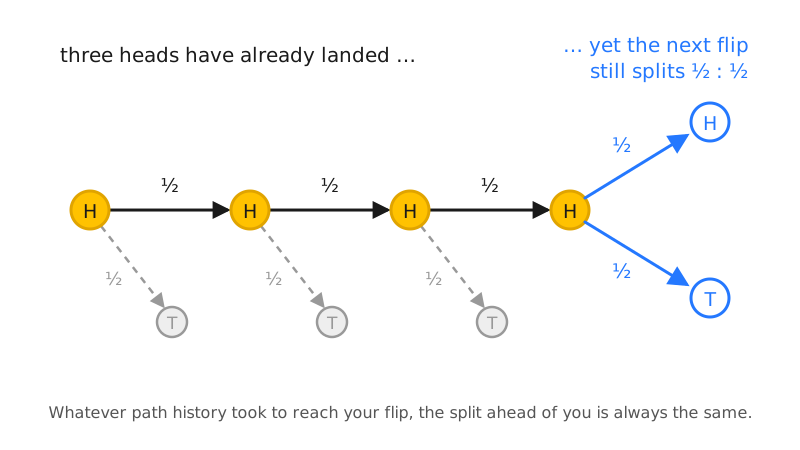
Exactly what it always is. The 1-in-137-million figure describes the whole sequence seen from the start; once 25 blacks sit in the past, they cost nothing more — the astonishing part has already happened for free. The wheel is a lump of wood and metal in equilibrium: it holds no ledger of past results, no spring wound tighter with every black, no mechanism by which spin 25 could lean on spin 26. Betting that red had become likelier was betting that the ball remembers — as wrong after 25 blacks as after one. The tree below makes the point with a coin: whichever branch history took to reach your flip, the split ahead of you is always the same.
But doesn't it all even out?
The fallacy survives because it impersonates a true theorem. The law of large numbers really does say that over many spins, the proportion of blacks converges to . Gamblers hear that as: a surplus of blacks must be repaid by a surplus of reds. But the law works by dilution, not correction.
Follow the 26-spin surplus forward. Every future spin is still black with probability , so those 26 extra blacks are never "paid back" — in expectation the surplus persists forever. It is simply swamped. After 1,000 further spins the expected proportion of blacks is just under 50%; after 10,000 it is 48.8% — sliding towards 48.6% not because red ever caught up, but because 26 becomes a rounding error in a denominator of thousands. There is no "law of averages" standing behind the wheel settling debts; the counts are free to drift apart forever while the percentages quietly converge. (The casino, whose edge is a percentage of turnover, is perfectly content with this arrangement — as we show in our tour of doomed betting systems.)
What the streak actually changed
The streak of 1913 was a genuine 1-in-137-million event, and it left the odds of the next spin exactly untouched: black, red, zero, as always. The gamblers lost fortunes betting against independence — and psychologists have since shown the instinct is universal: we expect random sequences to self-correct far sooner and far harder than they ever do [2]. One honest caveat: the story of that night reaches us through later retellings [1], and details like the exact count of 26 cannot be checked against surviving casino records. The mathematics, however, needs no archive — whatever happened in Monte Carlo, the wheel had no memory of it by the very next spin.
References:
[1] Darrell Huff and Irving Geis, How to Take a Chance (W. W. Norton, New York, 1959).
[2] Amos Tversky and Daniel Kahneman, "Judgment under Uncertainty: Heuristics and Biases," Science 185 (1974), 1124–1131.
Note: Probabilities assume an unbiased single-zero wheel with independent spins. A physically biased wheel would make streaks more likely to continue, not less — the exact opposite of what the fallacy predicts.