
Squeeze the Earth to the size of a marble — about 9 millimetres across — and it becomes a black hole. The Sun needs squeezing to a radius of 3 km; the giant at the centre of our galaxy already commands a boundary 12 million kilometres wide. What is remarkable is not just these numbers, but where they come from: the same single line of algebra that launches rockets. In an earlier article we derived the Earth's escape velocity of 11.2 km/s. In this paper we take that one equation on the longest journey in physics: from a thought-experiment cannon on a mountaintop, across every world in the solar system, and all the way down a collapsing star — arriving, 131 years before Einstein, at the exact radius of a black hole. Everything we need is energy conservation and a square root.
I. The cannon on the mountain
Newton opens his System of the World [1] with the best thought experiment in mechanics. Put a cannon on an impossibly tall mountain and fire horizontally. Fire gently, and the ball arcs to the ground. Fire harder, and it lands further away — the Earth's surface, being curved, keeps falling away from under it. Fire at about 7.9 km/s and something magical happens: the ground curves away exactly as fast as the ball falls. The ball never lands. It is in orbit — falling forever, missing forever.
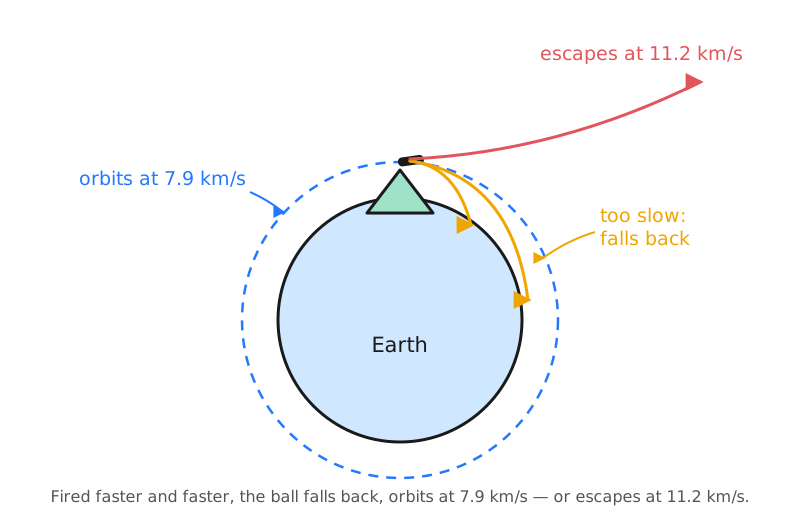
But orbit is not the end of the story. Fire harder still and the circle stretches into an ever-longer ellipse — until, past one final threshold, the path opens up and the ball simply leaves, slowing forever but never stopping, never returning. That threshold is the escape velocity, and Newton's picture already contains the two questions this paper answers: how fast is it, and what happens on a world where the answer is faster than light?
II. One line of energy, two dials
Two ingredients, one line each:
- Kinetic energy: a mass at speed carries .
- Gravitational potential energy: climbing from the surface of a world of mass and radius all the way out of its gravity costs , where N m²/kg² is the gravitational constant. (Unlike the school formula , this one accounts for gravity weakening with distance — that is why the cost of an infinite climb is a finite number.)
Escaping means just barely making it to infinity, arriving with an empty tank. So we launch with kinetic energy exactly equal to the cost of the climb:
The mass of the escaping object cancels — pebble, rocket or photon-cannonball, the threshold is the same — and:
One equation, two dials: pile on mass , or shrink the radius , and the exit speed climbs. Keep your eye on that second dial — it is the one that leads somewhere strange.
III. A tour of the solar system
Let us spin the first dial and take the formula sightseeing, using NASA's fact-sheet values for mass and radius [2].
The Moon ( kg, km): the formula gives km/s — gentle enough that the Apollo crews left in a flimsy ascent module with one small engine.
The Earth ( kg, km): km/s, the number every deep-space mission must buy with fuel, derived step by step in the original article. (The here is a number we weighed for ourselves in another article.)
Jupiter ( kg, km): 318 times Earth's mass but only 11 times its radius, so
The Sun ( kg, km): the same arithmetic gives km/s — 0.2% of the speed of light, from the surface of an ordinary star.
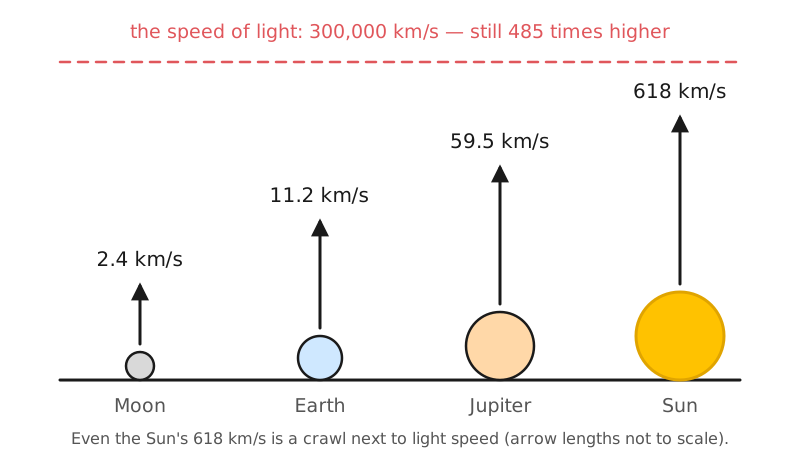
Notice the trend: bigger, denser, deeper gravity wells — and each step up the ladder is still nothing compared to km/s. Light outruns the Sun's gravity five hundred times over. To trap light, we need the other dial.
IV. Set v = c, and the lights go out
Here is the boldest move in the paper, and it is pure GCSE algebra. Ask: how small would a world of mass have to be for its escape velocity to reach the speed of light? Set and solve for :
This radius has a name: the Schwarzschild radius, the size of a black hole's event horizon in general relativity. Our Newtonian cannonball algebra has landed exactly on it. Plug in the residents of this paper:
- Earth: mm — a marble.
- The Sun: km — a village, holding the mass of 333,000 Earths.
- Sagittarius A*, the black hole at the centre of the Milky Way, measured at about 4.15 million solar masses by the Nobel-winning GRAVITY observations [3]: million km — 18 times the radius of the Sun, about a fifth of the way out to Mercury's orbit.
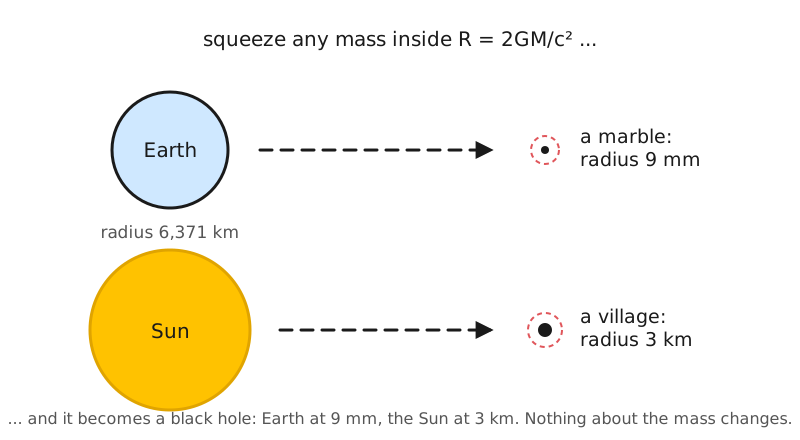
Nothing about the mass makes a black hole — Earth-mass black holes are allowed. What makes a black hole is compression: fitting the mass inside its own Schwarzschild radius. The Earth misses its target by a factor of 700 million; a collapsing stellar core, crushed by its own gravity once its fuel runs out, does not miss.
V. The clergyman who saw it coming
Here the history outruns the physics textbooks. In 1784, the English clergyman and polymath John Michell ran essentially this argument in a letter to the Royal Society [4]. Treating light as Newton did — tiny corpuscles launched at speed — he asked when a star's escape velocity would exceed it, and computed that a star with the Sun's density but 500 times its diameter would trap its own light. (Run our formula: at constant density, grows in proportion to , and km/s — Michell's round 500 was astonishingly close.) He even proposed detecting such dark stars by watching luminous companions orbit an invisible partner — which is, give or take a century of instrumentation, exactly how Sagittarius A* was found. Pierre-Simon Laplace published the same speculation independently in 1796. Then the wave theory of light triumphed, corpuscles fell from fashion, and the dark star was quietly forgotten for over a century.
VI. Right answer, wrong reasons
Now the honest reckoning, because our derivation is hiding a miracle. Newtonian light would behave nothing like real light: Michell's corpuscles would slow down as they climbed, like any cannonball — a dark star would be a fountain, launching light that rises, stalls and rains back down, faintly visible up close. Real light never slows; general relativity instead describes gravity as curved spacetime, in which — inside the horizon — there simply are no outward paths, at any speed. A black hole is not a strong fountain but a one-way door; even Newton's premise (light leaves the surface at and decelerates) is wrong from the first word.
So why does come out exactly right, when Karl Schwarzschild solved Einstein's equations in 1916? Partly deep structure — both theories are built around a gravitational potential energy, and the combination is the only dimensionless dial nature offers — and partly genuine luck: the general-relativistic factor works out to exactly 2, the same 2 that energy conservation put in front of . The Newtonian argument gets the light-bending angle near the Sun wrong by a factor of 2, so the clean agreement here is a coincidence of the particular question asked. We derived the right radius, for the wrong physics — a reminder to admire the algebra without trusting it past its warranty.
VII. One equation and a square root
One line — — carried us from a cannon on a mountaintop to the edge of the galaxy's central black hole: 2.4 km/s to leave the Moon, 11.2 for the Earth, 59.5 for Jupiter, 618 for the Sun, and, at the extreme where the ledger demands the speed of light, : 9 mm for Earth, 3 km for the Sun, 12 million km for Sagittarius A*. Our model's limits are real: Newtonian mechanics has no business near an event horizon, and the perfect agreement of that final formula is part structure, part fluke. But the story it tells is true, and told in the right order — Michell in 1784 and Laplace in 1796 predicted dark stars with exactly this algebra, and the universe, it turned out, had been building them all along. Not bad for one equation and a square root.
References:
[1] Isaac Newton, A Treatise of the System of the World (1728) — the source of the cannonball thought experiment.
[2] NASA planetary fact sheets: nssdc.gsfc.nasa.gov/planetary/factsheet
[3] GRAVITY Collaboration, "A geometric distance measurement to the Galactic center black hole with 0.3% uncertainty," Astronomy & Astrophysics 625, L10 (2019).
[4] John Michell, "On the Means of Discovering the Distance, Magnitude, &c. of the Fixed Stars," Philosophical Transactions of the Royal Society of London 74 (1784).
Note: All escape velocities are computed from each body's surface (the Sun's photosphere), ignoring rotation and atmospheres; Jupiter's uses its equatorial radius, matching the NASA fact-sheet convention.