
On average, your friends have more friends than you do. This is not a joke at your expense — it is a mathematical theorem about networks, published by the sociologist Scott Feld in 1991 [1], and it holds in any friendship network in which some people are more popular than others. Real measurements agree: in Feld's school-friendship data, and later in massive studies of social media, most users are less popular than their friends' average. In this paper we build a tiny village, count its friendships by hand, and watch the paradox appear.
A five-person village
Meet Zara, Amir, Bea, Chen and Dee. Their friendships (each one mutual) are: Zara–Amir, Zara–Bea, Zara–Chen, Zara–Dee, and Amir–Bea. That is five friendships in total. Counting each person's friends — their degree, in network language — gives:
- Zara: 4 friends
- Amir: 2 friends (Zara, Bea)
- Bea: 2 friends (Zara, Amir)
- Chen: 1 friend (Zara)
- Dee: 1 friend (Zara)
The average number of friends in the village is:
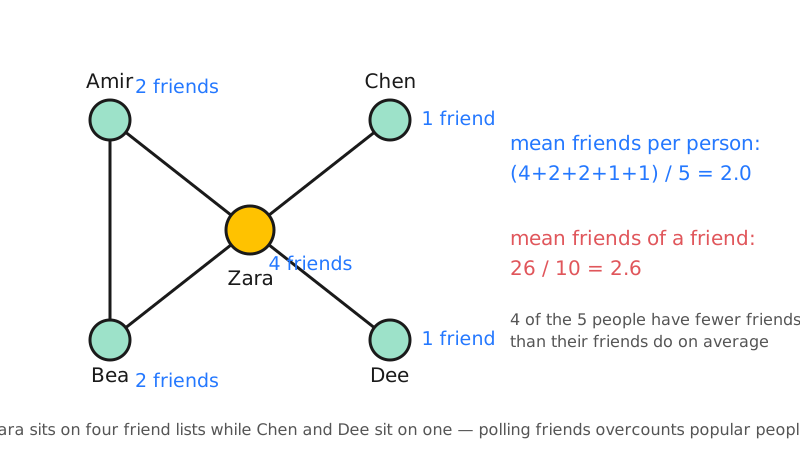
Here is the paradox-producing question: pick a person, pick one of their friends, and ask how many friends does the friend have? Each of the 5 friendships has two ends, so there are ways to point at "a friend of somebody". Let's list the friend's friend-count for all 10:
- Zara's four friends have 2, 2, 1, 1 friends — contributing .
- Amir's friends are Zara (4) and Bea (2) — contributing .
- Bea's friends are Zara (4) and Amir (2) — contributing .
- Chen's one friend is Zara — contributing .
- Dee's one friend is Zara — contributing .
The total is over 10 observations, so the average friend has:
The gap survives any way you slice it. If instead each person computes the average among their own friends, they get 1.5 (Zara), 3, 3, 4 and 4 — a mean of 3.1, and four of the five villagers are strictly less popular than their friends' average. Only Zara, the hub, beats her friends.
Why popular people get overcounted
Nothing mystical happened: the two averages ask different questions of different populations. The first samples people — everyone counted once. The second samples friendships — and a person with friends shows up on different friend lists. Zara, with 4 friends, was counted four times in that tally; Chen and Dee were counted once each. Popular people are systematically overcounted precisely because they are popular. In general, writing for each person's friend count, the average friend has
friends, where is the ordinary mean and is the variance of friend counts. In our village and , giving — exactly what our hand count found. Since , the friends' average can never be smaller than the ordinary average, with equality only in the eerie world where everyone has exactly the same number of friends.
Why this isn't about you
Your friends really do have more friends than you do, on average — not because of anything about you, but because averaging over friendships oversamples the very people who drag the average up. The bias is even useful: Christakis and Fowler monitored friends of randomly chosen students during a flu outbreak and detected the epidemic roughly two weeks earlier, because well-connected people catch things sooner [3]. One honest limitation: the theorem is about averages, not individuals — hubs like Zara do out-friend their friends. But since most of us are not hubs, the safest conclusion, as with the birthday paradox, is that when intuition and counting disagree, back the counting.
References:
[1] Scott L. Feld, "Why Your Friends Have More Friends Than You Do," American Journal of Sociology 96, no. 6 (1991).
[2] Steven Strogatz, "Friends You Can Count On," The New York Times, Opinionator (2012).
[3] Nicholas A. Christakis and James H. Fowler, "Social Network Sensors for Early Detection of Contagious Outbreaks," PLoS ONE 5, no. 9 (2010).
Note: The paradox concerns averages over a network; particular individuals (highly connected hubs) can and do have more friends than their friends' average.