
42 folds. Take an ordinary sheet of printer paper, about 0.1 mm thick, and imagine folding it in half again and again. By the seventh fold it is about as thick as your thumb. By the forty-second fold it would be roughly 439,800 km thick — comfortably past the Moon, which orbits at an average distance of 384,400 km [1]. This claim gets passed around endlessly online, usually with no working shown. In this paper we check it for ourselves, using nothing more than powers of 2 — and then we look honestly at why nobody will ever actually do it.
Every time you fold a sheet of paper in half, the number of layers doubles: 1 layer becomes 2, then 4, then 8. After folds there are layers, so the total thickness is
where is the thickness of a single sheet. We will take mm, a standard figure for 80 gsm printer paper — a ream of 500 sheets is about 5 cm tall, which works out to exactly this.
That is the whole model. The surprise is not in the maths but in how violently grows.
Climbing to the Moon, fold by fold
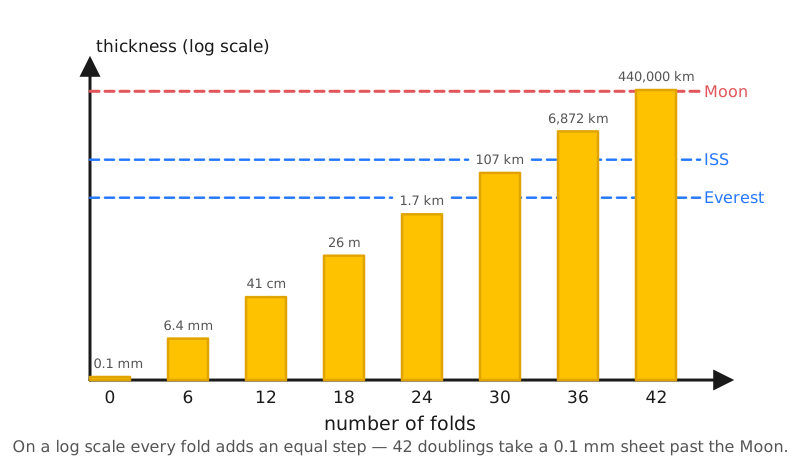
Let us walk up the milestones, computing each time:
- 7 folds: layers, so mm — about the thickness of your thumb.
- 10 folds: layers, so cm — a chunky paperback.
- 20 folds: m — taller than Big Ben.
- 27 folds: km — past Mount Everest (8.85 km) and past airliner cruising altitude.
- 30 folds: km — past the Kármán line, the conventional edge of space.
- 32 folds: km — past the International Space Station.
- 42 folds: layers, giving
That clears the Moon's average distance of 384,400 km with about 55,000 km to spare. Notice how close-run the finish is: at 41 folds we have only reached about 219,900 km — barely halfway. A single extra fold covers the remaining 165,000 km, because each fold adds as much thickness as all the previous folds combined: .
Why you can't actually do it
Try folding any sheet of paper and you will stall at around 7 folds. The reason is that folding halves the length as well as doubling the thickness, and every fold wastes some paper in the curved crease. In 2002, a Californian high-school student named Britney Gallivan analysed exactly how much. For a sheet folded repeatedly in the same direction, she derived the minimum length of paper (of thickness ) needed to survive folds [2]:
The formula told her that 12 folds of thin paper would need a sheet roughly a kilometre long — so she bought a 1.2 km roll of toilet paper and, after seven hours, set the world record of 12 folds. For our lunar sheet, the same formula with mm and demands a sheet about m long — roughly 107,000 light-years, about the diameter of the Milky Way. The Moon claim is mathematically sound but physically hopeless.
Why exponentials always win
The famous claim survives scrutiny: 42 doublings really do take a 0.1 mm sheet past the Moon, and the arithmetic fits on the back of the very sheet you would be folding. But it is a statement about exponential growth, not about origami — the creases defeat you around fold 7 or 8, and even a heroic, record-setting effort only reaches 12. The same doubling that makes the claim true is what makes it undoable: exponentials outrun every physical resource we can throw at them, a lesson that reappears when we count the ancestors in your family tree.
References:
[1] NASA, Moon Fact Sheet: https://nssdc.gsfc.nasa.gov/planetary/factsheet/moonfact.html
[2] Britney Gallivan, How to Fold Paper in Half Twelve Times: An "Impossible Challenge" Solved and Explained (Historical Society of Pomona Valley, 2002).
Note: This paper assumes an idealised sheet of uniform 0.1 mm thickness whose layers stack perfectly with no air gaps; real folded paper traps air and bulges, so a physical stack would be thicker still — not that anyone will ever check.