
All 8.1 billion of us, poured into Loch Ness, would fill about 7% of it. Squashed together into a single block, the entire human race would form a cube roughly metres on each side — and the loch could swallow about fourteen of those cubes.
Loch Ness famously holds more water than every lake in England and Wales combined [1], but "a lot of water" is vague, and "8.1 billion people" is unimaginable. In this paper we make both numbers concrete, using only three tools: the density formula, the volume of a cuboid, and standard form. Let's check the claim for ourselves.
How do you estimate the volume of a person? Measuring one directly is awkward, but there is a lovely trick: people just barely float in water. Floating means our average density is almost exactly the density of water, . So instead of measuring volume, we can measure mass — which we know very well — and use the density formula rearranged:
Here we have taken kg as a representative human mass — the global adult average is about kg [3], and using a round figure slightly above it roughly balances out heavier adults against children. So a person occupies about cubic metres, or litres: less than half a bathtub.
The UN estimates the world population at about billion people [2]. Multiplying:
Every human who has ever queued for a bus, all together, makes about half a cubic kilometre. To picture it, take the cube root:
A single cube about metres on each side would contain the whole of humanity. If numbers like "8.1 billion" refuse to feel real, we build up intuition for them in another article.
How big is Loch Ness?
Loch Ness is about km long, with a surface area of roughly and a mean depth of about m [1]. Volume is just area times average depth:
Now the comparison we came for:
Humanity fits with room to spare — about fourteen times over. There is one catch, though. Our tidy cube is m tall, but the loch is only m deep at its deepest point. As a cube, we would tower absurdly out of the water:
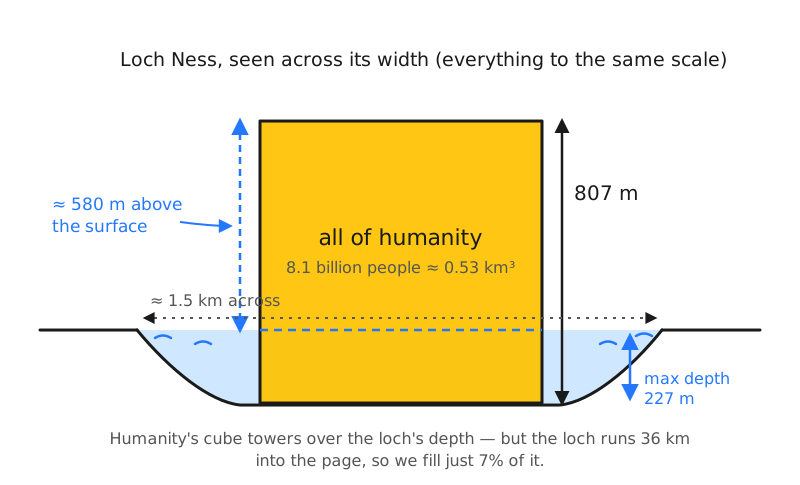
To actually fit, we would have to spread out along the loch's km length — at which point we would raise the water level by only
The entire human race, added to one Scottish lake, lifts it by about the height of a three-storey house.
Bodies are not liquid
Yes — every human on Earth fits inside Loch Ness, occupying only about 7% of its volume. We should be honest about the model, though. Bodies are not liquid: packed randomly like spheres we would fill space at perhaps efficiency, pushing our total to around — still only about of the loch. We have also, mercifully, ignored the question of anyone breathing. As a statement about volume, however, the claim survives scrutiny comfortably: humanity is tiny. One unremarkable lake in the Highlands out-volumes all of us fourteen times over — and nobody has even checked what else is in there.
References:
[1] Encyclopaedia Britannica, "Loch Ness": britannica.com/place/Loch-Ness
[2] United Nations, Department of Economic and Social Affairs, World Population Prospects 2024.
[3] Walpole, S. C. et al. "The weight of nations: an estimation of adult human biomass." BMC Public Health 12, 439 (2012).
Note: Published figures for the loch's mean depth vary between about 130 m and 140 m; the headline percentage is robust to this spread.