
11.2 kilometres per second. That is roughly 40,000 km/h — fast enough to fly from London to New York in about eight minutes. Throw anything upwards at that speed and it will never come back: not slow down and hover, not drift into orbit, but leave the Earth's gravity behind forever. Throw it even slightly slower and, eventually, it falls back down.
This threshold is called the escape velocity, and it is one of the most famous numbers in spaceflight. In this paper we derive it from scratch, using one law — conservation of energy — and a single line of A-level algebra.
Newton himself gave the best mental picture [1]. Imagine a cannon on an impossibly tall mountain, firing horizontally. Fire slowly and the ball arcs down and hits the ground. Fire faster and it lands further away. Fire fast enough — about 7.9 km/s — and the ground curves away beneath the ball as fast as it falls: the ball is in orbit, endlessly falling and endlessly missing. Fire faster still, and there is a final threshold beyond which the ball does not just miss the Earth — it leaves and never returns.
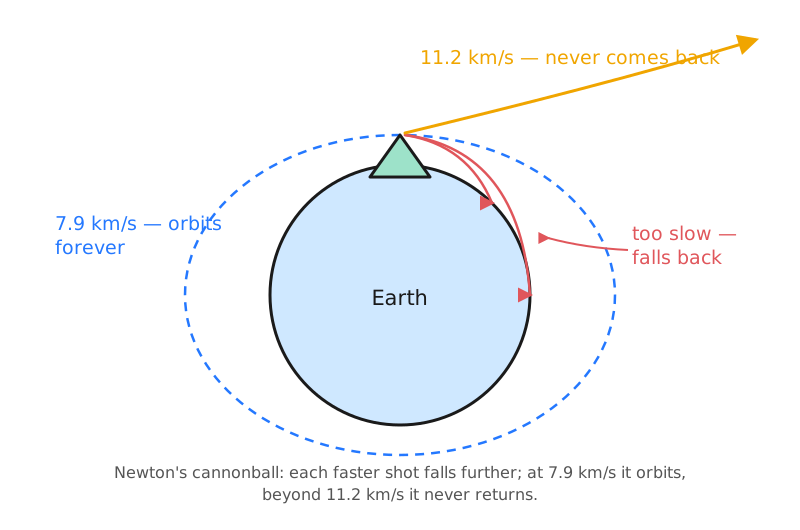
Why the mass cancels out
Two tools, one line each:
- Kinetic energy — the energy of motion: for a mass moving at speed .
- Gravitational potential energy — lifting a mass from the Earth's surface (radius , mass ) all the way out of the Earth's gravity entirely costs an energy of , where is the gravitational constant. (This comes from Newton's law of gravitation; unlike the familiar , it accounts for gravity weakening with distance.)
"Escaping" means just barely making it to infinity — arriving with nothing left in the tank. So we launch with kinetic energy exactly equal to the energy the climb will cost:
Now the magic step: the mass cancels from both sides.
The escape velocity does not depend on what is escaping. A pebble, a rocket, or a molecule of air — same threshold. (Heavier objects need more energy, but not more speed.)
We use , m, and kg — a number we derived from scratch in another article.
- Compute the top of the fraction:
- Divide by :
- Square root:
A pleasing shortcut: since , the formula collapses to , and m/s — the same answer using only two numbers you already know. Notice also that escape velocity is exactly times the orbital speed of Newton's cannonball.
From the Moon to black holes
The formula works for any world. For the Moon ( kg, km [2]):
Almost five times gentler than Earth — which is why the Apollo astronauts could leave the Moon in a fragile ascent module with a single small engine, while leaving Earth had required the 111-metre Saturn V.
Now run the formula the other way. What if a body were so dense that its escape velocity reached the speed of light, ? Setting and rearranging gives : squeeze the Earth to a radius of about 9 millimetres — a marble — and not even light could leave it. John Michell reasoned his way to such "dark stars" in 1784 [3]; today, via general relativity rather than this Newtonian shortcut (which happens to land on the same formula), we call them black holes.
What our derivation left out
One line of energy conservation gives km/s, matching the accepted value [2]. Two honest caveats. First, we ignored air resistance, which is very unkind to objects doing 11 km/s at sea level. Second, real rockets never actually travel at 11.2 km/s near the ground: escape velocity is the speed an unpowered projectile needs. A rocket that keeps its engines burning can leave Earth as slowly as it likes — it just pays for the privilege in fuel.
References:
[1] Isaac Newton, A Treatise of the System of the World (1728) — the source of the cannonball thought experiment.
[2] NASA planetary fact sheets: nssdc.gsfc.nasa.gov/planetary/factsheet
[3] John Michell, "On the Means of Discovering the Distance, Magnitude, &c. of the Fixed Stars," Philosophical Transactions of the Royal Society of London 74 (1784).
Note: Escape velocity here is computed from the Earth's surface, ignoring atmosphere and the Earth's rotation (which gifts an eastward launch about 0.46 km/s for free at the equator).