
Roughly 40,000 kilometres — measured with a stick, a well, and a long walk, 2,200 years before satellites. Around 240 BC, Eratosthenes of Cyrene, chief librarian at Alexandria, worked out the circumference of the entire planet without leaving Egypt. His method needs nothing beyond GCSE geometry: angles on parallel lines and a proportion. In this paper we retrace every step, check the arithmetic ourselves, and then look honestly at how close he really got.
A well, a shadow, and parallel rays
Eratosthenes had heard a curious report from Syene (modern-day Aswan, in southern Egypt): at noon on the summer solstice, sunlight reached the very bottom of a deep well, and a vertical stick cast no shadow at all. The Sun was directly overhead.
At the same moment in Alexandria, roughly due north of Syene, a vertical stick — a gnomon — most certainly did cast a shadow. Eratosthenes measured the angle between the stick and the Sun's rays and found it to be about [1].
Same Sun, same moment, two different shadows. That difference is not a curiosity — it is a direct consequence of standing on a curved surface, and it contains enough information to measure the whole Earth.
The Sun is so far away that its rays arrive at Earth effectively parallel (the same fact we lean on in our article on the Sun's energy). Now the key insight. A vertical stick points directly away from the Earth's centre — extend it downwards and it passes straight through the centre. So the stick at Alexandria and the stick at Syene are not parallel to each other; they splay apart by exactly the angle between the two cities as seen from the Earth's centre.
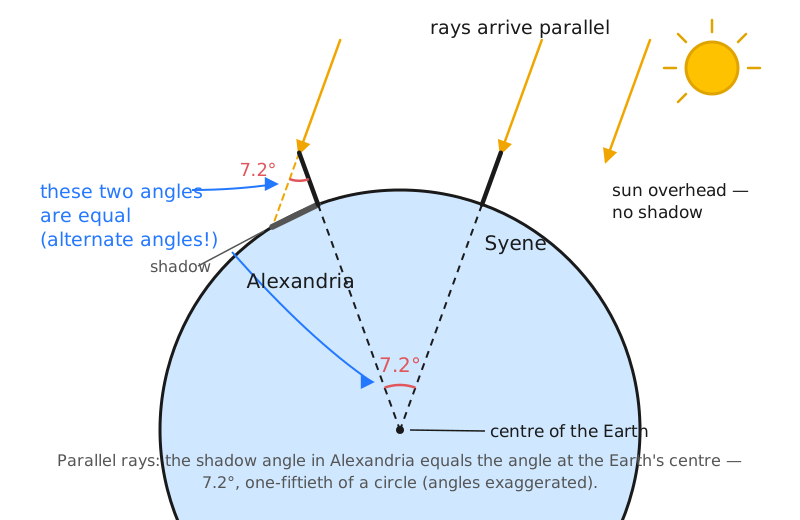
Treat the Syene ray (which continues through to the Earth's centre) as a line crossing two others: the Alexandria stick's extension and the Alexandria ray. Because the two rays are parallel, alternate angles tell us:
A shadow you can measure with your hands has just told you an angle at the centre of the planet, 6,000 km beneath your feet.
One-fiftieth of the planet
The rest is one line of arithmetic. The arc from Alexandria to Syene subtends of the full circle:
So the distance between the cities is one-fiftieth of the Earth's circumference. That distance was reckoned — by professional pacers and camel-caravan timings — at about stadia [1]. Therefore:
And here is where honesty matters. How long is a stadion? Nobody is quite sure which one Eratosthenes used, and the candidates disagree:
- Egyptian stadion, about m: km — within 2% of the true polar circumference of km [2].
- Attic stadion, about m: km — about 16% too big.
The popular story quotes the 2% figure; the fair statement is "somewhere between 2% and 16%, depending on a unit we can't pin down."
How close he really got
With a stick, a well, and the fraction , Eratosthenes measured the planet to within perhaps 2%, and at worst 16% — a staggering result either way for 240 BC. Honesty also compels us to note his luck: Syene is not exactly on the Tropic of Cancer, it is not exactly due south of Alexandria, and 5,000 stadia was a round estimate — yet these errors partly cancelled. The method, though, is flawless, and it still works: repeat it today with a friend in another city, two sticks and a sunny solstice, and you can measure the Earth yourself. Once you have the radius that falls out of it, a whole family of questions opens up — like how far away the horizon is.
References:
[1] Cleomedes, On the Circular Motions of the Celestial Bodies — the principal surviving ancient account of Eratosthenes' method.
[2] Nicholas Nicastro, Circumference: Eratosthenes and the Ancient Quest to Measure the Globe (St. Martin's Press, New York, 2008).
Note: Ancient sources also report the rounder figure of 252,000 stadia, possibly adjusted by Eratosthenes himself for divisibility; the reconstruction above uses the simpler 250,000-stadia version of the calculation.