
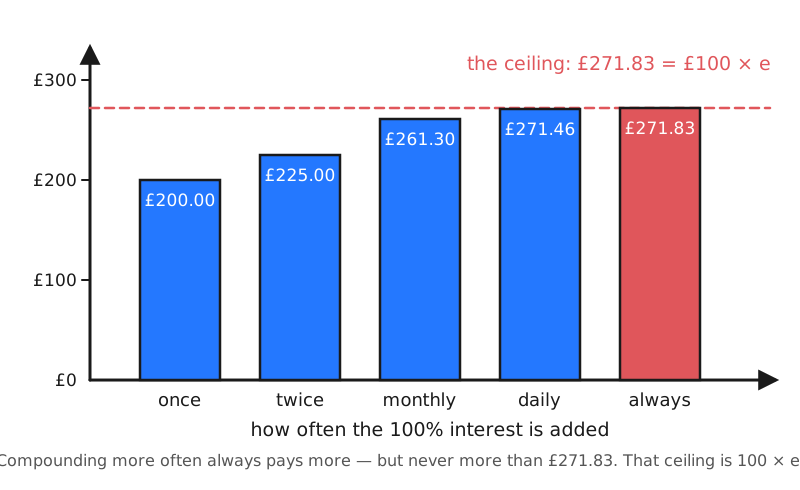
Put £100 in a bank paying 100% interest a year, and insist they compound it as often as physically possible — every month, every second, every nanosecond — and you will finish the year with £271.83. Not a penny more. Infinite greed, finite reward.
That ceiling is £100 times , a number nobody invented on purpose. It fell out of a genuinely mercenary question that Jacob Bernoulli asked in 1683, and in this paper we will ask it ourselves and watch climb out of the arithmetic. Then we will watch the same constant reappear in radioactive decay, in a cooling cup of coffee, in the rule bankers use to estimate doubling times — and finally in a cloakroom full of lost hats, a problem with no money, no interest and no growth in it whatsoever. Everything we need is GCSE arithmetic plus one idea from A-level: the gradient of a curve.
I. Bernoulli's bank hits a wall
Deposit £1 at 100% interest per year. After a year you have £2. So far, so dull.
Now persuade the bank to pay you half-yearly instead: 50% at six months, 50% at twelve. This is not the same deal, because the interest earned in the first half-year then earns interest of its own:
Twenty-five pence of free money, conjured out of nothing but a change of bookkeeping. Naturally we get greedy. Chop the year into equal slices, each paying of 100%, and each slice multiplies your money by :
Let us just compute it. Every figure below is that one formula with a different :
| compounded | £1 becomes | |
|---|---|---|
| yearly | 1 | £2.000000 |
| half-yearly | 2 | £2.250000 |
| quarterly | 4 | £2.441406 |
| monthly | 12 | £2.613035 |
| weekly | 52 | £2.692597 |
| daily | 365 | £2.714567 |
| hourly | 8,760 | £2.718127 |
| every second | 31,536,000 | £2.718282 |
The pattern is the point. Going from yearly to half-yearly bought us 25p. Going from hourly to every-second buys us less than a fiftieth of a penny. The sequence keeps climbing, but it is climbing into a wall.
Bernoulli found that wall in 1683 and proved it was real — he showed the value is trapped strictly between 2 and 3 — but he could not pin down what it was. This was, as far as anyone knows, the first time in history a number was defined as the limiting value of an expression rather than built by arithmetic or drawn in geometry. It took another 65 years and Leonhard Euler to give it a name. In his Introductio in analysin infinitorum of 1748, the symbol went into print:
The repeated 1828 is a coincidence, and a cruel one — it does not continue. is irrational; the digits never settle into a pattern.
II. The rate you actually get
Real banks, sadly, do not offer 100%. So generalise: principal , annual rate , compounded times a year, for years:
To let run to infinity, substitute , so that and the exponent becomes :
As so does , and the bracket is exactly Bernoulli's expression. It becomes , leaving the formula every finance textbook opens with:
So how much is continuous compounding actually worth? Take a 5% headline rate and compute the effective annual rate — what your money really grows by over a year:
- credited once a year: 5.0000%
- credited monthly: 5.1162%
- credited daily: 5.1267%
- credited continuously: 5.1271%
Monthly compounding already captures all but about a hundredth of a percentage point of the theoretical maximum. The interesting gap is not between monthly and continuous — it is between once and monthly, and that gap is why the law forces lenders to advertise an AER (savings) or APR (borrowing): the effective rate with the compounding folded back in.
Run it in the other direction and it stops being cute. A credit card advertising 19.9% a year, charged monthly is really charging
That 1.9-point gap between the poster and the reality is the same compounding effect we were cheerfully harvesting a moment ago, working for the bank instead of for you. Over long stretches it is not trivial either: £1,000 at 5% for 30 years is £4,321.94 compounded annually but £4,481.69 compounded continuously — £160 of difference produced by nothing but a timing convention.
III. Why is everywhere
Here is the fact that promotes from a banking curiosity to one of the load-bearing numbers of science.
Differentiate and you do not get back — you get . Differentiate and you get . Every exponential curve has a gradient proportional to its own height, but each drags along an awkward fudge factor. As we slide the base from 2 up to 3 that factor slides from past to , so somewhere in between there is a base where the fudge factor is exactly . That base is :
is the only function (apart from the trivial ) that is its own derivative. At every single point, the steepness of the curve equals its height.
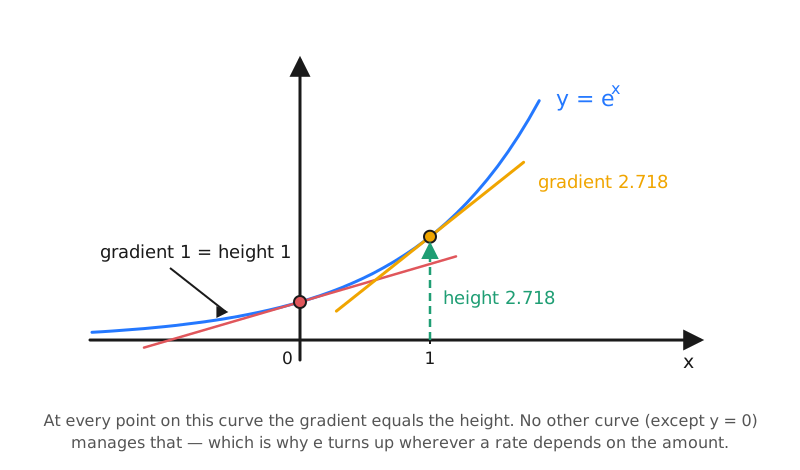
Why does that matter? Because an enormous number of real processes obey the same sentence: the rate of change is proportional to how much there is. Twice as much radioactive material means twice as many decays per second. Twice as hot a cup of coffee (above room temperature) loses heat twice as fast — that is Newton's law of cooling. Twice as much charge on a capacitor drives twice the current out of it. Twice as many rabbits make twice as many baby rabbits. In symbols, all of them say
and the only function that solves this is — because it is the only function whose gradient is a multiple of itself. Positive gives growth, negative gives decay. Bernoulli's bank was just the first place anyone happened to notice.
Two quick worked examples. Carbon-14 has a half-life of 5,730 years, so its decay constant is per year. A bone 10,000 years old therefore retains — about 29.8% — of its original carbon-14. Coffee at 90°C in a 20°C room, measured at 60°C after ten minutes, has ; after half an hour it is down to 33.1°C, which is roughly the moment you should have drunk it.
IV. The rule of 72 is really 69.3
Every investor knows the shortcut: divide 72 by the interest rate and you get the doubling time. At 6%, money doubles in 12 years. Where does 72 come from? Not, it turns out, from the maths.
Do the maths honestly. Under continuous compounding, doubling means
And . Expressing the rate as a percentage (so ) gives
The rule of 69.3. So why does every textbook say 72? Two reasons, and only one of them is mathematical.
The honest mathematical reason: real accounts compound in discrete steps, not continuously, so real doubling is a little slower than and the number wants nudging upward. The much bigger reason is that 72 is divisible by 1, 2, 3, 4, 6, 8, 9, 12, 18, 24 and 36, whereas 69.3 divides tidily by essentially nothing. The rule of 72 is a mental-arithmetic decision wearing a mathematical costume.
How much does the costume cost? Compare against the exact annual answer :
| rate | exact | rule of 72 | rule of 69.3 |
|---|---|---|---|
| 2% | 35.00 yrs | 36.00 | 34.65 |
| 4% | 17.67 yrs | 18.00 | 17.33 |
| 6% | 11.90 yrs | 12.00 | 11.55 |
| 8% | 9.01 yrs | 9.00 | 8.66 |
| 12% | 6.12 yrs | 6.00 | 5.78 |
| 20% | 3.80 yrs | 3.60 | 3.47 |
| 25% | 3.11 yrs | 2.88 | 2.77 |
At 8% the rule of 72 is astonishing — 9.000 against a true 9.007. That is no accident: 72 is calibrated for the 6–10% band, exactly the range of a long-run stock market return or a mortgage. Outside that band it drifts, and it drifts in a predictable direction: it is 2.8% too pessimistic at 2%, and 5.3% too optimistic at 20%, and 7.3% too optimistic on 25% credit card debt (2.88 years against a real 3.11). Note also that 69.3 is not simply the better rule — it is exact for continuous compounding but consistently too fast for annual compounding, undershooting at every rate in the table. Use 72 for investments, and know that it is a compromise, not a theorem.
V. The cloakroom where turns up
Now for the twist, and the reason deserves its reputation.
A cloakroom takes in the hats of people. The attendant drops the tickets in a puddle and, rather than admit it, hands the hats back in a completely random order. What is the probability that nobody gets their own hat?
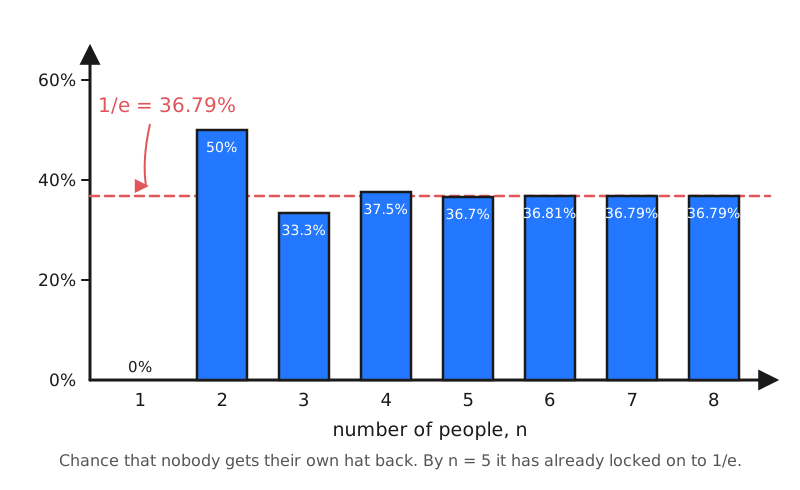
Intuition offers two confident answers and both are wrong. With more people there are more chances for someone to get lucky, so surely the probability drifts to 0? Or: with more people each individual is less likely to be matched, so surely it drifts to 1? Instead it does something far stranger. We can settle it exactly for small by brute force — listing every possible way the hats can be handed out and counting the arrangements in which no one is matched (these are called derangements):
| arrangements | derangements | probability | |
|---|---|---|---|
| 2 | 2 | 1 | 0.500000 |
| 3 | 6 | 2 | 0.333333 |
| 4 | 24 | 9 | 0.375000 |
| 5 | 120 | 44 | 0.366667 |
| 6 | 720 | 265 | 0.368056 |
| 7 | 5,040 | 1,854 | 0.367857 |
| 8 | 40,320 | 14,833 | 0.367882 |
It parks. By five people it has already locked on to roughly 36.8% and it simply refuses to move again.
Counting the derangements properly uses the inclusion–exclusion principle: start with all arrangements, subtract those where person 1 is matched, and person 2, and so on; then add back the ones you subtracted twice (where two people are matched), subtract the triples, and continue. When the dust settles, the probability that nobody is matched is
And now look at the series that Euler gave for , evaluated at :
They are the same series. is simply chopped off after terms — and because explodes, the chopping barely matters: by the two agree to five decimal places. So
Sit with that. No bank. No interest. No growth, no compounding, no time passing at all — just people, hats and bad luck. And out comes the same constant we squeezed out of Bernoulli's greedy savings account. That is what mathematicians mean when they call a constant fundamental: it is not about money, it is about a shape that money happens to have.
If feels familiar, it should. It is also the answer to the secretary problem — interview 37% of the candidates, reject them all, then hire the next one who beats them — where it arrives from yet another unrelated direction.
VI. Every exponential is an opening act
Bernoulli's £100 really does stop at £271.83, and really is the ceiling on compounding. But we should be honest about what our models are doing.
Continuous compounding is an idealisation. No bank credits interest at 3am on a Tuesday, and money comes in whole pence, so is a smooth fiction painted over a staircase. It is a useful fiction — at 5% it differs from monthly compounding by a hundredth of a percentage point — but it is a fiction, and the fact that the limit is so nearly reached by month twelve is precisely why nobody loses sleep over it.
The larger caveat is exponential growth itself. The equation says the growth rate depends on the amount and on nothing else — no food supply, no floor space, no shortage of customers, no limit to the world. Nothing real obeys that for long. Rabbits eat all the grass; savings accounts cut their rates; an epidemic runs out of people left to infect, which is exactly why the honest model there is the logistic curve — exponential at the start, then bending over into a plateau (we chase that curve in the maths of epidemics). Every exponential in nature is really the opening act of an S-shape.
Which is a fitting note to end on, because the very first thing ever taught anybody was that greed has a ceiling. Compound as often as you like. The answer is still £271.83.
References:
[1] Jacob Bernoulli, investigation of continuously compounded interest (1683), published in Acta Eruditorum (Leipzig, 1690) — the first known instance of a number being defined as the limit of an expression.
[2] Leonhard Euler, Introductio in analysin infinitorum (Lausanne, 1748) — the work that put the symbol into print and computed its value to more than twenty decimal places.
[3] Eli Maor, e: The Story of a Number (Princeton University Press, Princeton, 1994).
Note: All figures here were computed directly from the formulas given, and the derangement counts for were confirmed by exhaustive enumeration of all arrangements. Real accounts round to the penny, apply tax, and change their rates; treat every pound figure as the model's answer rather than a statement about any actual bank.