
384,400 km. That is the average distance from the Earth to the Moon — about thirty Earths placed side by side, or roughly ten times around the equator. Today we measure it to millimetre precision by bouncing lasers off reflectors left behind by the Apollo missions [1]. But you do not need a laser. In this paper we will derive the distance using GCSE geometry — similar triangles and one small angle — and then check the answer with a coin.
Distance = size ÷ angular size
Hold your thumb at arm's length and it covers a door on the far side of the room. Your thumb is not the size of a door — it just takes up the same angle at your eye. That angle is called the angular size of an object, and it obeys a beautifully simple rule.
Recall how radians work: an arc of a circle of radius subtending an angle (in radians) has length . For small angles, a flat object of width at distance is almost indistinguishable from such an arc, so
In words: distance = actual size ÷ angular size. If we know how wide the Moon really is, and we measure the angle it takes up in the sky, the distance falls straight out.
The Moon's diameter is km [1], and averaged over its orbit it subtends an angle of about — almost exactly half a degree.
- Convert the angle to radians (multiply by ):
- Divide size by angle:
That is within half a percent of the true average of km. (The Moon's orbit is an ellipse, so the real distance swings between about 357,000 and 407,000 km through the month — which is why is only an average, and why some full moons look slightly bigger than others.)
Check it with a coin
Notice what our formula says when we flip it around: the ratio of distance to diameter is
The Moon sits about 110 of its own diameters away. By similar triangles, any disc held 110 of its own diameters from your eye will exactly cover it.
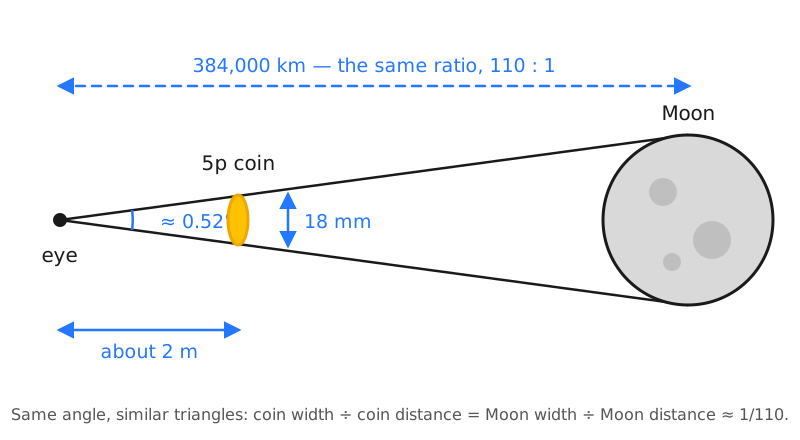
A British five pence coin is 18.0 mm across [2], so it should cover the Moon from a distance of m — call it 2 metres. Here we must be honest: that is further than an arm. Popular versions of this trick say "a coin at arm's length covers the Moon", and our calculation shows that is false — at a true arm's length of about 70 cm, an object needs to be only mm wide, roughly a pea. To do the experiment properly, tape a 5p to a window, stand two metres back, and watch it eclipse the full Moon. If the coin covers it with room to spare, you are standing too close.
The deeper point: the Moon looks enormous, but it occupies a tiny angle. Your little fingernail at arm's length covers it easily.
Around 270 BC, Aristarchus of Samos found the distance with no coin and no known diameter — he used a lunar eclipse [3]. Watching the Moon cross the Earth's shadow, he could see that the shadow was roughly 2.5 Moon-widths across, and from this scale of shadow-to-Moon he deduced, with geometry not far beyond this paper's, that the Moon lies about 60 Earth radii away. Using the modern figure of 60.3 Earth radii:
His method needed the Earth's radius as an input — a number his contemporary Eratosthenes measured with shadows and a well, as we retrace in another article. Two Greeks, no telescopes, and between them the scale of the Earth–Moon system.
Why the approximation barely matters
From one measured angle and a known diameter, we derived km — within 0.5% of the laser-ranged value of 384,400 km. Our model assumes the Moon's angular size is measured at its average distance and uses the small-angle approximation, but at half a degree the error from that approximation is less than one part in 100,000 — far smaller than our rounding. The result is well within reach of anyone with a protractor, a clear night, and a five pence piece.
References:
[1] NASA Moon Fact Sheet: nssdc.gsfc.nasa.gov/planetary/factsheet/moonfact.html
[2] The Royal Mint, five pence coin specifications: royalmint.com
[3] Thomas Heath, Aristarchus of Samos, the Ancient Copernicus (Oxford University Press, 1913).
Note: Distances quoted are centre-to-centre averages; the Moon's elliptical orbit varies them by around ±6% over a month.