
About 4.7 kilometres. That is how far away the horizon is when you stand on a beach and look out to sea. It feels like the edge of the world should be further — but the Earth curves away from you surprisingly quickly, and with one right-angled triangle and Pythagoras' theorem we can work out exactly where your view runs out. Let's derive it for ourselves.
The geometry: one tangent line
Your line of sight to the horizon is the line that just grazes the Earth's surface — in the language of circle theorems, a tangent. And a tangent to a circle meets the radius at the point of contact at exactly . That single fact hands us a right-angled triangle:
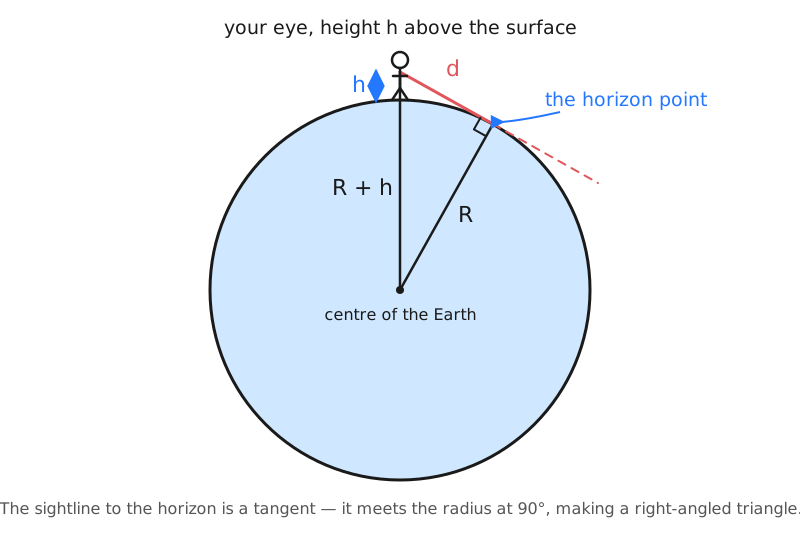
The three sides are: the Earth's radius out to the horizon point, your sightline of length , and the hypotenuse from the Earth's centre up to your eye, of length , where is the height of your eye above the surface. Pythagoras' theorem then says:
Solving for and expanding the bracket:
Now for a lovely simplification. Because is tiny compared with , the term is negligible: for a person with eye height m, is about 21.7 million m², while is just 2.9 m². Dropping it:
One radius, one height, one square root.
We take m [1] and work in metres throughout.
- Standing on the beach, eye height m:
- On a 100 m cliff top:
- From a plane cruising at 11,000 m:
(Even at aeroplane height our approximation holds up: the exact formula gives 374.5 km, a difference of only 0.04%.) Notice the square root at work: multiplying your height by 4 only doubles your view. That is exactly why sailors climbed to the crow's nest — every metre of mast bought a disproportionately useful amount of extra horizon.
The same geometry explains a phenomenon observed for millennia. A ship sailing away doesn't shrink to a dot and fade — it sinks below the horizon, hull first, while the masts stay visible longest. Once the ship passes your tangent point, the bulge of the Earth stands between your eye and the ship's waterline, but the taller parts still poke above your grazing sightline:
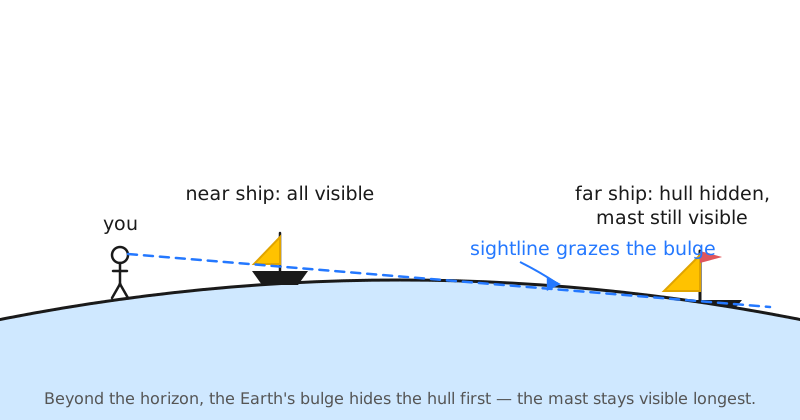
Long before satellites, this was everyday evidence that the sea is curved — the very curvature that a stick in Alexandria measured 2,200 years ago.
What the atmosphere adds
With one circle theorem and Pythagoras, we found : about 4.7 km from the beach, 36 km from a 100 m cliff, and 374 km from a cruising aeroplane. Our model is honest but simplified. Real air bends light: the atmosphere's density gradient refracts your sightline slightly around the curve, extending the visible horizon by roughly 8% under standard conditions — navigators' handbooks bake this correction into their tables [2]. We have also ignored waves, tides and the Earth's slight squashedness. Still, next time you're at the beach, you can point at the horizon and say precisely how far you're looking — and know the square root that put it there.
References:
[1] NASA Goddard Space Flight Center: Earth Fact Sheet
[2] Nathaniel Bowditch, The American Practical Navigator (National Geospatial-Intelligence Agency, Bethesda).
Note: All distances assume a smooth, spherical Earth and neglect atmospheric refraction, which in practice pushes the horizon a little further than the pure geometry suggests.