
About 8,700 years. That is how long it would take one determined person, digging at a brisk professional pace for eight hours a day, every day, to dig a hole straight through the Earth. The playground promise "I'll dig a hole to Australia!" turns out to be one of the great underestimates of childhood. In this paper we take the promise seriously: we will build a simple model of the world's most ambitious DIY project, work out the timescale using nothing more than volume and division, and finish with one of the loveliest results in classical physics — what happens if, instead of digging, you just jump in.
How long one digger would take
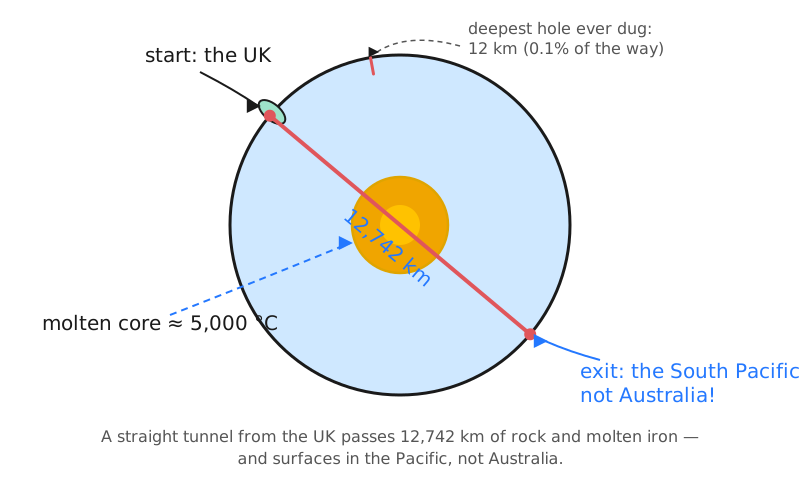
We model the tunnel as a straight shaft with a cross-section of — just enough room for one digger and a shovel — passing right through the centre of the Earth. The Earth's mean diameter is about km [1], a distance humans have known to reasonable accuracy for over two thousand years (see how Eratosthenes measured the Earth).
The volume of material to remove is simply length times cross-sectional area:
That is 12.7 million cubic metres of soil, rock, and iron — roughly five thousand Olympic swimming pools' worth of spoil to haul back up the shaft.
A fit person with a shovel, working in soft soil, can shift roughly per hour. Working an 8-hour day, that clears per day — and since our shaft has a cross-section, the tunnel advances exactly 4 metres a day. The total time is then:
Had you broken ground before the invention of writing, you would be arriving right about now. And this is wildly generous to the digger. The deepest hole humans have ever made — the Kola Superdeep Borehole in Russia — reached 12,262 m after about two decades of industrial drilling, then stopped, partly because the rock at the bottom was already at around 180 °C [2]. That is less than 0.1% of the way through. Beyond it lie thousands of kilometres of solid and molten rock, then an iron core at roughly 5,000 °C — about the temperature of the Sun's surface — under millions of atmospheres of pressure.
The 42-minute shortcut
Suppose the impossible tunnel exists anyway: frictionless, airless, and somehow refrigerated. A famous piece of classical physics, worked through by Paul Cooper in 1966 [3], says that if you step in, you fall faster and faster until you pass the centre at about 7.9 km/s, then decelerate symmetrically, arriving at the far side with exactly zero speed — after about 42 minutes. For a planet of uniform density the one-way time is:
Even more delightfully, the same analysis shows that a straight, frictionless tunnel between any two points on Earth — London to Paris, or London to the antipode — takes the same 42 minutes to traverse under gravity alone. Shorter tunnels are shallower, so gravity pulls you along them more gently, and the two effects exactly cancel.
You wouldn't even land in Australia
So: no, you cannot dig a hole to Australia — and here is the final indignity: even if you could, you would not arrive in Australia. Digging straight down from the UK and through the centre, you would surface in the empty South Pacific, south-east of New Zealand, near a small group of rocks named — for exactly this reason — the Antipodes Islands. To pop up in Australia you would need to start from the North Atlantic, near Bermuda. Our model also quietly assumed you could dig molten iron at the same rate as garden soil, ignored hauling 12.7 million cubic metres of spoil up a shaft thousands of kilometres deep, and ignored the small matter of the tunnel walls being liquid. The honest conclusion: 8,700 years is not an estimate of the digging time — it is a lower bound on an impossible task. The 42-minute jump, however, remains one of the prettiest "if only" results in physics.
References:
[1] NASA Goddard Space Flight Center, Earth Fact Sheet.
[2] BBC Future, "The deepest hole we have ever dug" (2019).
[3] Paul W. Cooper, "Through the Earth in Forty Minutes," American Journal of Physics 34, 68–70 (1966).
Note: The 42-minute result assumes a planet of uniform density and no friction or air resistance; using the Earth's real density profile changes the answer to roughly 38 minutes, but the classic figure of 42 is the one everyone quotes.