
80 quadrillion dollars. That is our estimate for the steel alone needed to build the Death Star — roughly 770 times the annual economic output of the entire planet. No wonder the Galactic Empire ran its budget meetings in a windowless room. In this paper we cost the most infamous megaproject in cinema using nothing beyond GCSE maths: the volume of a sphere, a density estimate, and some very long multiplication.
How big is a 140 km sphere?
The first Death Star is usually quoted at about 140 km in diameter [1] — a ball as tall as sixteen Mount Everests stacked on top of one another. The volume of a sphere is , and with a radius of m:
About 1.4 quadrillion cubic metres. Volumes grow with the cube of the radius, which is why this number is about to get out of hand.
How much steel, and what it costs
A solid steel ball is clearly wrong — the Death Star is full of hangars, corridors, reactor shafts, and at least one fatally unguarded exhaust port. So how densely is it packed? A useful real-world anchor is a warship. A warship floats, so averaged over its hull it must be less dense than water; a figure of about across its enclosed volume is typical. A battle station, being mostly open hangar space, should be far emptier — let's assume it packs steel at just one tenth of a warship's density-fill, i.e. . Then:
That is about 115 trillion tonnes of steel. The entire world currently produces about 1.9 billion tonnes of steel per year [2], so simply making the material would take:
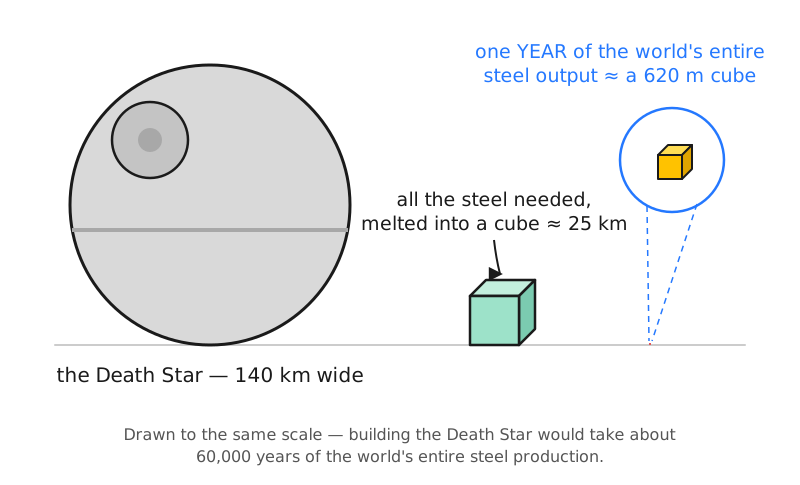
Steel currently trades at very roughly 700 dollars per tonne. The materials invoice is therefore:
Eighty quadrillion dollars — and a quadrillion is a million billions, a number large enough to deserve its own article. World GDP is around 105 trillion dollars [3], so the steel bill alone is roughly 770 years of everything humanity produces, spent on one project.
We are in famous company here. In 2012, economics students at Lehigh University, writing on their blog Centives, made essentially this estimate and arrived at 852 quadrillion dollars of steel — about 13,000 times the world GDP of the time [1]. Their figure is roughly ten times ours, almost entirely because they assumed a more densely packed station. That gap is the real lesson of back-of-envelope maths: when your answer is (assumption × huge number), the assumption is everything, and honest estimators say so. The estimate became so famous that a petition asking the US government to build a Death Star drew an official White House response in 2013 — "This Isn't the Petition Response You're Looking For" — which cited the 850-quadrillion-dollar price tag and noted, reasonably, that "the Administration does not support blowing up planets."
Not an engineering problem
For the cost of somewhere between 80 and 852 quadrillion dollars in raw steel, you could buy the entire annual output of planet Earth for most of a millennium. And steel is the cheap part: we have ignored the cost of lifting 115 trillion tonnes into orbit (current launch costs run to thousands of dollars per kilogram), the labour of building it, and a planet-destroying superlaser for which no supplier quotes exist. Our model is crude — the true steel fraction of a battle station is anyone's guess — but the conclusion is robust to any reasonable assumption: the Death Star is not an engineering problem. It is an economics problem, and it is unsolvable.
References:
[1] Centives (Lehigh University), "How Much Would The Death Star Cost?" (2012).
[2] World Steel Association, World Steel in Figures (2024).
[3] World Bank, World Development Indicators — GDP (current US dollars), world total.
Note: All figures are rough estimates; steel prices and production vary year to year, and the density-fill of moon-sized battle stations is not well documented in the engineering literature.