
Take any whole number. If it is even, halve it; if it is odd, triple it and add one. Repeat. Every number ever tested — more than of them — eventually crashes down to 1. And yet nobody on Earth can prove that they all must. The rule is simple enough for a nine-year-old, the conjecture has stood since Lothar Collatz circulated it in the 1930s, and Paul Erdős's verdict has become its unofficial motto: "Mathematics may not be ready for such problems" [1].
In this paper we will play the game ourselves, watch the number 27 do something spectacular, and then ask the real question: why is this so hard?
Halve, triple, and the flight of 27
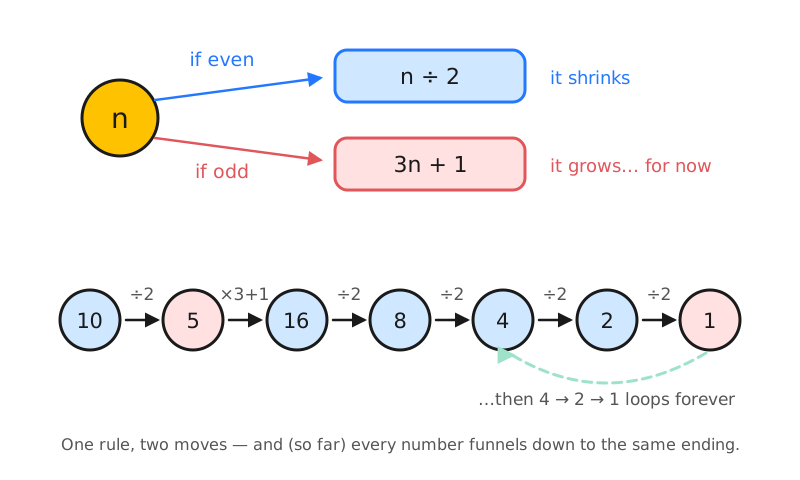
One line of instructions:
Start with 10: it is even, so halve to 5; odd, so triple-and-add-one to 16; then 8, 4, 2, 1. Six steps, done. The conjecture says this always happens: whatever number you start from, you eventually land in the funnel .
Most small numbers give up quickly: 26 reaches 1 in 10 steps, 28 in 18. Sandwiched between them, 27 takes 111 steps — and on the way it climbs to a peak of 9,232, over 340 times its starting value, before collapsing.
The opening moves already show the turbulence:
Every climb is undone, every recovery collapses again. The peak of 9,232 arrives at step 77, and then the whole tower unravels to 1 in just 34 more steps. Trajectories like this are called hailstone sequences: like hailstones in a storm cloud, the numbers ride updrafts and fall repeatedly before finally hitting the ground.
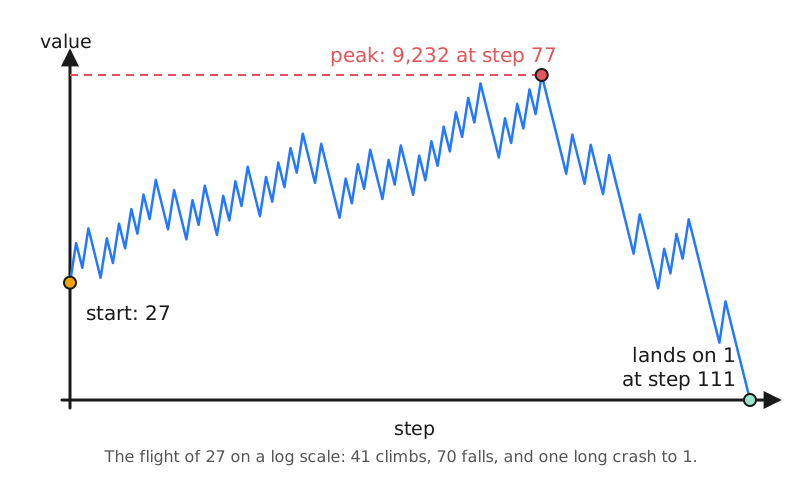
This is the unsettling part. Neighbouring starting points behave wildly differently, and nothing about 27 warns you what it is about to do. A proof would have to tame every number's flight at once.
The three-quarters argument that proves nothing
Here is an argument that the conjecture ought to be true. Follow what happens across one odd step. If is odd, we jump to — roughly a tripling. But is always even (odd times odd is odd, plus one is even), so a halving is guaranteed next. Half the time, the result of that halving is even again and we halve once more; a quarter of the time we halve a third time, and so on. On average, each tripling is followed by about two halvings.
So the typical cost of one odd step is a factor of about
Since , a "typical" trajectory should shrink by about 25% per odd step — a drunken walk, but a drunken walk downhill. The flight of 27 fits the picture: it used 41 triplings and 70 halvings, and against is a losing battle.
An average is a statement about typical behaviour. The conjecture is a statement about every single starting number — and one rogue seed is enough to sink it. A number could exist whose trajectory keeps drawing lucky, halving-poor steps forever and climbs without bound. Or a trajectory could fall into some enormous undiscovered loop that never touches 1. The heuristic rules out neither, any more than "the casino wins on average" rules out one gambler having an infinite lucky streak.
This is why the problem is genuinely hard: the map mixes multiplication and division so erratically that trajectories behave pseudo-randomly, and mathematics has few tools for proving that a pseudo-random process always lands in the same place. Jeffrey Lagarias, who has surveyed everything ever thrown at the problem, calls it "extraordinarily difficult" [1]. The strongest results are partial: computers have verified every start below [3], and Terence Tao proved in 2019 that almost all trajectories fall almost as far as you like — "almost all", agonisingly, is not "all".
Why evidence isn't enough
The Collatz conjecture is arithmetic a child can do, wrapped around a question nobody can answer. A quintillion confirmations feel persuasive, but mathematics runs on proof, not evidence: as we saw when Euclid proved that the primes never run out, one page of airtight reasoning about all numbers is worth more than any finite amount of checking. Until someone finds that page for Collatz, 27 will keep its secret — and every whiteboard doodle of will remain an open frontier of mathematics.
References:
[1] Jeffrey C. Lagarias, "The 3x+1 Problem and Its Generalizations," The American Mathematical Monthly 92, no. 1 (1985): 3–23.
[2] Jeffrey C. Lagarias (ed.), The Ultimate Challenge: The 3x+1 Problem (American Mathematical Society, Providence, 2010).
[3] David Barina, "Convergence verification of the Collatz problem," The Journal of Supercomputing 77 (2021): 2681–2688.
Note: Step counts here treat every halving and every tripling as one step; some authors count only the odd steps, which gives smaller totals for the same flight.