
The hands of a clock overlap 22 times a day — not 24. Ask around: almost everyone reasons "the hands cross about once an hour, there are 24 hours, so 24 times". The logic even sounds airtight, and it is wrong — two whole meetings go missing every day. In this paper we do what the guess doesn't: actually track the hands. The number 22 falls out of a single division, and the only tool we need is relative speed — the same idea we use for two runners on a circular track, or for working out how fast you are moving while sitting perfectly still.
Two runners on a circular track
Think of the hands as runners on a 360-degree track.
- The minute hand completes a lap every hour: per hour.
- The hour hand completes a lap every 12 hours: per hour.
At 12:00:00 they stand together. The minute hand sprints off — but the hour hand is also moving, and that is precisely the detail the "24 times" guess ignores. For the hands to meet again, the minute hand must gain a full lap on the hour hand, and it gains ground at the relative speed
Gaining at per hour takes
which is minutes: 65 minutes 27.27 seconds (27 and 3/11 seconds, exactly). Overlaps arrive not once an hour but once every 65 min 27 s — noticeably more than an hour. That is the whole secret. In a full day we therefore fit in
Starting at 12:00:00, the eleven meeting times in a 12-hour cycle (rounded to the second) are:
12:00:00, 1:05:27, 2:10:55, 3:16:22, 4:21:49, 5:27:16, 6:32:44, 7:38:11, 8:43:38, 9:49:05, 10:54:33 — then 12:00:00 again.
They repeat once for a.m. and once for p.m., giving .
Read the list closely: there is no overlap in the 11 o'clock hour. After the 10:54:33 meeting, the next one lands exactly on 12:00:00. That is where the "missing" meetings go — an overlap belonging to the 11 o'clock hour and the one at 12 would have to be the same event. It happens once each morning and once each evening, and that is exactly the difference between 24 and 22.
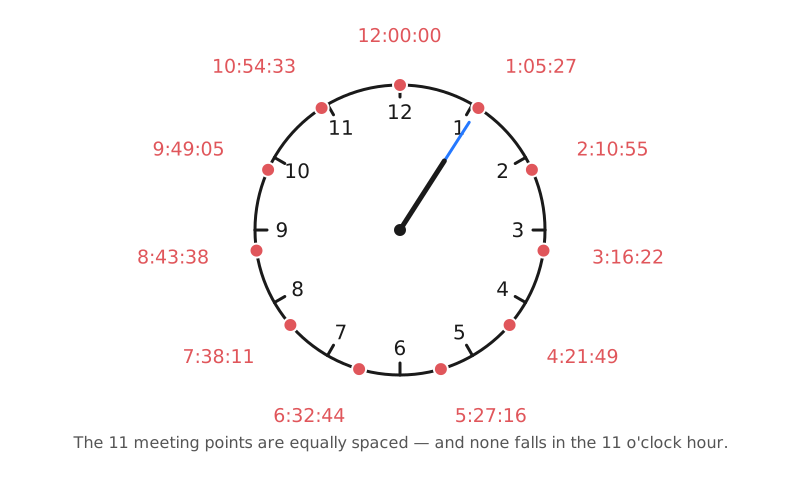
The diagram shows a pleasing pattern: the 11 meeting points are perfectly evenly spaced, apart. And the interval minutes never lands on a whole second — the exact times need elevenths, a cousin of the endless nines in our paper on 0.999….
The false step in the "24" guess is treating the hour hand as a fixed post that the minute hand revisits once per lap. But chasing a moving target always takes longer than a lap, so each meeting slips a little later: 12:00, then 1:05, then 2:11. The delay compounds by about five and a half minutes each time, until — twice a day — a whole meeting is squeezed out of the cycle.
Right angles and straight lines
The same engine answers the classic follow-ups instantly.
Right angles. The gap between the hands grows at per hour, and every time it sweeps out a full it passes through once and once — two right angles per relative lap. The minute hand gains full laps in a day, so the hands are perpendicular
not the 48 that "twice an hour" intuition suggests.
Opposite hands. A straight line — hands exactly apart — happens once per relative lap, so 22 times a day: at 6:00:00, 7:05:27, 8:10:55, and so on. It is the overlap timetable, shifted by half a relative lap.
Three answers from one number
The hands of a clock meet 22 times a day, sit at right angles 44 times, and point in opposite directions 22 times — three answers from one number, the relative speed of per hour. The "once an hour" intuition fails because an overlap-to-overlap gap is not an hour but hours: the hour hand keeps creeping forward, so the minute hand always needs overtime to catch it. Our model assumes ideal, continuously sweeping hands; a quartz clock ticks in little jumps and may hop over the exact alignment instant, but the counting — and the answer — survives. The next time someone confidently says "24", send them to check the 11 o'clock hour.
References:
[1] Henry Ernest Dudeney, Amusements in Mathematics (Thomas Nelson & Sons, London, 1917).
[2] W. W. Rouse Ball and H. S. M. Coxeter, Mathematical Recreations and Essays, 13th ed. (Dover, New York, 1987).
Note: Overlap times are rounded to the nearest second; the exact instants involve elevenths of a second (e.g. 1:05:27 3/11). Over a 12-hour cycle the counts halve: 11 overlaps and 22 right angles.