
About one molecule per breath. On the Ides of March, 44 BC, Julius Caesar exhaled for the last time. The famous claim — beloved of chemistry teachers everywhere — is that after two thousand years of winds stirring the sky, the molecules of that single breath are now spread so evenly through the atmosphere that every breath you take contains, on average, about one of them. A single breath, diluted into the entire sky of planet Earth, and yet you still catch a molecule of it? It sounds absurd. Let's check it for ourselves — all we need is the idea of a mole and some very large division.
Counting a breath against the whole sky
A relaxed human breath is about half a litre of air. To count molecules we use the chemist's favourite tool: one mole of any gas — that is, molecules, Avogadro's number — occupies about 24 litres at room temperature. So half a litre contains:
Twelve and a half billion trillion molecules, in one unremarkable breath. Molecules are small.
Now for the denominator. The total mass of Earth's atmosphere is about kg [2] — you can estimate this yourself from atmospheric pressure pushing on the Earth's surface area. Air is mostly nitrogen (, molar mass 28 g) and oxygen (, molar mass 32 g), giving a weighted average of about 29 g — that is, kg — per mole. The whole sky therefore holds:
Why the two huge numbers cancel
Assume Caesar's last breath has had time to mix completely and uniformly into the atmosphere — we will question this shortly. Then any single molecule of today's air is one of Caesar's with probability:
A vanishingly small chance. But when you inhale, you don't sample one molecule — you sample of them. The expected number of Caesar-molecules per breath is :
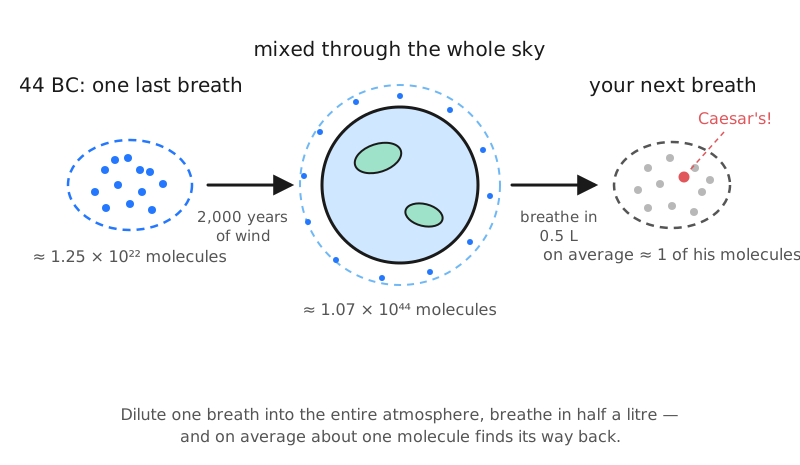
The two absurdly large numbers almost perfectly cancel: the claim survives. On average, about one to two molecules of Caesar's final breath are in your lungs right now. We can go one step further: for such a tiny and enormous , the number of Caesar-molecules per breath follows a Poisson distribution, which tells us the chance of a breath containing none at all is . So roughly three breaths out of four contain at least one molecule Caesar exhaled as he died. Like the birthday paradox, it is a result that feels wrong right up until you do the counting.
Where the model gets shaky
Now for the honesty. Our model assumed two things: perfect mixing, and that molecules are conserved. The first is fine — the atmosphere mixes across the globe within a few years, and Caesar has had two millennia. The second is shakier: much of a breath is chemically busy. Carbon dioxide gets eaten by plants and dissolved into oceans; oxygen gets breathed and burned; water rains out. But nitrogen — 78% of every breath — cycles slowly, and argon, about 1%, is a noble gas that reacts with essentially nothing: the argon atoms Caesar exhaled really are still up there, unchanged. Sam Kean's book Caesar's Last Breath [1], which popularised this calculation, runs the accounting and finds the punchline survives. One final democratising thought: nothing here is special about Caesar. The same arithmetic applies to the last breath of Cleopatra, Newton, or anyone who breathed long enough ago for the sky to shuffle the deck. Every breath you take is a tiny census of everyone who ever lived.
References:
[1] Sam Kean, Caesar's Last Breath: Decoding the Secrets of the Air Around Us (Little, Brown and Company, 2017).
[2] Kevin E. Trenberth and Lesley Smith, "The Mass of the Atmosphere: A Constraint on Global Analyses," Journal of Climate 18, 864–875 (2005).
Note: The headline figure assumes perfect atmospheric mixing and no loss of molecules to chemistry, oceans, or space; restricting the count to inert gases like argon lowers the number but preserves the spirit of the result.