
Drop a needle onto a lined floor 3,408 times, count how often it crosses a line, and you can estimate π correct to six decimal places. That, at least, is what the Italian mathematician Mario Lazzarini reported in 1901. The claim rests on a genuine and beautiful result from 1777, when Georges-Louis Leclerc, Comte de Buffon, posed what is now regarded as the first problem in geometric probability [2]. In this paper we state Buffon's result, turn it into a machine for estimating π, and then do what this series does best: check the famous numbers for ourselves. Lazzarini's experiment, we will see, is a little too perfect.
From floorboards to a π-machine
Rule a floor with parallel lines a distance apart — think of the gaps between floorboards — and drop a needle of length onto it completely at random, with so the needle can cross at most one line. Buffon showed that the probability of the needle crossing a line is
Deriving this properly needs a little calculus (the needle lands at a random angle, and averaging over all angles is what drags the circle — and hence π — into the answer), so we will take the result as given and sanity-check it instead. It says a longer needle crosses more often, and more widely spaced lines are crossed less often — both obviously right. And for a needle half as long as the gap, , it predicts
about a 32% chance — a claim you can genuinely test tonight with a box of matches and some ruled paper.
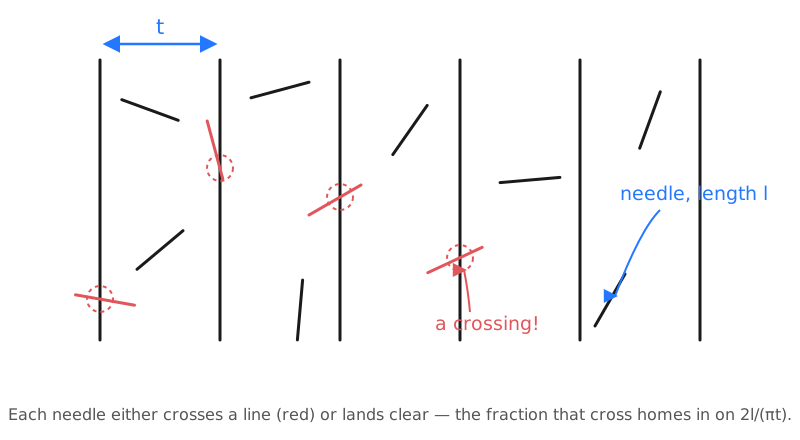
Rearranging the formula gives . We can never know the probability exactly, but we can estimate it: throw the needle times, count crossings, and use . Substituting:
With this simplifies to the delightful recipe : throw, count, divide. This is a Monte Carlo method — using randomness to estimate a quantity — the same idea used today to price financial options and simulate nuclear reactors [3].
The catch is speed. Random noise in only shrinks like , so each extra decimal place of accuracy costs roughly times more throws. Keep that in mind for what comes next.
Lazzarini's suspiciously perfect experiment
In 1901 Lazzarini reported using a needle of cm on lines cm apart (so ), throwing it times, and observing crossings. Plugging in:
The true value is , so his error is under . Let's apply some honest scepticism:
- is not a random-looking fraction — it is the most famous rational approximation to π, known to the Chinese mathematician Zu Chongzhi in the 5th century.
- With , the estimate is . To land on exactly, you need . And behold: and .
- The result is absurdly fragile. One extra crossing () gives ; one fewer gives . A single needle changes the error by a factor of about .
- The expected number of crossings in throws is almost exactly , but with a typical random wobble of about . The chance of hitting on the nose is roughly — a 1-in-70 shot.
The statistician Lee Badger analysed the experiment in 1994 and concluded that Lazzarini almost certainly rigged it [1] — most likely by choosing throw counts in multiples of and stopping at a convenient moment, if the throws happened at all.
Four million years of needle-dropping
Buffon's needle is entirely real: the formula is correct, the method genuinely works, and running it is a lovely afternoon experiment. But it is honest about its slowness — to earn six decimal places you would need roughly throws, which at one per second is about four million years of needle-dropping. Probability has a habit of humbling our intuition (see the birthday paradox), but it also polices fraud: when a result looks too good to be true, the same formulas that make it possible tell you it probably isn't. Lazzarini's needle didn't find π — but checking his claim is a better lesson than his experiment ever was.
References:
[1] Lee Badger, "Lazzarini's Lucky Approximation of π", Mathematics Magazine, 67(2) (1994), 83–91.
[2] Georges-Louis Leclerc, Comte de Buffon, "Essai d'arithmétique morale", Supplément à l'Histoire Naturelle, vol. 4 (1777).
[3] Charles M. Grinstead and J. Laurie Snell, Introduction to Probability (American Mathematical Society, 1997).
Note: Our analysis assumes the needle is no longer than the line spacing and that throws are genuinely random — both harder to achieve with real needles than the mathematics suggests.