
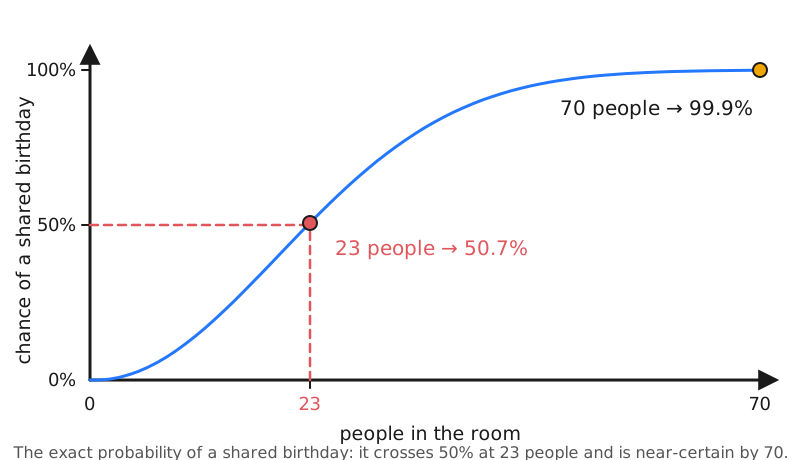
In a room of just 23 people, the chance that two of them share a birthday is 50.7% — better than a coin flip. By 70 people it exceeds 99.9%. Ask someone how large a group must be before a shared birthday becomes more likely than not, and most will guess somewhere near 180 — roughly half of 365. The correct answer, 23, feels absurd. In this paper we derive it for ourselves, and everything we need is a single tool: multiplying probabilities.
Where intuition fails: people versus pairs
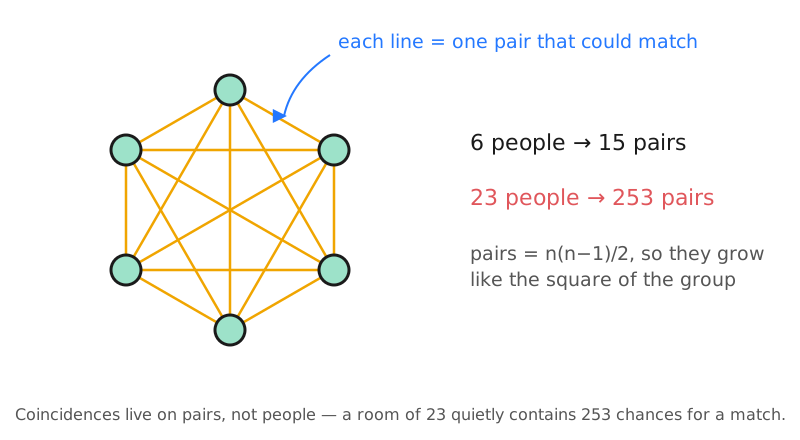
The instinctive (and wrong) framing is personal: "23 people, 365 days — surely the chance that someone matches my birthday is tiny?" And it is. But the question never mentioned you. It asks whether any two people in the room match, and matches live on pairs of people, not on people.
How many pairs can 23 people form? Each of the 23 can be paired with each of the other 22, and dividing by 2 (the pair Alice–Bob is the same as Bob–Alice) gives:
A room of 23 quietly contains 253 chances for a coincidence. That is the intuition repair: the number of pairs grows roughly with the square of the group size, which is why the probability climbs so much faster than we expect.
Counting the ways nobody matches
Computing the probability of at least one shared birthday directly is messy — there are many ways matches can happen. So we use complementary counting: compute the probability that nobody shares a birthday, and subtract from 1. We assume 365 equally likely birthdays (more on that at the end).
Line the 23 people up and assign birthdays one at a time:
- Person 1 can have any birthday: probability .
- Person 2 must avoid 1 day: probability .
- Person 3 must avoid 2 days: probability , and so on, down to person 23 avoiding 22 days: .
Multiplying all 23 factors:
So with 23 people a shared birthday is more likely than not — just. With 22 people the probability is 47.6%, so 23 really is the threshold.
Try it yourself: predict whether the next room will contain a match, then reveal a new room. Compare 22 people with 23, and use Try 100 rooms to see how the experimental rate compares with the exact probability.
Assuming independent, equally likely birthdays on 365 days, the probability of at least one match among n people is 1 − (365/365)(364/365)…((366 − n)/365). With 22 people it is about 47.6%; with 23 it is about 50.7%. There are 253 pairs among 23 people. One sampled room is not evidence of the long-run rate.
A single room either has a match or it does not. The 50.7% describes the long-run proportion of rooms with a match, not a promise about your next room. Which grows faster as you add people: the number of people, or the number of pairs?
Our pairs picture from earlier gives a satisfying sanity check. Each single pair fails to match with probability , and if we (slightly illegally) treat all 253 pairs as independent, the chance that all of them fail is — a shared birthday with probability about 50.05%, remarkably close to the exact answer.
Running the same product for other group sizes shows how steep the climb is: 10 people give 11.7%, 30 people give 70.6%, 50 people give 97.0%, and 70 people give 99.92% — near-certainty with barely a fifth of the days of the year covered.
What we assumed about birthdays
A group of just 23 people is enough to make a shared birthday more likely than not, because 23 people conceal 253 opportunities for a match. Our model did make two simplifications: we ignored 29 February, and we assumed birthdays are uniformly distributed across the year. Real birthdays are not uniform — in most countries some months are measurably more popular — but any clustering only makes collisions more likely, so the true threshold is, if anything, at or below 23. The paradox survives scrutiny; it is our intuition that fails, just as it does in the Monty Hall problem.
References:
[1] William Feller, An Introduction to Probability Theory and Its Applications, Vol. 1, 3rd ed. (Wiley, New York, 1968).
[2] Persi Diaconis and Frederick Mosteller, "Methods for Studying Coincidences," Journal of the American Statistical Association 84 (1989).
Note: This paper assumes 365 equally likely birthdays; leap days and real-world birthday clustering shift the numbers only slightly, and in the direction of making matches easier.