
One 18-inch pizza is more pizza than two 12-inch pizzas. Not roughly the same — strictly more: about 254 square inches of pizza against 226. Most menus price the two 12-inch pizzas higher, so the counterintuitive order is also the cheaper one. The whole result rests on one line of GCSE maths — the area of a circle — and it generalises into a rule of thumb you can use at any counter, plus one of the deepest theorems in geometry, hiding in the way you hold a slice.
The area of a circle of radius is . An 18-inch pizza (that is its diameter) has radius 9 inches:
A 12-inch pizza has radius 6 inches, and we are buying two:
The single 18-inch wins by square inches — a whole extra 6-inch-diameter pizza's worth of food, and 12.5% more overall.
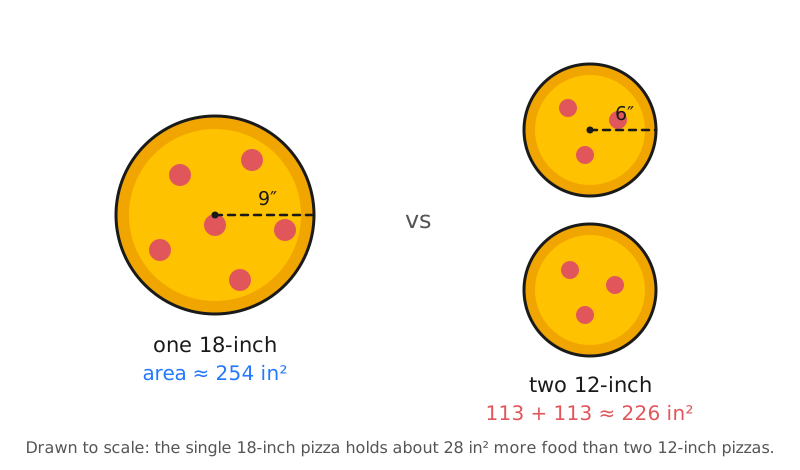
Our intuition fails here because we judge size by diameter, which grows linearly, while food lives in area, which grows with the square of the diameter. 18 is only 1.5 times 12 — but , so one 18-inch pizza is more than double a 12-inch, all by itself.
Doubling the diameter quadruples the food
The same squaring explains pizza pricing. Doubling a pizza's diameter — 12 inches to 24 — multiplies its area by . So a fair price would scale with the square of the diameter, not the diameter itself. Menus almost never do this: the jump from a 12-inch to an 18-inch typically costs 30–50% more money for 125% more pizza. An analysis of 74,476 pizza prices by NPR's Planet Money found exactly this pattern across thousands of US pizzerias: the larger the pizza, the less you pay per square inch, almost without exception [1].
This is a two-dimensional slice of the square-cube law: lengths scale as , areas as , volumes as . It is why a giant ant would collapse (weight grows as , leg strength only as ), why babies lose heat so fast (surface area is large relative to volume), and why honeybees build hexagons — nature is obsessive about the ratio of perimeter to area. At the pizzeria, the consequence is simpler: big pizzas are almost always the bargain.
You do not need in the queue. Since every pizza's area is , the cancels in any comparison — just compare diameter squared per pound:
Whichever pizza (or bundle) has more per unit money is the better deal. For our headline case: beats even before prices enter. A 16-inch versus two 10-inch? versus — the single 16 wins again. The rule compresses the whole paper into mental arithmetic: square the diameters, then shop.
Why you fold the slice
One more genuinely deep fact rides along with every slice. A flat slice droops at the tip — so you curl it into a U across its width, and suddenly it holds firm. Why?
In 1827 Gauss proved his Theorema Egregium ("remarkable theorem"): a surface's Gaussian curvature — the product of its curvatures in two perpendicular directions — cannot change when you bend the surface without stretching it [2]. A pizza slice starts flat: curvature zero in every direction, so the product is zero, and bending cannot ever make it non-zero. When you curl the slice across its width, you use up one direction's curvature — so for the product to stay zero, the lengthwise direction is forced to stay perfectly straight. The tip cannot flop without stretching or tearing the crust. You have been exploiting differential geometry since your first slice.
What our model ignores
The claim survives with room to spare: one 18-inch pizza is 254 in² against 226 in² for two 12-inch pizzas — 12.5% more food, usually for less money, because area grows with the square of the diameter while menus price closer to the diameter itself. Our model does ignore two real-world quibbles: crust (a ring of roughly fixed width eats a larger fraction of a small pizza, favouring the big one even more) and the scenario where two pizzas mean two different sets of toppings, which no theorem can price. Squaring aside, geometry has a firm recommendation — and it folds your slice too.
References:
[1] Quoctrung Bui, "74,476 Reasons You Should Always Get The Bigger Pizza," NPR Planet Money (26 February 2014).
[2] Carl Friedrich Gauss, Disquisitiones generales circa superficies curvas (Göttingen, 1827).
Note: Areas are for the nominal quoted diameters; real pizzas vary, and crust width slightly increases the large pizza's advantage in edible area.