
30.1%. Take a big, messy, real-world collection of numbers — invoice amounts, river lengths, country populations, share prices — and look only at the first digit of each. You might expect the nine possible leading digits to appear equally often, about each. Instead, in dataset after dataset, roughly 30.1% of the numbers start with a 1, and barely 4.6% start with a 9. This is Benford's law, and its prediction for each digit is:
(A quick refresher: is the power you must raise 10 to in order to get , so .) In this paper we check the law for ourselves — and see why it has become a favourite tool of tax inspectors and fraud investigators.
Plugging into the formula gives . A leading 1 is about 6.6 times more common than a leading 9.
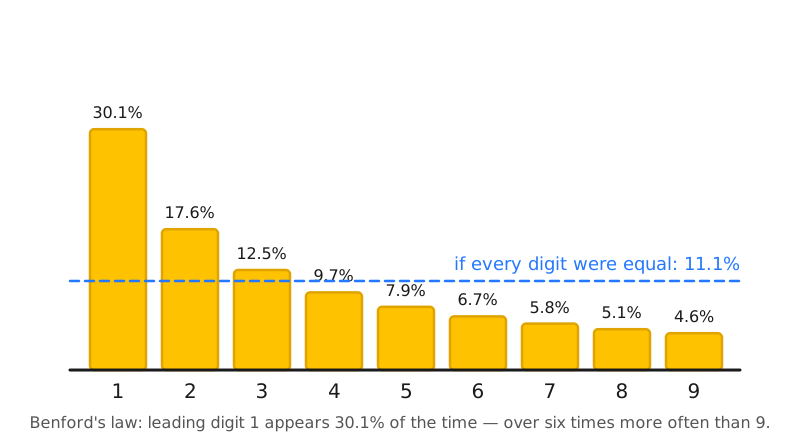
As a sanity check, the nine probabilities should sum to 1 — and they do, beautifully. Since , the sum telescopes:
Why on earth would 1 be special?
The secret is that most real-world quantities grow (or shrink) multiplicatively — by percentages, not by fixed steps. And multiplicative growth is lazy about leaving the 1s. To push a quantity from 100 to 200 it must double; to push it from 900 to 1,000 it needs to grow just 11%. So a growing quantity spends far more time with leading digit 1 than with leading digit 9.
The cleanest way to see it is on a logarithmic ruler, where equal ratios take equal space. There, the stretch from 1 to 2 occupies of each decade, while 9 to 10 gets only — exactly the Benford proportions.
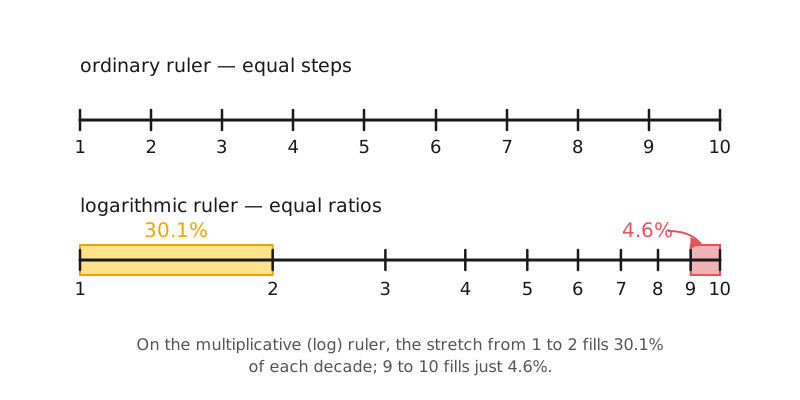
This picture also explains the law's most elegant property, scale invariance: converting a Benford dataset from pounds to dollars, or miles to kilometres, just slides everything along the log ruler without changing how much of it each digit owns. Any universal law of first digits had to be scale invariant — and the logarithmic distribution is the only one that is.
Let's test it. The powers of 2 grow multiplicatively, so they should obey the law. Among , we counted the leading digits ourselves: 301 start with a 1 and 45 start with a 9, against Benford predictions of about 301 and 46. The fit is almost eerie. (For a feel of how fast these numbers ride across orders of magnitude, has 302 digits.)
The taxman's favourite theorem
Now the sting. Genuine accounting data — invoices, expenses, payments — typically spans several orders of magnitude and follows Benford's law closely. Numbers invented by people do not: fraudsters intuitively spread their first digits around "randomly", i.e. far too uniformly, and overuse mid-range digits. The forensic accountant Mark Nigrini pioneered testing ledgers against the Benford curve, and digit-frequency screening is now a standard tool in auditing and tax-fraud detection [3]. The law itself is much older: astronomer Simon Newcomb spotted it in 1881, noticing that books of logarithm tables were grubbiest on the early pages [1], and physicist Frank Benford rediscovered it in 1938, checking it against 20,229 numbers from rivers, populations, physical constants and more [2].
Where the law doesn't apply
Benford's law is that rare thing: a piece of pure mathematics — a telescoping sum of logarithms — that catches real criminals. But let's be honest about its limits. It applies to data that spans several orders of magnitude and arises from multiplicative processes; it says nothing about adult heights, phone numbers, or lottery draws, which are deliberately uniform. And even for ledgers, a failed Benford test is a flag, not a conviction — an invitation for the auditor to start reading receipts. The taxman doesn't know your numbers are fake; he knows they are worth a closer look. That is often enough.
References:
[1] Simon Newcomb, "Note on the Frequency of Use of the Different Digits in Natural Numbers," American Journal of Mathematics 4 (1881).
[2] Frank Benford, "The Law of Anomalous Numbers," Proceedings of the American Philosophical Society 78 (1938).
[3] Mark J. Nigrini, Benford's Law: Applications for Forensic Accounting, Auditing, and Fraud Detection (Wiley, 2012).
Note: The digit counts for powers of 2 were computed directly; small deviations from the ideal percentages are expected for any finite sample.