
Our universe is vast, mysterious, and full of wonders that often leave us pondering questions about its nature. One such question that has been a subject of curiosity and study for millennia is: How old is the universe? Thanks to a blend of keen observations and clever mathematics, we've been able to estimate its age with remarkable precision. This article offers a glimpse into the simple calculations and the groundbreaking concept of Hubble's constant that help us arrive at the often-quoted age of around 13.8 billion years. Let's embark on a journey to understand where this number comes from and how we, with a bit of mathematics, can recreate this cosmic calculation.
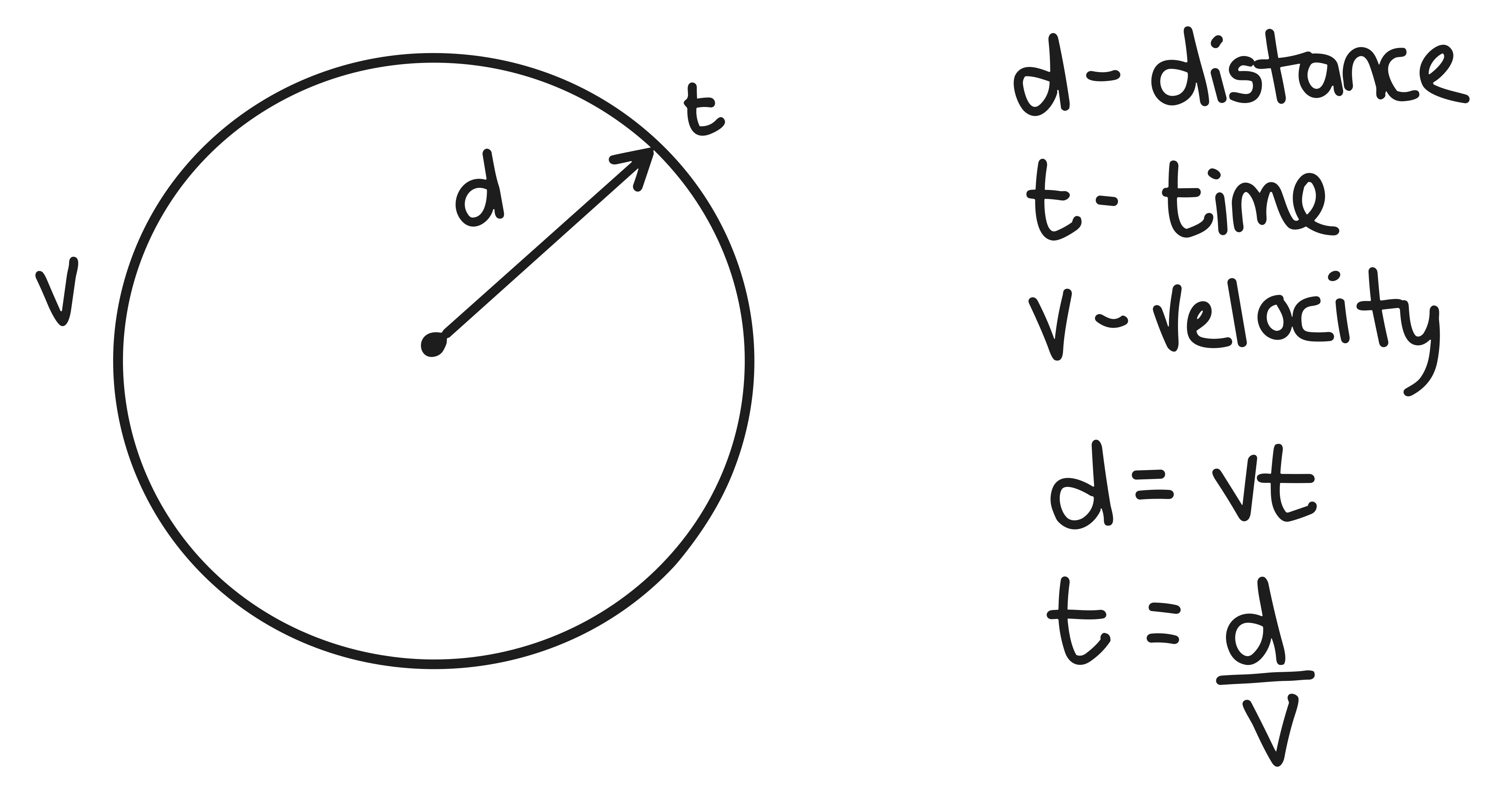
Initially, we'll assume that the universe's expansion velocity is constant, even though it isn't in reality. We'll touch on this in more detail later. Consider the diagram below, since the big bang, the universe has been expanding at a constant velocity for time . Using basic mathematics, this relationship can be described as .
What Hubble saw in the redshift
Now, let's take a break from that for a second to understand Hubble's constant. Back in the 1920s, an astronomer named Edwin Hubble made a groundbreaking discovery. He observed that galaxies were moving away from us, and the farther away a galaxy was, the faster it seemed to move away. This observation suggested that the universe was (and still is) expanding!
Hubble's observations led to what we now call Hubble's Constant, a value that represents the rate at which the universe is expanding. Hubble's Constant is roughly estimated to be 67.8 (km/s)/Mpc. This means for every mega parsec (Mpc) of distance from us, a galaxy is moving away from us at a speed of 67.8 kilometers per second. You might be wondering, what exactly is a mega parsec?
- Parsec: The name "parsec" comes from the combination of "parallax" and "arcsecond". It's a distance equivalent to about 3.26 light-years. One parsec is defined as the distance at which one astronomical unit (the average distance between Earth and the Sun) subtends an angle of one arcsecond.
- Mega: In many contexts, "mega" is a prefix meaning "one million." So, a mega parsec (Mpc) is one million parsecs, or approximately 3.26 million light-years.
But how did astronomers arrive at this value of 67.8? Through observations! By meticulously observing the light from distant galaxies, particularly the shift in light spectrum (known as redshift), astronomers can gauge how fast these galaxies are moving away from us. Combine this with the known distance to these galaxies, and voilà, we have Hubble's Constant.
Turning Hubble's constant into a time
Ok, now back to our diagram.
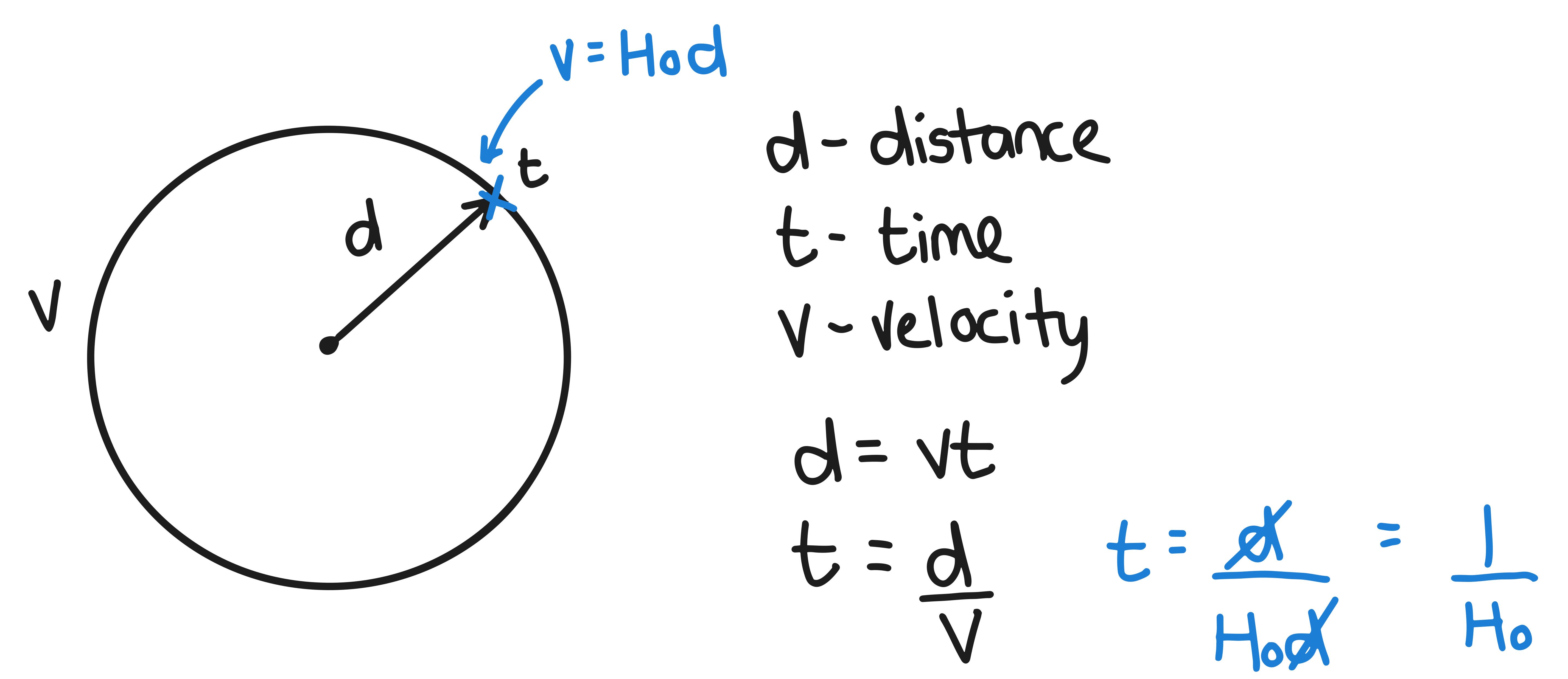
With knowledge of Hubble's constant, we can determine what the expansion velocity at the "edge" of our observable universe, it will be Hubble's constant multiplied by the distance between us and the farthest galaxies we can detect. We now have 2 equations we can link together, our original equation and . Substituting in the 2nd equation into the first and cancelling out the , we conclude that .
There is one subtlety before we can plug numbers in: mixes two different units of distance — kilometers and megaparsecs. For to come out as a time, the distance units need to cancel, so we first convert the megaparsec into kilometers. Using :
Now the reciprocal really is a time:
Why we got 14.4, not 13.8
You might be thinking, wasn't the universe said to be 13.8 billion years old? Our calculation doesn't exactly pinpoint the age of the universe. Instead, it suggests what the age would have been if the expansion had been linear (our original assumption). In reality, the expansion is not linear, we currently appear to be approaching a period where the expansion of the universe is exponential due to the increasing dominance of vacuum energy, but that's a story for another day.