
The sheet of A4 in your printer is an irrational number made physical: its sides are in the ratio . That is not an accident of history or a printer's convenience — it is the only possible shape with a magical property: cut the sheet in half, and each half is the exact same shape as the original. Every number on the A-series datasheet — A0's 841 × 1189 mm, A4's 210 × 297 mm, the photocopier's mysterious 141% button — follows from that one design decision. In this paper we derive the lot from scratch.
Take a rectangle with short side 1 and long side , and cut it in half across the long side. The two halves are rectangles with sides and — and now the old short side is the new long side. For the half-sheet to have the same shape as the original, the ratios of long side to short side must match:
Multiply both sides by :
That is the whole derivation — two lines. No other rectangle works: a longer, thinner sheet halves into something stubbier, a squarer sheet halves into something thinner. Only is the fixed point. And since is irrational (a fact provable with A-level maths, cousin to the strangeness in 0.999… = 1), no sheet of A-series paper can ever have both sides a whole number of any unit — the standard survives by rounding to the nearest millimetre.
The idea is older than the standard: the German scientist Georg Christoph Lichtenberg proposed exactly this self-similar ratio in a letter to Johann Beckmann in 1786, noting with delight that a sheet with this shape keeps it forever under halving [1]. Germany adopted it as DIN 476 in 1922, and the world (minus North America) followed as ISO 216.
From one square metre down to A4
A ratio fixes a shape but not a size, so the standard adds one clean rule: A0 has an area of exactly 1 m². If A0's short side is metres, its long side is , so
and the long side is
Rounded to the millimetre: 841 × 1189 mm, exactly the A0 on the datasheet. Both sides are (quarter) powers of 2 — the aspect ratio , as required.
Each cut halves the area, so has area m². Four cuts take us to A4:
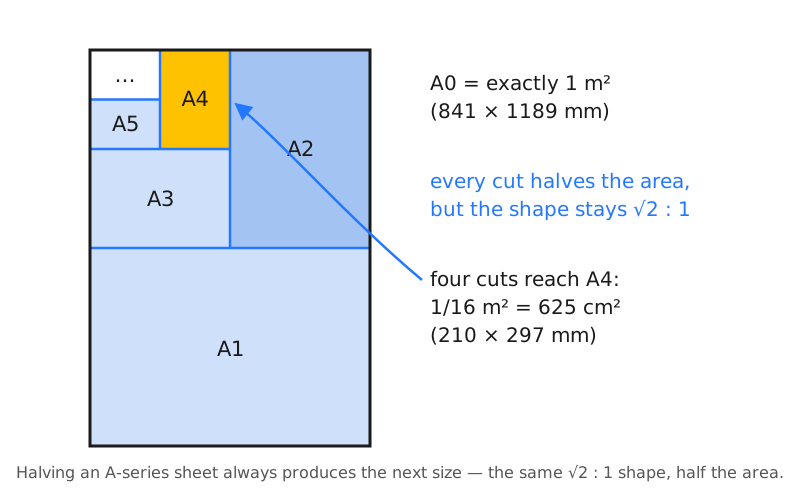
Its exact sides are m and m. Rounding down to whole millimetres, as ISO 216 does, gives the familiar 210 × 297 mm. (The rounded sheet's area is 623.7 cm² — the standard sacrifices a sliver of area to keep the millimetres whole.) Check the ratio: , matching to four decimal places.
Why the 141% button exists
Here is where the design pays rent. To enlarge A4 onto A3 — double the area — every length must grow by , i.e. 141%, which is exactly the preset button on every photocopier. Reducing A3 to A4 is 71%, the other preset. Because every A-size is the same shape, the scaled image fits its new sheet perfectly: no cropping, no white borders, and two A4 pages tile exactly onto one A3.
Contrast US Letter, at 8.5 × 11 inches: ratio . Halve it and you get 5.5 × 8.5 — ratio , a different shape. No single magnification maps Letter onto its half or double; every scaling must either crop content or waste margin, which is why North American copier presets (129%, 78%…) are a zoo of compromises. Letter has virtue, but self-similarity is not among them.
Infrastructure with a proof
Everything checks out: demanding that a sheet keep its shape when halved forces the ratio ; demanding A0 be one square metre forces sides of metres, i.e. 841 × 1189 mm; and four halvings force A4's 210 × 297 mm and 625 cm². One irrational number, chosen in a letter in 1786, quietly runs every office outside North America. It is a rare thing: infrastructure with a proof. For more mileage from repeatedly halving and doubling paper, see what happens if you fold it 42 times.
References:
[1] Georg Christoph Lichtenberg, letter to Johann Beckmann, 25 October 1786 (reprinted in Lichtenberg's collected correspondence).
[2] ISO 216:2007, Writing paper and certain classes of printed matter — Trimmed sizes — A and B series.
[3] Markus Kuhn, "International standard paper sizes," University of Cambridge Computer Laboratory, cl.cam.ac.uk/~mgk25/iso-paper.html.
Note: ISO 216 permits small manufacturing tolerances (±1.5–3 mm depending on size), so a real sheet's ratio is √2 only to within a rounding error — the mathematics is exact, the paper merely close.